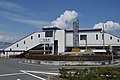
Yatomi Takenageshi Chaya ac.jpg
Article

23235 / やとみし

Aichi Prefecture

Yatomi City

Part of a tea house moved to a landing.

Takenageshi Chaya, Nagoya Castle

Photo by Asturio Cantabrio (CC BY-SA 4.0)

01 / Sluice gate

A sluice gate built for drainagelater served to draw in irrigation water.

Tatsuta Waju Jinzoseki Himon ac (3).jpg
Photo by Asturio Cantabrio (CC BY-SA 4.0)

The Tatsuta Waju Regular Water Utilization Association completed this sluice gate in 1902 (Meiji 35), when the Kiso Three Rivers improvement works were under way. The city records that it did not drain well enough, that it was later used to draw irrigation water, and that it became an idle sluice gate when the Kaifu trunk waterway was completed.

  • Completed 1902 (Meiji 35)
  • City-designated historic site
  • Idle after the Kaifu trunk waterway opened

02 / Goldfish

A pond to rest goldfish was madein the post town of Maegasu.

弥富金魚養殖池.jpg
Photo by 椙元舟 (CC BY-SA 3.0)

About 150 years ago, a goldfish merchant from Koriyama, on his way along the Tokaido to the Atsuta post town, made a pond in the Maegasu post town and set his goldfish in it to rest. The tourist association records that Gonjuro of the temple school bought them and began keeping them, and that Sato Sozaburo succeeded in egg collection and hatching in the Meiji era.

  • About 150 years ago
  • Gonjuro of the temple school began keeping them
  • Meiji era: Sato Sozaburo succeeds in hatching

03 / White Java sparrow

A pure white Java sparrowis said to have been born in the Meiji era.

Yatomi Japanese Rice Bird ac.jpg
Photo by Asturio Cantabrio (CC BY-SA 4.0)

Yatomi's Java sparrow keeping is said to have begun at the end of the Edo period, when Yae, who married into the Matahachi district, brought cherry-blossom Java sparrows from a samurai residence in Nagoya. A pure white Java sparrow is said to have been born in the Meiji era, and farmers kept the birds as a side business.

  • Yae said to have brought cherry-blossom Java sparrows
  • White Java sparrow said to be born in the Meiji era
  • Peak in the 1975-84 period

Living here

13 minutes from Kintetsu-Nagoya by express.

  • about 40,000 people
  • 30 min to a city centre

Kintetsu-Yatomi Station on the Kintetsu Nagoya Line is 13 minutes from Kintetsu-Nagoya by express, with no change of trains (the fastest daily service on the Kintetsu timetable read on 20 October 2026, on weekdays and on weekends and holidays alike). The city says City Hall is about a 10-minute walk from Yatomi Station on the Kintetsu Nagoya Line (updated 31 March 2025).

People living here
43,025people
2010

−0.6% since 2015

43,272 → 43,025

Area
49.26km²

49.17km² of it habitable

2024

Households
17,066households

2.5 people per household

2020

Rent (average for rentals)
57,055yen

National average 60,630 yen

2023

Healthcare
2 hospitals / 33 clinics

8.1 per 10,000 people

2023

Almost entirely flat.Almost all of it is habitable land (99.8%)
Area and habitable land at the same scalee-Stat B1101 / B1103
Children waiting for childcare
—10 nurseries and similar
Home purchase subsidy
—
Average annual temperature
—

These 3 items are waiting on a nationwide data source. We do not fill them with estimates.

ACCESS

Where you can go from here.

Yatomi City in Japan35.110°N 136.725°E
TokyoYatomi City
Kintetsu-Yatomi Station
近鉄弥富駅2020
  • to NagoyaKintetsu Nagoya Line express13min

Travel times follow 近畿日本鉄道『駅の時刻表』(eki.kintetsu.co.jp。2026-10-20 に読んだ)。近鉄名古屋駅(名古屋線・伊勢中川方面)の発車時刻表(平日 dw=0・土休日 dw=1。平日188本・土休日175本のうち普通を除く全列車)の各列車の停車駅表(T7)で、近鉄名古屋『発』→近鉄弥富『着』を機械で数えた。 (checked 2026-10-20). They vary by time of day.

Shape

Borders 5 municipalities across 1 prefectures.

Territory of Yatomi City
Boundaries: National Land Numerical Information (N03)

North to south

13.3km

Aichi Prefecture
愛西市, 飛島村, 蟹江町
Mie Prefecture
木曽岬町, 桑名市

Yatomi City isthis kind of town.

  1. 01Takenageshi Chaya is a city-designated building: part of a tea house for the Owari domain's use that stood in the Kitaogai-maru of Nagoya Castle was moved in 1872 (Meiji 5) by the Sato family of Maegasu to what was then the Ikada River boat landing, and it takes its name from the half-split bamboo used for the nageshi beams in every room
  2. 02The Tatsuta Waju Jinzo Seki Sluice Gate, completed in 1902 (Meiji 35), is a city-designated historic site preserved in Waju Park as a relic of water-use history; the tourist association records that goldfish keeping began about 150 years ago with a pond made in the Maegasu post town
  3. 03Java sparrow keeping in Yatomi is said to have begun at the end of the Edo period, and a pure white Java sparrow is said to have been born in the Meiji era; the History and Folklore Museum shows videos of Java sparrow farmers at work and old keeping tools

See the town as it is now.

Source: Wikidata (P2002, P2003, P2013, P2397)

If something caught your eye, ask the town itself.