Shan Shan Dance in Oku.jpg
Article

38442 / いかたちょう

Ehime Prefecture 西宇和郡

Ikata Town

A dance named for a line of its song.

Shanshan dance, Oku

Photo by Amake (CC BY-SA 3.0)

01 / Bon rites for the first Bon of the dead on the Sadamisaki Peninsula

Some rites circle in a ring;others float a boat out to sea.

Households holding the first Bon after a death lead rites that honor the newly deceased and see them off. The Mouna rites of the former Misaki town circle in a ring, one turn for each newly deceased, to gongs and drums; in the former Seto town, Oshoro-bune boats of barley straw and bamboo carrying lanterns and dolls are set adrift. Ask locals and the family before watching or photographing.

  • National selected intangible folk cultural property (selected 2010)
  • Former Misaki town: Mōryō and Mouna
  • Former Seto town: Oshoro-bune

02 / Former Hiraiso Submarine Cable Landing Station (旧平礒水底線陸揚室)

A small building that broughtthe cable from Kyushu ashore.

The town records that it was built in 1927 to connect the peninsula with Shiiki (志生木) in Saganoseki, a 44.2 km run. The single-story reinforced-concrete building stands on a granite stone wall, with German-style wall finish and an arched canopy over the entrance. It is a nationally registered tangible cultural property, described as telling of the peninsula's modernization.

  • Nationally registered tangible cultural property (2003)
  • 1927; reinforced concrete; 35 sq m
  • Saganoseki to Hiraiso: 44.2 km (town)

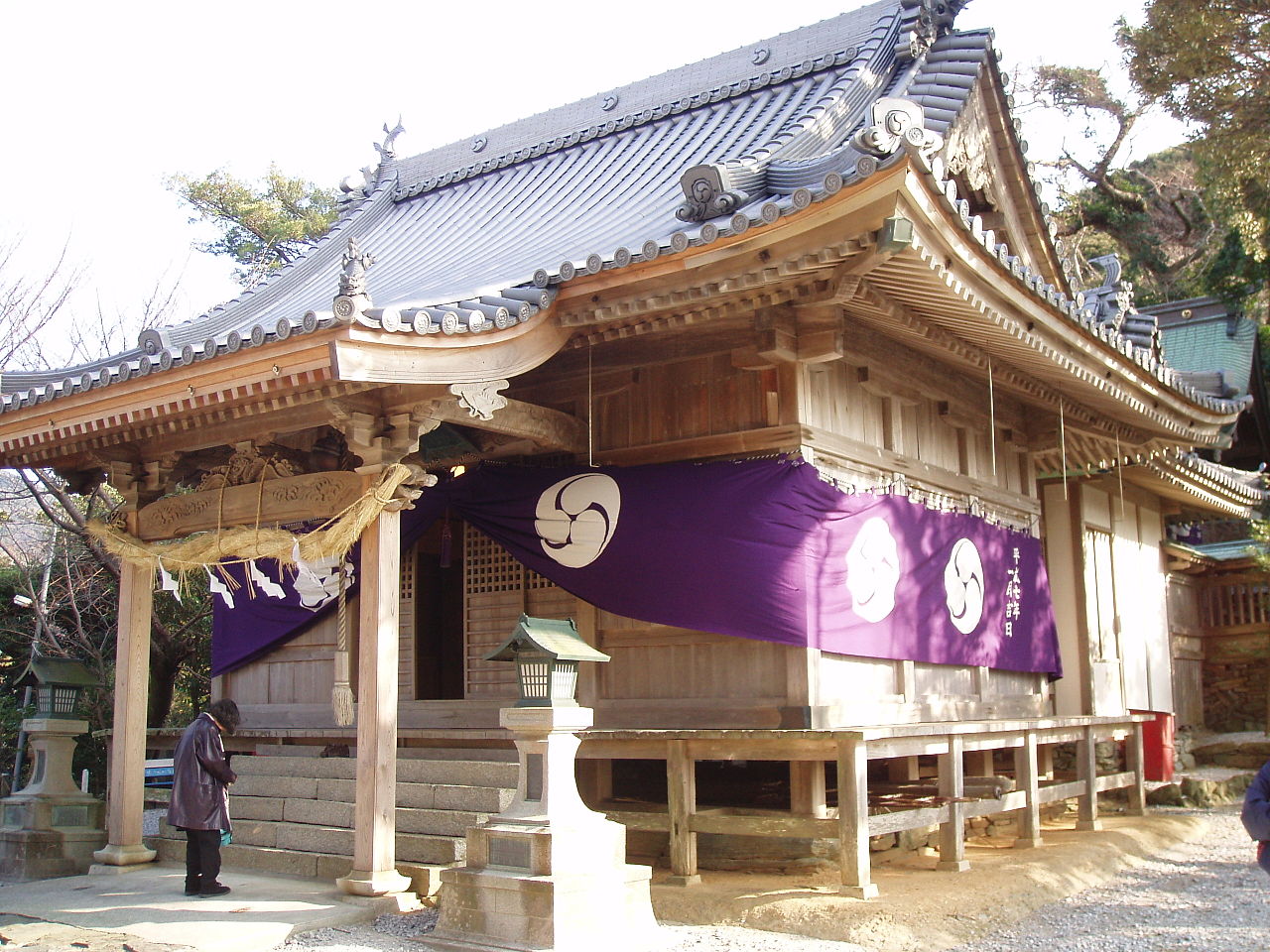
03 / Misaki Hachiman Shrine (三崎八幡神社)

A torii felled by an earthquakeis said to be rebuilt from a surviving pillar.

Misaki Hachiman Temple.jpg
Photo by Amake (CC BY-SA 3.0)

Said to have been founded in 860 (Jogan 2), though this is not certain. Until the Meiji Restoration it was called Daisha Shohachimangu, the tutelary shrine of the 15 villages of Misaki-ura, and later came to be called the general tutelary shrine. Designated a town tangible cultural property (building).

  • Town-designated tangible cultural property (building, 1979)
  • Said to be founded in 860
  • Shrine of the 15 villages of Misaki-ura

Living here

White sands on the Uwa Sea side,a rias coast on the Inland Sea side.

  • about 8,000 people
  • Rural district town

Ikata sits on the Sadamisaki Peninsula, the westernmost tip of Shikoku. The climate is mild and maritime, with an annual mean of 16°C. The peninsula lands a wide variety of fish and shellfish, including pufferfish, yellowtail, sea bream, abalone and spiny lobster, and its terraced slopes grow citrus such as Beni Madonna and Setoka.

People living here
8,397people
20052020

−12.8% since 2015

12,095 → 8,397

Area
93.83km²

46.32km² of it habitable

2024

Households
4,077households

2.1 people per household

2020

Rent (average for rentals)
—
Healthcare
0 hospitals / 10 clinics

11.9 per 10,000 people

2023

Area93.83km²Habitable land46.32km² / 49%
Area and habitable land at the same scalee-Stat B1101 / B1103

Population from 2005 onward (municipal boundary changed).2005-04-01 に新設合併(瀬戸町・三崎町)。2005年調査から市域が変わっている。

Children waiting for childcare
—7 nurseries and similar
Home purchase subsidy
—
Average annual temperature
—

These 3 items are waiting on a nationwide data source. We do not fill them with estimates.

Shape

Borders 1 municipalities.

Ikata Town in Japan33.489°N 132.354°E
TokyoOsakaIkata Town
Territory of Ikata Town
Boundaries: National Land Numerical Information (N03)

North to south

19.7km

八幡浜市

Travel times per leg are not published by the municipality, so they are not shown.

Ikata Town isthis kind of town.

  1. 01Shanshan Odori (しゃんしゃん踊り) is a dance offered in Oku on September 1 and designated a town intangible folk cultural property. Its name comes from the words "shanshan" in the song, and it is said to have begun to console the spirit of a woman named Oikiyo; it has been passed down for over 300 years.
  2. 02The Bon rites of the Sadamisaki Peninsula are a nationally selected intangible folk cultural property, including Mouna in the former Misaki town and Oshoro-bune in the former Seto town. The former Hiraiso Submarine Cable Landing Station, set up in 1927, is a nationally registered cultural property.
  3. 03The Natori (名取) hamlet is said to have begun when people brought from Oshu by Date Hidemune in 1615 settled there, and its slopes show many kinds of stone walls. The nationally registered Sadamisaki Lighthouse, lit in 1918, stands at the tip of the peninsula, and the Ikata Toji (伊方杜氏, sake master brewers) museum is in the Minatoura lifelong-learning center.

If something caught your eye, ask the town itself.