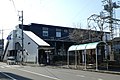
紀州街道・山中宿 04.jpg
Article

27232 / はんなんし

Osaka Prefecture

Hannan City

Twenty-odd inns lined the border valley.

Yamanaka post town, Kishu Road

Photo by Indiana jo (CC BY-SA 4.0)

01 / Stone mortar

For elderly people without teeth,a stone mortar pounded hard food soft.

A koko-usu is a small pounding mortar made of Izumi sandstone, with a pestle light enough for one hand. The guidebook Izumi Meisho Zue, published in 1796, says hard food was pounded soft in it and served to elderly people without teeth. Seven in Hannan are city-designated folk cultural properties, and the city says only some twenty are confirmed in the Sennan area.

  • Seven city-designated folk cultural properties
  • Izumi Meisho Zue, published in 1796
  • Some twenty confirmed in the Sennan area

02 / Auxiliary hall

The auxiliary hall south of the main hallis a single nagare-zukuri building.

Hata-jinja, Nanden.jpg
Photo by 運動会プロテインパワー (CC BY-SA 4.0)

The city says Hata Shrine is one of the ten shrines of Hine District listed in the Engishiki. The main hall stands behind the worship hall, so its whole form cannot be seen. South of it, the Massha Sanjinja main hall, the hall of three auxiliary shrines, is a single three-bay nagare-zukuri building divided inside into three chambers. Its roof was changed from cypress bark to copper sheet. It was designated an Important Cultural Property in 1993.

  • One of ten Hine District shrines in the Engishiki
  • Three-bay nagare-zukuri, copper-sheet roof, one building
  • Important Cultural Property, 1993

03 / Farmhouse estate

The estate of a wealthy village-headman familyholds seven registered cultural properties.

Minami-ke Jutaku Omotemon.jpg
Photo by Suikotei (CC BY 4.0)

The city says the Minami family were wealthy farmers who served as village headmen in the Edo period and as kocho, or district heads, in the Meiji era for the areas of today's Hannan and Misaki. The site measures about 70 m east-west and 50 m north-south. Seven buildings, including the main house, front gate, earthen wall and storehouses, are Registered Tangible Cultural Properties, and the front gate is a single-bay yakuimon. The garden is a Registered Monument and is normally closed to the public.

  • Seven Registered Tangible Cultural Properties (2005)
  • About 70 m east-west, 50 m north-south
  • Garden: Registered Monument, normally closed

Living here

From Namba, 37 minutes by limited express.

  • about 50,000 people

The town has three stations on the Nankai Main Line: Ozaki, Tottorinosho and Hakotsukuri. The Southern limited express stops at Ozaki Station, 37 minutes from Namba without a change (a limited-express fee is extra; the express, which needs no fee, takes 41 minutes). The city also guides "about 37 minutes by limited express". The JR Hanwa Line has Izumi-Tottori and Yamanakadani stations.

People living here
51,254people
19952020

−5.6% since 2015

55,625 → 51,254

Area
36.17km²

17.42km² of it habitable

2024

Households
20,774households

2.5 people per household

2020

Rent (average for rentals)
41,045yen

National average 60,630 yen

2023

Healthcare
3 hospitals / 43 clinics

9.0 per 10,000 people

2023

Area36.17km²Habitable land17.42km² / 48%
Area and habitable land at the same scalee-Stat B1101 / B1103
Children waiting for childcare
—7 nurseries and similar
Home purchase subsidy
—
Average annual temperature
—

These 3 items are waiting on a nationwide data source. We do not fill them with estimates.

ACCESS

Where you can go from here.

Hannan City in Japan34.360°N 135.240°E
TokyoHannan City
Ozaki Station
尾崎駅2020
  • to OsakaNankai limited express37min

Travel times follow 南海電鉄『ダイヤ検索』(kensaku.nankai.co.jp。事業者公式の経路検索)を、2026-10-14(水)と 2026-10-18(日)の05:00〜23:30、30分おきの出発時刻で引き、『乗換 0回』の経路で 難波『発』→尾崎『着』(と尾崎『発』→難波『着』)の所要を数えた。作業ファイルは $SP/hannan/scan_*.txt。 (checked 2026-10-14). They vary by time of day.

Shape

Borders 4 municipalities across 1 prefectures.

Territory of Hannan City
Boundaries: National Land Numerical Information (N03)

North to south

8.5km

Osaka Prefecture
泉南市, 岬町
Wakayama Prefecture
和歌山市, 岩出市

Hannan City isthis kind of town.

  1. 01The city writes that Yamanakadani was a post town with twenty-odd inns lining the Kishu Road in the Edo period. Along the road are the site of the honjin, the lodging used by the lord of Kishu, the Tanaka residence, said to be an Edo-period building, and Sakai Bridge on the border between Izumi and Kishu
  2. 02The koko-usu is a small pounding mortar of Izumi sandstone. The city has also designated as folk cultural properties 475 tools of quarry stonemasons and 294 tools of finishing stonemasons of the Senshu stonemason trade, which worked Izumi stone
  3. 03The main hall and the three-shrine auxiliary hall of Hata Shrine were designated Important Cultural Properties in 1993. At Jinenda, the Minami residence has seven Registered Tangible Cultural Properties, including the main house, front gate and storehouses, and its garden is a Registered Monument

See the town as it is now.

Source: Wikidata (P2002, P2003, P2013, P2397)

If something caught your eye, ask the town itself.