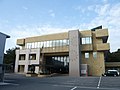
Mihama mio.jpg
Article

30381 / みはまちょう

Wakayama Prefecture 日高郡

Mihama Town

News of salmon sent villagers overseas.

Kuno Gihei and America-mura

Photo by Opqr (CC BY-SA 4.0)

01 / Houses in Mio

A Western-style house, and a Japanese-style one with a Western room,built in Mio by Canada emigrants, are Registered Tangible Cultural Properties.

The former Noda residence is a Western-style house built around 1934 (Showa 9) by a family who had returned from Canada, with light-blue walls and a roof of green Western-style cement tiles. Yushin-an was built in 1933 (Showa 8) by Tanaka, who had prospered in salmon fishing in Canada. The main buildings and the gates and walls, four items in all, were registered as national Registered Tangible Cultural Properties in 2019.

  • Built in 1933 and 1934
  • Four items: main buildings, gates and walls
  • Registered in 2019

02 / Old ubame oak

The old ubame oak of Misaki Shrineis said to be 1,100 years old.

Misaki shirine (mihama town).jpg
Photo by On-neko (CC BY-SA 4.0)

An ubame oak stands in the grounds of Misaki Shrine, and its age is said to be 1,100 years. It was designated a Prefectural Natural Monument in 1958 (Showa 33). The Oni-jishi lion dance performed at the shrine's annual festival, Wada Matsuri, is danced guided by the sasara, a bamboo percussion tool, and is a Town-designated Cultural Property.

  • Prefectural Natural Monument, 1958
  • Said to be 1,100 years old
  • Oni-jishi: Town-designated

03 / Enjugahama

Since the early Edo period, the Kii Domain and local peoplehave kept a pine forest about 4.5 km long.

Enjugahama.jpg
Photo by Opqr (CC BY-SA 4.0)

Enjugahama is a sandbar coast facing the Pacific, with a pine forest about 4.5 km long and up to 500 m wide. The pines are said to number as many as 100,000. The name is said to have been given in the late Taisho era by the painter Kondo Koichiro.

  • About 4.5 km long
  • Up to 500 m wide
  • Said to number 100,000 pines

Living here

12 minutes by local bus from Gobo Station.

  • about 7,000 people
  • Rural district town

There is no JR station in the town. From JR Gobo Station, the Hinomisaki Park Line of Kumano Gobo Nankai Bus takes 12 minutes to the Wakayama Byoin-mae stop, the one nearest the town office. Seven buses a day leave Gobo Station (timetable revised October 2022).

People living here
6,867people
19952020

−8.2% since 2015

8,919 → 6,867

Area
12.77km²

6.85km² of it habitable

2024

Households
2,863households

2.4 people per household

2020

Rent (average for rentals)
—
Healthcare
1 hospital / 8 clinics

13.1 per 10,000 people

2023

Area12.77km²Habitable land6.85km² / 54%
Area and habitable land at the same scalee-Stat B1101 / B1103
Children waiting for childcare
—2 nurseries and similar
Home purchase subsidy
—
Average annual temperature
—

These 3 items are waiting on a nationwide data source. We do not fill them with estimates.

ACCESS

Where you can go from here.

Mihama Town in Japan33.894°N 135.133°E
TokyoMihama Town
和歌山病院前
和歌山病院前2014
  • to GoboLocal bus12min

Travel times follow 熊野御坊南海バス『日の岬パーク線 時刻表』(2022.10.1改正・熊野御坊南海バス㈱御坊支社。https://kumanogobobus.nankai-nanki.jp/cms/wp-kumanogobobus/wp-content/uploads/hinomisakisen_20230110.pdf。事業者公式『御坊エリア』のページ https://kumanogobobus.nankai-nanki.jp/local/gobo/ から時刻表として載っている)。『海猫島→御坊駅』『御坊駅→海猫島』の2表とも見出しは『平日・土曜・休日』の1列で、運転日の注記は無い。御坊駅発の下りの『御坊駅』→『和歌山病院前』の列を読んだ (checked 2026-10-14). They vary by time of day.

Shape

Borders 2 municipalities.

Territory of Mihama Town
Boundaries: National Land Numerical Information (N03)

North to south

4.6km

日高町, 御坊市

Mihama Town isthis kind of town.

  1. 01Mio is a village called "America-mura"; the town records that in 1888 Kuno Gihei went to Canada and sent word home of huge salmon runs, after which villagers crossed the sea one after another
  2. 02The former Noda residence and Yushin-an are houses Canada emigrants built in Mio, and four items, the main buildings and the gates and walls, are national Registered Tangible Cultural Properties
  3. 03Misaki Shrine has the old ubame oak, a Prefectural Natural Monument, and the coastal Enjugahama has a pine forest about 4.5 km long

If something caught your eye, ask the town itself.