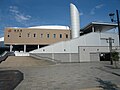
Tyoukouji1.JPG
Article

23220 / いなざわし

Aichi Prefecture

Inazawa City

A finial crowns the hexagonal roof.

Jizo Hall, Chokoji Temple

Photo by Bariston (CC BY-SA 4.0)

01 / Ginkgo

Kinbei, Kyuji, Eishin.Sobue has the original ginkgo trees behind these names.

Yusen-ji Temple in Inazawa city Sobue town ac.jpg
Photo by Asturio Cantabrio (CC BY-SA 4.0)

Among the city-designated natural monuments in Sobue are ginkgo trees that are the original trees of named ginkgo nuts. Kinbei Ginkgo is 15 m tall; the city records that in the early Meiji era the nuts gathered by the householder Kinbei came to be called the Kinbei variety. Eishin Ginkgo is said to be named by combining a character from Eijiro's name with one from the place name. Kyuji Ginkgo stands in Yamazaki.

  • Kinbei Ginkgo is 15 m tall
  • City designation, 2005 and 2010
  • Eishin combines two characters

02 / Provincial temple site

Owari Kokubunji placed its pagoda east of the cloister,excavation has shown.

Owari-kokubunji-ato tou.JPG
Photo by Saigen Jiro (CC0)

The Owari Kokubunji site in Yawase-cho, designated a national historic site in 2012, is an ancient temple site where remains of the main hall, pagoda and lecture hall have been confirmed. The priest Hakuan of Kokubunji in Yawase-cho is said to have brought back from China the grafting technique for citrus seedlings and taught it to farmers, which began Inazawa's nursery trade.

  • National historic site, 2012
  • 14 rounds of excavation
  • Hakuan: 1328, the city records

03 / Pagoda

A pagoda at Mantokuji suggests it wasmodeled on the one at Shokaiji.

Mantokuji.jpg
Photo by Bariston (CC BY-SA 4.0)

The Mantokuji pagoda, an Important Cultural Property, is recognized as a Muromachi-period building. The city points to similarities with the Shokaiji pagoda, such as the head tie beams, the nose ends and the plain bracket arms without spirals, and says it suggests the pagoda was modeled on that one. The Shokaiji pagoda is said to date from 1253, but is regarded as a mid-Muromachi rebuilding.

  • Recognized as Muromachi-period
  • Important Cultural Property, 1901
  • Three bays on the lower roof

Living here

Nagoya is 10 minutes by Meitetsu limited express.

  • about 130,000 people
  • 30 min to a city centre

From Meitetsu Nagoya Station, the Meitetsu limited express reaches Konomiya Station in 10 minutes. The city gives about 10 minutes by limited express from Nagoya Station to Konomiya Station on the Meitetsu Nagoya Main Line, and about 10 minutes from Nagoya Station to Inazawa Station on the JR Tokaido Main Line.

People living here
134,751people
20052020

−1.5% since 2015

136,965 → 134,751

Area
79.35km²

79.35km² of it habitable

2024

Households
52,005households

2.6 people per household

2020

Rent (average for rentals)
50,770yen

National average 60,630 yen

2023

Healthcare
4 hospitals / 100 clinics

7.7 per 10,000 people

2023

Almost entirely flat.Almost all of it is habitable land (100.0%)
Area and habitable land at the same scalee-Stat B1101 / B1103

Population from 2005 onward (municipal boundary changed).2005-04-01 に編入合併(祖父江町・平和町)。2005年調査から市域が変わっている。

Children waiting for childcare
—31 nurseries and similar
Home purchase subsidy
—
Average annual temperature
—

These 3 items are waiting on a nationwide data source. We do not fill them with estimates.

ACCESS

Where you can go from here.

Inazawa City in Japan35.248°N 136.780°E
TokyoInazawa City
Inazawa Station
稲沢駅2007
  • to NagoyaMeitetsu limited express10min

Travel times follow 名古屋鉄道 公式の名古屋本線の時刻表PDF(2026年3月14日改正。平日の下りは 2026-06-22 掲載の改訂版 kai_20260314_NH_W1.pdf、ほかは 2026-02-25 掲載)https://www.meitetsu.co.jp/train/timetable/ (checked 2026-10-20). They vary by time of day.

Shape

Borders 6 municipalities across 1 prefectures.

Territory of Inazawa City
Boundaries: National Land Numerical Information (N03)

North to south

9.2km

Aichi Prefecture
一宮市, 愛西市, あま市, 清須市
Gifu Prefecture
羽島市, 海津市

Inazawa City isthis kind of town.

  1. 01Chokoji's Jizo Hall is a hexagonal hall with an iron base and a jewel finial at the roof's peak, and the city notes that few hexagonal halls survive nationwide
  2. 02Sobue's Kinbei, Kyuji and Eishin ginkgo trees are city natural monuments, the Owari Kokubunji site is a national historic site, and the Mantokuji and Shokaiji pagodas are Important Cultural Properties
  3. 03The Konomiya Naoi festival is a prefecturally designated intangible folk cultural property, its night rite uses carried earth cakes and large figures made of chigaya grass, and the gate of Owari Okunitama Shrine is an Important Cultural Property

See the town as it is now.

Source: Wikidata (P2002, P2003, P2013, P2397)

If something caught your eye, ask the town itself.