Ougo Kofun, sendou-1.jpg
Article

25384 / りゆうおうちょう

Shiga Prefecture 蒲生郡

Ryuo Town

A stone passage goes into a square tomb.

Ougo Kofun

Photo by Saigen Jiro (CC0)

01 / Namura Shrine

In keeping with 33 parish villages, it is said,the great festival was fixed at once every 33 years.
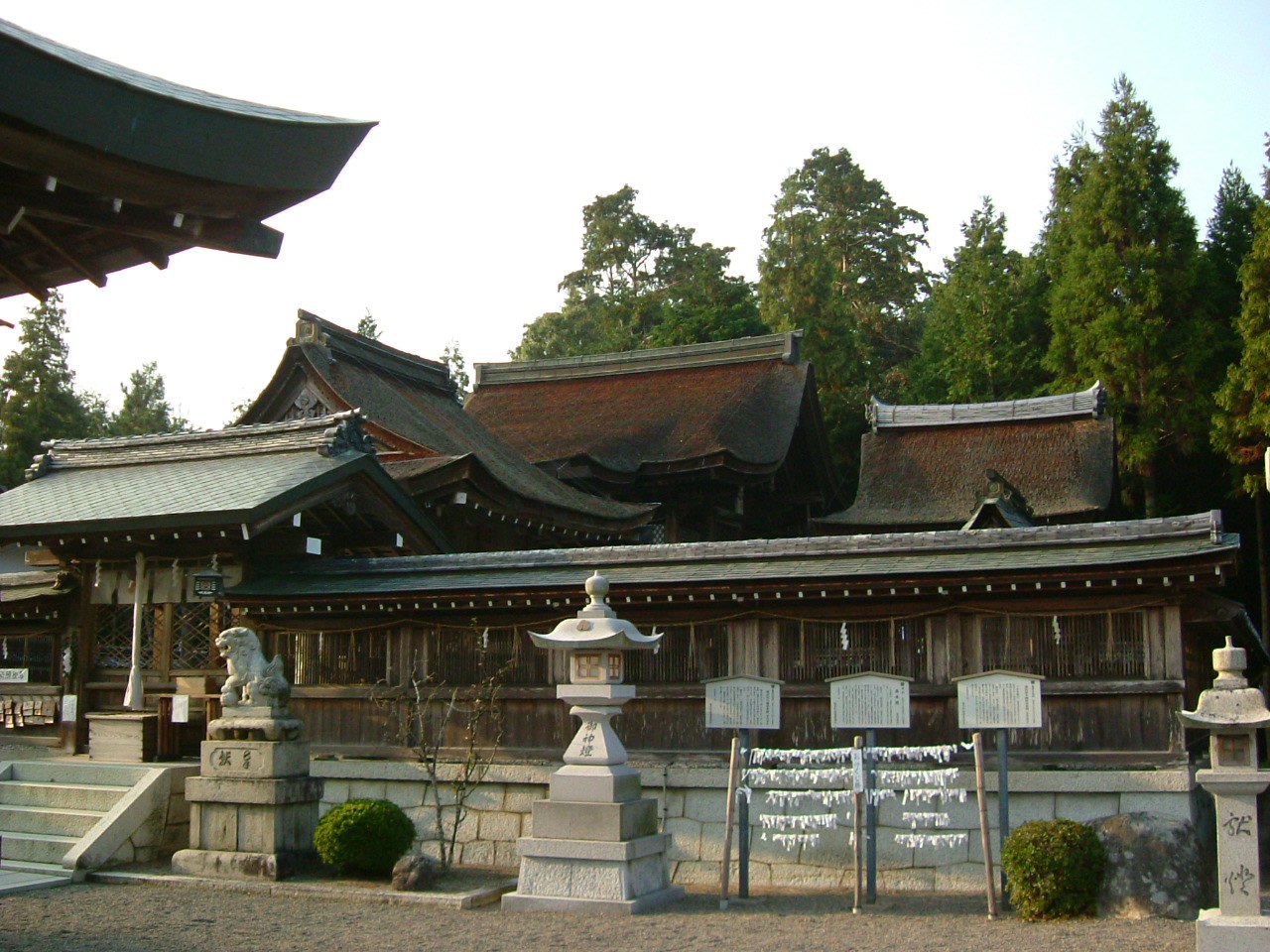
Shiga Namura1.jpg
Photo by Yusuke.ogawa at Japanese Wikipedia (Public domain)

The great festival, attended by the shrine's 33 parish villages, was once held every autumn. According to the shrine, in 1599 it was changed to a ceremonial festival held once every 33 years, in keeping with the 33 villages. The West Main Hall in the precinct is a National Treasure of the late Kamakura period, and a ridge tablet kept by the shrine suggests it was rebuilt in 1308.

  • Great festival every 33 years
  • National Treasure main hall
  • Ridge tablet of 1308

02 / Saikoji temple site

A late-Kamakura stone pagoda with"owls" carved at the four corners of its body.

At the site of Saikoji temple, at the foot of Mount Kagami, stands a granite hokyointo pagoda. Above a two-tier base, a foundation carved with peacocks facing each other in ornamental panels carries the body, roof and finial, making a large pagoda about 2.1 m tall. The prefectural board of education notes that the "owl" carvings on the four corners of the body are a distinctive feature of this pagoda.

  • About 2.1 m tall
  • Peacock panels
  • Important Cultural Property, 1960

03 / Kenketo festival, Yamanoue

People topple and scramble fora heron pole regarded as a god's incarnation.

The spring festival at Sugino Shrine is one of the Ōmi Kenketo naginata festivals, a national Important Intangible Folk Cultural Property. In Yamanoue, instead of a flower pole, a heron pole regarded as an incarnation of a god appears. The pole, hung with five-colored paper streamers, is called Inaburo, and because the streamers are said to ward off insects, people topple it and scramble for them.

  • Heron pole (Inaburo)
  • Five-colored paper streamers
  • Important Intangible Folk Cultural Property, 2020

Living here

Mount Yukino to the east, Mount Kagami to the west; the town is named for them.

  • about 10,000 people
  • Rural district town

Farmland spreads between Mount Yukino to the east and Mount Kagami to the west. The town takes its name from these two "Ryuo mountains." By train, the town office's guide says to take a bus of about 20 minutes (three routes) from JR Ōmi-Hachiman Station. The gateway is the bus stop near the town office.

People living here
11,789people
19952020

−5.2% since 2015

13,650 → 11,789

Area
44.55km²

29.15km² of it habitable

2024

Households
4,435households

2.7 people per household

2020

Rent (average for rentals)
—
Healthcare
0 hospitals / 9 clinics

7.6 per 10,000 people

2023

Area44.55km²Habitable land29.15km² / 65%
Area and habitable land at the same scalee-Stat B1101 / B1103
Children waiting for childcare
—2 nurseries and similar
Home purchase subsidy
—
Average annual temperature
—

These 3 items are waiting on a nationwide data source. We do not fill them with estimates.

Shape

Borders 5 municipalities.

Ryuo Town in Japan35.061°N 136.125°E
TokyoRyuo Town
Territory of Ryuo Town
Boundaries: National Land Numerical Information (N03)Lakes: National Land Numerical Information (Lake Data), MLIT. Processed by Machigatari. Prepared with the approval of the Director-General of the Geospatial Information Authority of Japan, using its Digital Map 25000 (Spatial Data Framework) and Digital Map 25000 (Place Names and Public Facilities). (承認番号 平27情使、第585号)

North to south

8.6km

湖南市, 近江八幡市, 東近江市, 野洲市, 甲賀市

Travel times per leg are not published by the municipality, so they are not shown.

Ryuo Town isthis kind of town.

  1. 01Ougo Kofun in Kuzushi is a square tomb thought to date from the late 6th century, with a large stone burial chamber about 10 m long, and was designated a prefectural historic site in 2019
  2. 02Namura Shrine is the shrine of 33 parish villages, with a National Treasure West Main Hall and a great festival once every 33 years; at Sugino Shrine in Yamanoue, people topple and scramble for a heron pole at the spring festival
  3. 03At the foot of Mount Kagami, many kiln sites for sue pottery remain, Minamoto no Yoshitsune is said to have come of age at the Kagami post town, and a pagoda with "owl" carvings stands at the Saikoji temple site

If something caught your eye, ask the town itself.