Hiyoshi-jinjya Godo04.JPG
Article

21381 / ごうどちょう

Gifu Prefecture 安八郡

Godo Town

A shrine's pagoda stacks three roofs.

Hiyoshi Shrine, pagoda

Photo by Monami (CC BY-SA 3.0)

01 / Godo Sanno Festival

In the procession, the seven mikoshi never stop and run at full speed,and the bearers change as they run.

日本国岐阜県安八郡神戸町の火祭りと神輿 02.jpg
Photo by HISASHI UNO (CC BY-SA 4.0)

The festival is the annual festival of Hiyoshi Shrine, centred on the procession of seven mikoshi, the portable shrines of the seven Sanno shrines. The shrine writes that during the procession the mikoshi never stop and run at full speed, with the bearers changing along the way as they run. Only the returning mikoshi go slowly, weaving their way back to each neighbourhood. All seven were made in Jokyo 4 (1687), and the festival and the mikoshi are designated by the prefecture.

  • All seven made in Jokyo 4 (1687)
  • Mikoshi: Important Tangible Folk Cultural Property of the prefecture
  • Annual festival on the 4th Saturday and Sunday of April
02 / Seisatsu notice boards

Nobunaga's edict went to the Godo market;the two later boards went to Godo village.

These notice boards are an Important Cultural Property of Gifu Prefecture and are privately owned. Oda Nobunaga's edict of Eiroku 4 (1561) was addressed to the Godo market within Hirano and forbade violence and plunder, setting up camps and arson, and felling bamboo and trees. The prefecture records the board of Tensho 10 (1582) as issued to reassure the common people, and that of Keicho 5 (1600) to reassure Godo village.

  • Nobunaga's edict of Eiroku 4 (1561)
  • Three boards with those of Tensho 10 and Keicho 5
  • Prefectural Important Cultural Property (designated 1958)

03 / Hibino Goho

The kana calligrapher Hibino Goho was born in Aichiand raised by his grandparents in Godo.

Hibino goho museum.JPG
Photo by Opqr (CC BY-SA 4.0)

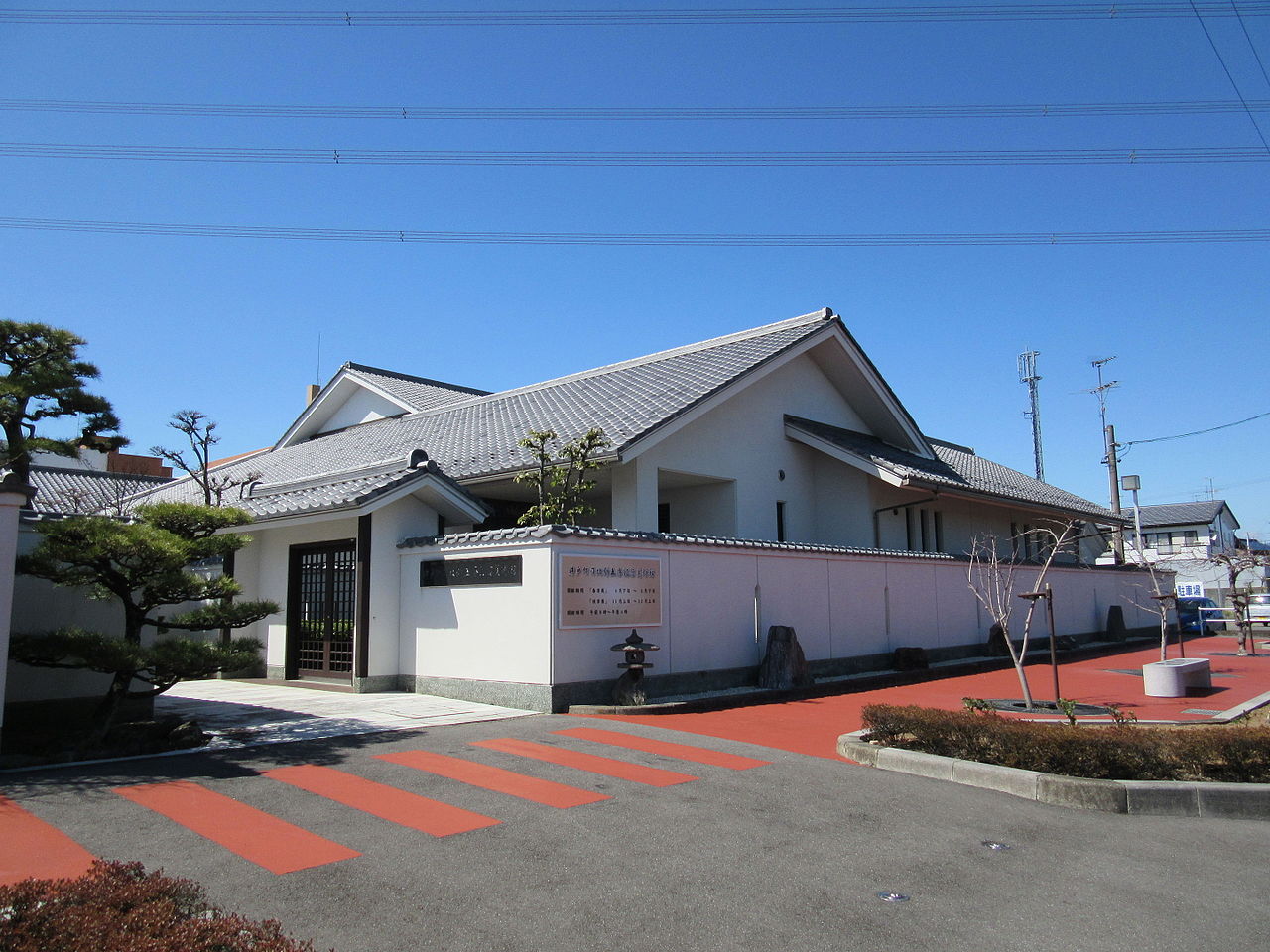
Hibino Goho was born in 1901 in Kasugai, Aichi Prefecture, and from that year was raised by his grandparents in Nakazawa, Godo Town. He began studying kana on his own in Taisho 10 (1921) and received the Japan Art Academy Prize in Showa 40 (1965) for his Nitten entry Shimizu. The town's memorial museum holds 299 of his major works and shows them twice a year, in spring and autumn.

  • Born in Meiji 34 (1901)
  • Japan Art Academy Prize, Showa 40 (1965)
  • Memorial museum holds 299 major works

Living here

About 15 minutes from Ogaki Station on the Yoro Railway.

  • about 20,000 people
  • Rural district town

The town's access page gives two routes to the town hall: from JR Ogaki Station on the Yoro Railway (for Ibi) in 15 minutes to Hiro-Godo Station, or by Meihan Kintetsu Bus (Ogaki-Ono Line) in 20 minutes to Godo Town Office. Timetables for the Yoro Railway and the Ogaki-Ono Line can be opened from the town's page.

People living here
18,585people
19952020

−3.6% since 2015

20,687 → 18,585

Area
18.78km²

18.78km² of it habitable

2024

Households
6,810households

2.7 people per household

2020

Rent (average for rentals)
39,342yen

National average 60,630 yen

2023

Healthcare
0 hospitals / 13 clinics

7.0 per 10,000 people

2023

Almost entirely flat.Almost all of it is habitable land (100.0%)
Area and habitable land at the same scalee-Stat B1101 / B1103
Children waiting for childcare
—4 nurseries and similar
Home purchase subsidy
—
Average annual temperature
—

These 3 items are waiting on a nationwide data source. We do not fill them with estimates.

Shape

Surrounded by 4 municipalities, and almost entirely flat.

Godo Town in Japan35.417°N 136.608°E
TokyoGodo Town
Territory of Godo Town
Boundaries: National Land Numerical Information (N03)

North to south

6.8km

大垣市, 大野町, 池田町, 瑞穂市

Travel times per leg are not published by the municipality, so they are not shown.

Godo Town isthis kind of town.

  1. 01The three-storied pagoda of Hiyoshi Shrine, a three-bay pagoda with a cypress-bark roof, is an Important Cultural Property of Japan. It is said to have been built by Saito Toshitsuna in the Eisho era (1504 to 1521), and a surviving ridge tablet records that Inaba Ittetsu repaired it in Tensho 13 (1585)
  2. 02The seven mikoshi were made in Jokyo 4 (1687), and the one that leads the procession, Ushionomiya's, is octagonal. At the central steps of the shrine's fence stand a pair of lamp stands holding 108 lamps, designated an Important Tangible Folk Cultural Property of the prefecture
  3. 03The three seisatsu notice boards, an Important Cultural Property of Gifu Prefecture, were issued to the Godo market and village. A lecture notice from Gifu Prefectural Library records that the birth mother of Hara Sankei was the daughter of Takahashi Kyoson, a Japanese-style painter of Godo village

See the town as it is now.

Source: Wikidata (P2002, P2003, P2013, P2397)

If something caught your eye, ask the town itself.