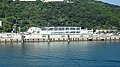
Ohunae.jpg
Article

42209 / つしまし

Nagasaki Prefecture

Tsushima City

Domain ships' inlet has four jetties.

Ofunae, Tsushima domain docks

Photo by As6022014 (CC BY 3.0)

01 / Kofun Tombs

Around Kechi Bay (雞知浦), kofun tombs standfrom the late 4th to the early 7th century.

Neso Kofungun-3, sekishitsu-1.jpg
Photo by Saigen Jiro (CC0)

Deizuka Kofun (出居塚古墳), a square-front, square-rear tomb, dates from the late 4th century; the Neso Kofun Group (根曽古墳群, national historic site: 3 keyhole-shaped and 2 round tombs) from the 5th to 6th; Saino-yama Kofun (サイノヤマ古墳), a square tomb, from the early 7th. The prefecture infers they hold chieftains of a lineage (対馬県直) that ruled Tsushima allied with the Yamato court.

  • Neso group: national historic site (1976)
  • 3 keyhole-shaped and 2 round tombs
  • Late 4th to early 7th century

02 / Hitotsubatago

The view of white blossoms shining on calm wateris called “Umiterashi” (ウミテラシ) locally.

Hitotsubatago.jpg
Photo by Snap55 (CC BY 3.0)

Wani-ura (鰐浦) is a fishing port at Tsushima's northern tip, and Hitotsubatago trees (ヒトツバタゴ) grow thickly on the hills around its inlet. They open pure white flowers around early May each year, and because the wood is hard they are also called “Nataorashi” (ナタオラシ). The prefecture notes it is significant that a continental plant grows here, nearest the continent.

  • National Natural Monument (1928)
  • Blooms around early May
  • Also called “Nataorashi”

03 / Stone-Roofed Storehouse

A raised storehouse is roofed with thick slabsof shale from the island itself.

The Shiine (椎根) stone-roofed storehouse is partitioned inside to hold rice, barley, grains and clothing. The prefecture gives as reasons for the stone roof that farmers were not allowed tile, and that stone protects food and valuables from fire and strong wind. It stands apart from the main house, also as fire protection; the designated one was completed in 1926.

  • Prefectural Tangible Cultural Property (1977)
  • Completed 1926 (Taisho 15)
  • Roof of shale from the island

Living here

To Hakata, 4 hours 45 minutes by ferry.

  • about 30,000 people

Tsushima is a long, narrow island, 82 km north to south and 18 km east to west, and the city's gateway is Izuhara Port. The Kyushu Yusen ferry from Hakata Port takes 4 hours 45 minutes (daytime sailing, via Iki). Busan is 49.5 km away.

People living here
28,502people
20052020

−9.4% since 2015

38,481 → 28,502

Area
707.42km²

74.44km² of it habitable

2024

Households
12,681households

2.2 people per household

2020

Rent (average for rentals)
33,822yen

National average 60,630 yen

2023

Healthcare
2 hospitals / 34 clinics

12.6 per 10,000 people

2023

Area707.42km²Habitable land74.44km² / 11%
Area and habitable land at the same scalee-Stat B1101 / B1103
Children waiting for childcare
—8 nurseries and similar
Home purchase subsidy
—
Average annual temperature
—

These 3 items are waiting on a nationwide data source. We do not fill them with estimates.

ACCESS

Where you can go from here.

Tsushima City in Japan34.203°N 129.287°E
TokyoOsakaTsushima City
Port of Izuhara
厳原港2020
  • to HakataKyushu Yusen285min

Travel times follow 島の町の決め(上島町〈愛媛。38356〉と同じ。駅の無い町のバスの起点と同じ扱いで、町内の玄関口の港へ乗り換えなしで着く船の起点を都市名、事業者名だけを mode にする)。事業者公式・九州郵船『時刻表 2026年7月1日〜2026年10月31日』(PDF。kyu-you.co.jp/route/ の『時刻表』から。2026-09-30 に読んだ)の『博多〜壱岐〜対馬(厳原)航路 フェリーきずな/フェリーちくし』の欄。博多発→厳原着:212便(フェリーきずな)10:00発→壱岐〈郷ノ浦〉12:20着・12:35発→厳原14:45着=285分、218便(フェリーちくし)00:05発→壱岐〈芦辺〉02:15着・02:25発→厳原04:45着=280分(厳原港での下船は入港時または7時、途中下船不可)。基本配船は 212・218 の2便が博多から厳原まで通す(215便〈20:35→22:55〉は壱岐〈郷ノ浦〉までで厳原へは行かない)。同じ船が壱岐に寄って厳原港に着くので乗り換えなし。 (checked 2026-09-30). They vary by time of day.

Shape

Borders 0 municipalities.

Territory of Tsushima City
Boundaries: National Land Numerical Information (N03)

North to south

71.5km

Tsushima City isthis kind of town.

  1. 01At the mouth of the Kuta River in Izuhara lie the remains of Ofunae (お船江), where the Tsushima domain's ships were docked; the prefecture records four jetties and five docks in an artificial inlet
  2. 02Kaneda Castle ruins (金田城跡), the former Kanaishi Castle garden (旧金石城庭園) and Banshoin's set of three altar implements (万松院の三具足) are among the island's constituent cultural properties of the Japan Heritage story “Borderland Islands Iki, Tsushima and Goto” (国境の島)
  3. 03Tsutsu (豆酘) keeps a rite that enshrines and grows red rice and a divination custom of reading cracks in a burnt turtle shell, both nationally selected intangible folk cultural properties

See the town as it is now.

Source: Wikidata (P2002, P2003, P2013, P2397)

If something caught your eye, ask the town itself.