保戸島全景1.jpg
Article

44207 / つくみし

Oita Prefecture

Tsukumi City

3- and 4-storey houses crowd a hillside.

Hotojima

Photo by Kazuyuki N (CC BY-SA 4.0)

01 / Otomo Sorin's Grave

Otomo Sorin died in exile, right here.Graves from different eras stand together.
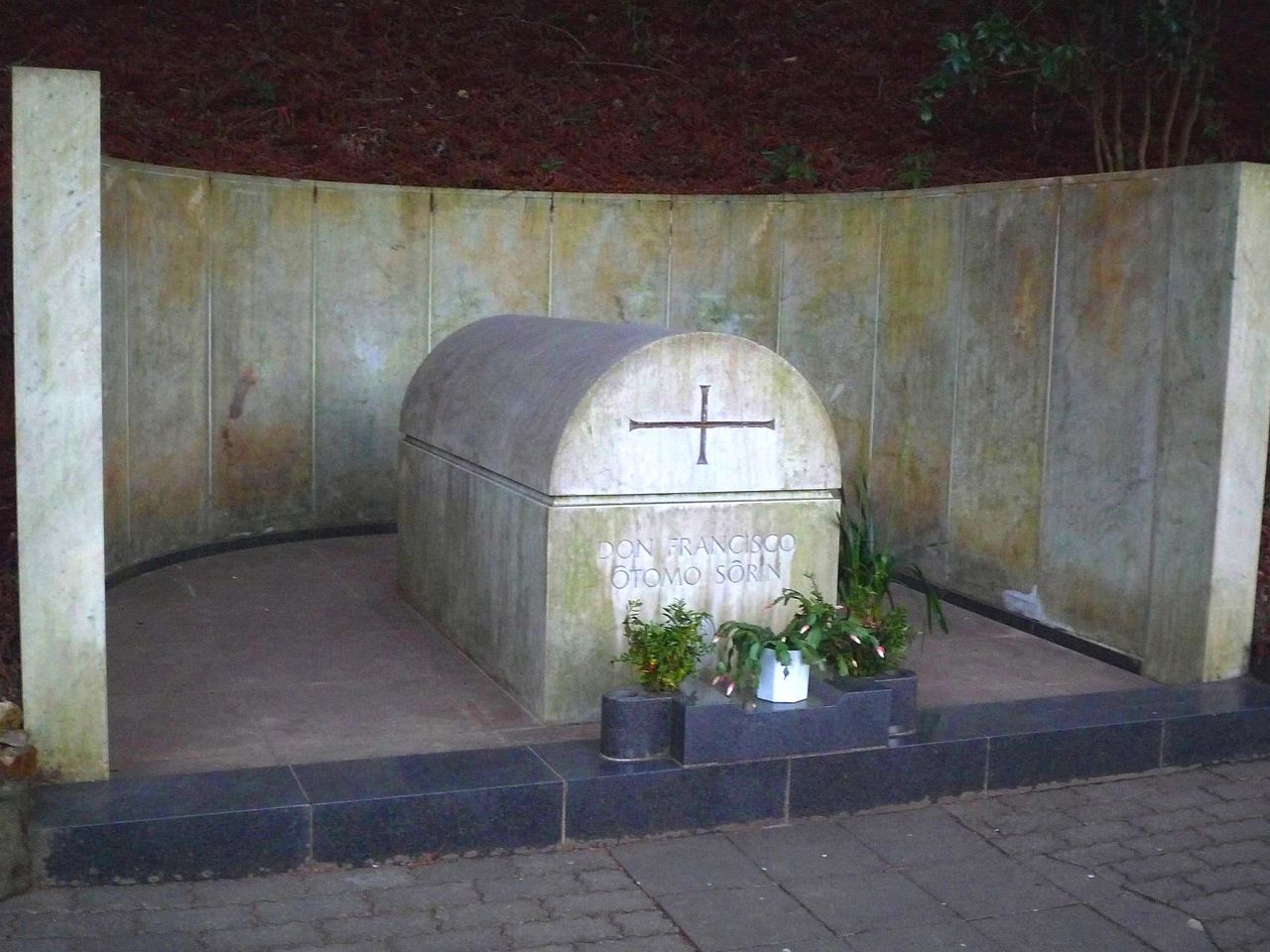
Otomo Sorin's Tombstone(Tsukumi-City).jpg
Photo by Heartoftheworld (CC BY-SA 4.0)

In 1583, the warlord Otomo Sorin retired to Tentoku-ji (天徳寺) here, hoping to build an ideal Christian domain, but died in 1587 at 58 with that dream unfinished. Among the cedars stand two graves: one built by descendants of his former retainers in the Edo period, and a Christian-style memorial designed in 1977 by the architect Isozaki Arata (磯崎新). The site is a city historic landmark.

  • 1587: died, aged 58
  • 1996: designated city historic landmark
  • Cedars over 100 years old

02 / Cement Town

An address that reads "Cement Town"—only here, and one other town in Japan.

津久見市セメント町 - panoramio.jpg
Photo by sk01 (CC BY-SA 3.0)

"Cement Town" (セメント町), created in a 1967 address reform, is one of only two place names of its kind in Japan; the other is in Sanyo-Onoda, Yamaguchi. The nearby limestone quarry covers about 2.1 million square metres, said to be about 45 times the area of the Tokyo Dome.

  • 1967: named in an address reform
  • 1 of only 2 such names nationwide
  • Quarry: about 45 Tokyo Domes

03 / Ozaki Komikan Ancestral Tree

A tree said to be planted in 740still yields 1 to 1.5 tonnes a year.

The mandarin tree is said to have been planted in 740 by Nito Niza'emon, then moved to its current site in 1157. Toppled by a storm in 1612, it survived through layering, and was designated a National Natural Monument in 1937. Nicknamed the "800-year tree," it still bears 1 to 1.5 tonnes of fruit a year, sold as "800-year-old mikan."

  • 1937: National Natural Monument
  • Nicknamed the "800-year tree"
  • 1–1.5 tonnes harvested a year

Living here

Ferries leave Tsukumi Port for two inhabited islands.

  • about 20,000 people

The JR Nippo Main Line runs north–south through this limestone and cement town. From Tsukumi Station, the gateway, it's about a 7-minute walk to city hall. Ferries reach the inhabited islands of Hotojima in about 25 minutes and Mukujima in about 30.

People living here
16,100people
19952020

−10.4% since 2015

24,848 → 16,100

Area
79.48km²

29.98km² of it habitable

2024

Households
6,995households

2.3 people per household

2020

Rent (average for rentals)
28,312yen

National average 60,630 yen

2023

Healthcare
1 hospital / 16 clinics

10.6 per 10,000 people

2023

Area79.48km²Habitable land29.98km² / 38%
Area and habitable land at the same scalee-Stat B1101 / B1103
Children waiting for childcare
—3 nurseries and similar
Home purchase subsidy
—
Average annual temperature
—

These 3 items are waiting on a nationwide data source. We do not fill them with estimates.

Shape

Borders 2 municipalities.

Tsukumi City in Japan33.072°N 131.861°E
TokyoOsakaTsukumi City
Territory of Tsukumi City
Boundaries: National Land Numerical Information (N03)

North to south

15.8km

佐伯市, 臼杵市

Travel times per leg are not published by the municipality, so they are not shown.

Tsukumi City isthis kind of town.

  1. 01Hotojima, a 25-minute boat ride from Tsukumi Port, is a fishing village of three- and four-storey houses packed onto a hillside, long a base for offshore tuna fishing since the Meiji era; nearby, farmers now raise fully farmed bluefin tuna on formulated feed alone
  2. 02The warlord Otomo Sorin retired to Tsukumi and died here in 1587 at 58; among the cedars of his gravesite stand both an Edo-period tomb and a Christian-style memorial
  3. 03"Cement Town" is one of only two such addresses in Japan, and Tsukumi has one of them; the Ozaki Komikan Ancestral Tree, nicknamed the "800-year tree," is a National Natural Monument

If something caught your eye, ask the town itself.