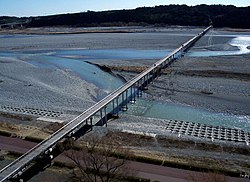
Ota-river in Mori, Shizuoka - 2024.jpg
Article

22461 / もりまち

Shizuoka Prefecture 周智郡

Mori Town

The town a geographer called "little Kyoto".

Shiga Shigetaka's little Kyoto

Photo by Halowand (CC BY-SA 4.0)

01 / Little Kyoto

A geographer called this townof hills and river "little Kyoto".

In July 1923 the geographer Shiga Shigetaka visited Mori and wrote Morimachi no Fu (森町之賦), a poem praising the town, ringed on three sides by hills with the Ōta River (太田川) running through it like a sash, as a "little Kyoto" (小京都). Latticed townhouses and storehouses remain from its days as a post town on the Akiha Road (秋葉街道), and in 2012 the town joined the Zenkoku Kyoto Kaigi (全国京都会議), the national league of "little Kyotos".

  • Shiga Shigetaka's visit, 1923
  • The poem Morimachi no Fu
  • Joined the league of little Kyotos, 2012

02 / Bugaku

Court dances from the capitaltook root at three shrines.

Okunijinja-Haiden, Mori-machi Shuchi-gun Shizuoka Japan 2013.06.29.JPG
Photo by Kenchan3229 (CC BY-SA 3.0)

The twelve-part bugaku (十二段舞楽) of Okuni Shrine (小國神社) and Amenomiya Shrine (天宮神社), and the Tennō Festival bugaku of Yamana Shrine (山名神社), were designated together in 1982 as an Important Intangible Folk Cultural Property, the Bugaku of Tōtōmi Mori (遠江森町の舞楽). Those at Okuni and Amenomiya are local forms of the Kasuga Taisha style of Nara; at Yamana, dancers wear crane and dragon headpieces.

  • Important Intangible Folk Cultural Property, 1982
  • Bugaku at three shrines
  • Twelve-part bugaku

03 / Jiro persimmon

A seedling washed down the riverbecame a classic sweet persimmon.

Jiro-gaki genboku.jpg
Photo by by Monado (CC BY-SA 3.0)

The Jiro persimmon (次郎柿) is said to have begun in the Kōka era of the Edo period, when Matsumoto Jirokichi planted a persimmon seedling that had floated down the Ōta River. The tree burned in a fire in 1869 but sprouted again from its roots, and the original tree is now a prefectural Natural Monument. Every autumn, Jiro persimmons from Mori are presented to the Imperial Household.

  • Planted in the Kōka era
  • Original tree a prefectural Natural Monument
  • Presented to the Imperial Household each autumn

Living here

25 minutes from Kakegawa on the Tenhama Line.

  • about 20,000 people
  • Rural district town

There is no JR station in town; the Tenryū Hamanako Railroad (Tenhama Line) runs through it. It takes about 25 minutes from Kakegawa Station to Enshū-Mori Station, and the town office is about 9 minutes' walk from there. The town has two interchanges on the Shin-Tōmei Expressway, and the town office is about 7 minutes by car from Mori-Kakegawa IC.

People living here
17,457people
19952020

−5.8% since 2015

21,321 → 17,457

Area
133.91km²

38.47km² of it habitable

2024

Households
6,242households

2.8 people per household

2020

Rent (average for rentals)
51,517yen

National average 60,630 yen

2023

Healthcare
1 hospital / 9 clinics

5.7 per 10,000 people

2023

Area133.91km²Habitable land38.47km² / 29%
Area and habitable land at the same scalee-Stat B1101 / B1103
Children waiting for childcare
—2 nurseries and similar
Home purchase subsidy
—
Average annual temperature
—

These 3 items are waiting on a nationwide data source. We do not fill them with estimates.

ACCESS

Where you can go from here.

Mori Town in Japan34.836°N 137.927°E
TokyoOsakaMori Town
Enshū-Mori Station
遠州森駅2021
  • to KakegawaTenryu Hamanako Railroad25min

Travel times follow 町の観光サイト(遠州の小京都 森町観光サイト。静岡県森町観光協会・所在地は森町役場産業政策課内・著作権表示 Mori Town Office)の「交通案内」の図に載っている値。天竜浜名湖鉄道の2026年3月14日改正の時刻表で今の所要を確かめた (checked 2026-09-24). They vary by time of day.

Shape

Borders 5 municipalities.

Territory of Mori Town
Boundaries: National Land Numerical Information (N03)

North to south

21.2km

浜松市, 掛川市, 袋井市, 磐田市, 島田市

Mori Town isthis kind of town.

  1. 01A hill town on the Ōta River that the geographer Shiga Shigetaka praised as a "little Kyoto" in 1923
  2. 02Bugaku handed down at three shrines, Okuni, Amenomiya and Yamana, is an Important Intangible Folk Cultural Property
  3. 03The original tree of the Jiro persimmon, said to have grown from a seedling that floated down the Ōta River, still stands in town

If something caught your eye, ask the town itself.