Shinmeisha no Osii tree of Castanopsis sieboldii A.jpg
Article

23213 / にしおし

Aichi Prefecture

Nishio City

Trunk dead, yet limbs and shoots thrive.

Shinmeisha's Great Shii

Photo by さかおり (CC BY-SA 4.0)

01 / Toba Fire Festival

The twelve ropes on the suzumiare wound 12 times, or 13 in a leap year.

鳥羽神明社 (愛知県幡豆郡幡豆町鳥羽) - panoramio (2).jpg
Photo by gundam2345 (CC BY 3.0)

It is held at Toba Shinmeisha Shrine on the second Sunday of February every year. The western and eastern halves of the district each build one suzumi, a great torch about 5 m tall, and wind twelve ropes, standing for the months of a year, around its base. They race to pull the sacred tree and the ropes out of the blazing torch and divine the year's harvest. It was designated an Important Intangible Folk Cultural Property in 2004.

  • Suzumi about 5 m tall
  • Second Sunday of February
  • Important Intangible Folk Cultural Property, 2004

02 / Kezoji Village levee

A 3,826.8 m outer levee around the villagewas built in Kanbun 1 (1661).

According to the Kezoji Village Yuraiki, the village was bounded by rivers to the south and north and by the old Yahagi River to the west. In Kanbun 1 (1661) an outer levee, or ring levee, was built around the village, and about 400 m of it survives today. The surviving section is 2 m high and 7 m wide, and big trees grow on it.

  • 2,126 ken (3,826.8 m) in total length
  • About 400 m survives
  • 2 m high, 7 m wide

03 / Iwase Bunko book stack

To keep damp out, the shelves are unboardedand the floor is slatted.

Iwase Bunko Library old book storage ac.jpg
Photo by Asturio Cantabrio (CC BY-SA 4.0)

The book stack of the Iwase Bunko library was built by the wealthy Iwase Yasuke so that citizens could read his collection. It has one basement floor and three floors above ground. The outer walls are brick, faced with unglazed tiles made to look like bricks laid with their short ends showing. The shelves are not boarded and the floor is slatted. It is a Registered Tangible Cultural Property of Japan.

  • One basement floor, three above ground
  • Brick
  • Registered Tangible Cultural Property

Living here

52 minutes from Nagoya, no transfers.

  • about 170,000 people
  • 60 min to a city centre

On a Meitetsu express, Nishio Station is 52 minutes at the fastest from Meitetsu-Nagoya Station, with no change of trains (timetable revised on March 14, 2026; services that run every day). From the east exit of Nishio Station, City Hall is about 6 minutes' walk to the east (about 500 m).

People living here
169,046people

2020

Area
161.22km²

136.32km² of it habitable

2024

Households
62,024households

2.7 people per household

2020

Rent (average for rentals)
49,582yen

National average 60,630 yen

2023

Healthcare
5 hospitals / 89 clinics

5.6 per 10,000 people

2023

Area161.22km²Habitable land136.32km² / 85%
Area and habitable land at the same scalee-Stat B1101 / B1103
Children waiting for childcare
—35 nurseries and similar
Home purchase subsidy
—
Average annual temperature
—

These 3 items are waiting on a nationwide data source. We do not fill them with estimates.

ACCESS

Where you can go from here.

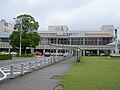
Nishio City in Japan34.862°N 137.062°E
TokyoNishio City
Nishio Station
西尾駅2005
  • to NagoyaMeitetsu express52min

Travel times follow 名古屋鉄道『路線別時刻表(2026.3.14からの時刻表)』の PDF。西尾線・蒲郡線の下り(蒲郡→西尾→新安城)・上り(新安城→西尾→蒲郡)と、名古屋本線の下り(豊橋→名鉄名古屋→名鉄岐阜)・上り(名鉄岐阜→名鉄名古屋→豊橋)の、平日・土休日の4組を pdftotext の座標で読み、同じ列車の新安城の時刻でつないで『名鉄名古屋発→西尾着』『西尾発→名鉄名古屋着』を数えた (checked 2026-10-19). They vary by time of day.

Shape

Borders 5 municipalities.

Territory of Nishio City
Boundaries: National Land Numerical Information (N03)

North to south

22.2km

幸田町, 安城市, 岡崎市, 碧南市, 蒲郡市

Nishio City isthis kind of town.

  1. 01The Great Shii of Shinmeisha is an old sudajii (Castanopsis sieboldii, also called itajii) in front of the worship hall of Shinmeisha Shrine, and a National Natural Monument. The city's cultural property page records that the main trunk is dead and that two branch trunks about 1 m around at chest height, and the sprouts around them, thrive
  2. 02The Shoboji Tumulus, a National Historic Site, is a keyhole-shaped mound about 94 m long. Among the city-designated historic sites are the Birthplace of the Imagawa Clan, where a second son of the lord of the Kira estate is said to have taken the name Imagawa from the place, and the Mica Mine of Mount Yatsuomote, where one mining pit remains and from whose mica the Kira estate is said to take its name
  3. 03On Sakushima in Mikawa Bay is the city-designated Sakushima Ancient Salt-making Site, where many stems of salt-making pottery from the Kofun to Nara periods have been found. The Koganezutsumi embankment is said by tradition to have been built in a single night by Kira Kozukenosuke with his people, and the tourist association presents it as a cherry blossom spot

See the town as it is now.

Source: Wikidata (P2002, P2003, P2013, P2397)

If something caught your eye, ask the town itself.