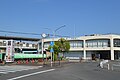
Tsushima Tennogawa Park 2021-06 ac (1).jpg
Article

23208 / つしまし

Aichi Prefecture

Tsushima City

A river through town survives as a pond.

Maruike, Tennogawa Park

Photo by Asturio Cantabrio (CC BY-SA 4.0)

01 / Hotta House

A small storehouse linksthe east and west storehouses.

Hotta House 2024-09 ac (2).jpg
Photo by Asturio Cantabrio (CC BY-SA 4.0)

A merchant house made up of a main building and three earthen storehouses, with a small storehouse joining the east storehouse (rice) and the west storehouse (storage). The storehouses lie in a line, reaching from the entrance through the main building's reception rooms, a layout said to be typical of Owari townhouses.

  • Main building and three storehouses
  • Important Cultural Property, 31 May 1978
  • Moved about 60 m west in 1973

02 / Okkan Shrine

A shrine whose deity appears in Montoku Jitsurokumoved when the Kamori post town opened.

Okamu-jinja ac (1).jpg
Photo by Asturio Cantabrio (CC BY-SA 4.0)

The city says a rain-bringing dragon god is enshrined here. The deity Okkan is mentioned in the Montoku Jitsuroku in 853, and the shrine stood in Kita-Kamori Village. When the Kamori post town opened in 1647, the village moved, and the shrine reached its present site in 1648.

  • Deity mentioned in Montoku Jitsuroku, 853
  • Kamori post town opened 1647
  • Moved to present site 1648

03 / Juo-do

Of the Juo halls at the four sides of Tsushima Village,only the one at Imaichiba remains.

In the Edo period, Juo halls stood at Imaichiba, Hashizume, Shimokamae and Kitaguchi, on the four sides of Tsushima Village. Only the Imaichiba hall survives. The Juo statues of Kitaguchi are kept at Dairyuji and those of Hashizume at Saihoji. The statues and paintings are city cultural properties.

  • Four halls in the Edo period
  • One survives, at Imaichiba
  • Statues and paintings: city cultural properties

Living here

Nagoya in 23 minutes by Meitetsu express.

  • about 60,000 people
  • 30 min to a city centre

Tsushima Station on the Meitetsu Tsushima Line is 23 minutes from Meitetsu Nagoya with no transfer, at the fastest (timetable revised 14 March 2026; the 0:01 departure). Daytime semi-express trains take 26 minutes. The city's guide (updated 7 September 2021) says about 22 minutes by semi-express and about 33 by local. City Hall is about 800 m straight east of Tsushima Station.

People living here
60,942people
19952020

−3.9% since 2015

63,723 → 60,942

Area
25.09km²

25.09km² of it habitable

2024

Households
24,258households

2.5 people per household

2020

Rent (average for rentals)
44,548yen

National average 60,630 yen

2023

Healthcare
4 hospitals / 55 clinics

9.7 per 10,000 people

2023

Almost entirely flat.Almost all of it is habitable land (100.0%)
Area and habitable land at the same scalee-Stat B1101 / B1103
Children waiting for childcare
—12 nurseries and similar
Home purchase subsidy
—
Average annual temperature
—

These 3 items are waiting on a nationwide data source. We do not fill them with estimates.

ACCESS

Where you can go from here.

Tsushima City in Japan35.177°N 136.741°E
TokyoTsushima City
Tsushima Station
津島駅2021
  • to NagoyaMeitetsu express23min

Travel times follow 名古屋鉄道『路線別時刻表 津島線』PDF(2026年3月14日改正。平日の下り『20260314_TB_W1.pdf』・上り『20260314_TB_W2.pdf』、土・休日の下り『20260314_TB_H1.pdf』・上り『20260314_TB_H2.pdf』。https://www.meitetsu.co.jp/train/timetable/index.html の『津島線』の4本)。名鉄名古屋の発時刻と津島の着時刻(上りは津島の発時刻と名鉄名古屋の着時刻)を、列ごとに差し引いて数えた。津島市公式『津島までのアクセス』(最終更新日 2021年9月7日) (checked 2026-10-19). They vary by time of day.

Shape

Borders 3 municipalities.

Territory of Tsushima City
Boundaries: National Land Numerical Information (N03)

North to south

7.4km

愛西市, あま市, 蟹江町

Tsushima City isthis kind of town.

  1. 01Maruike is what remains in Tennogawa Park of the Tennogawa River, which ran through the middle of the town until the Edo period; the stage of the Owari Tsushima Tennosai festival is now this pond. The evening-festival boats carry 365 lanterns, one for each day of the year
  2. 02Hotta House is a merchant house of a main building and three earthen storehouses, designated an Important Cultural Property in 1978. Okkan Shrine is mentioned in the Montoku Jitsuroku in 853 and moved to its present site in 1648 with the opening of the Kamori post town
  3. 03The Juo hall at Imaichiba is the one survivor of four built around Tsushima Village. The city introduces the main hall and tower gate of Tsushima Shrine as Important Cultural Properties, and an old muku tree still stands at the Kamori milestone site on the Saya Road

See the town as it is now.

Source: Wikidata (P2002, P2003, P2013, P2397)

If something caught your eye, ask the town itself.