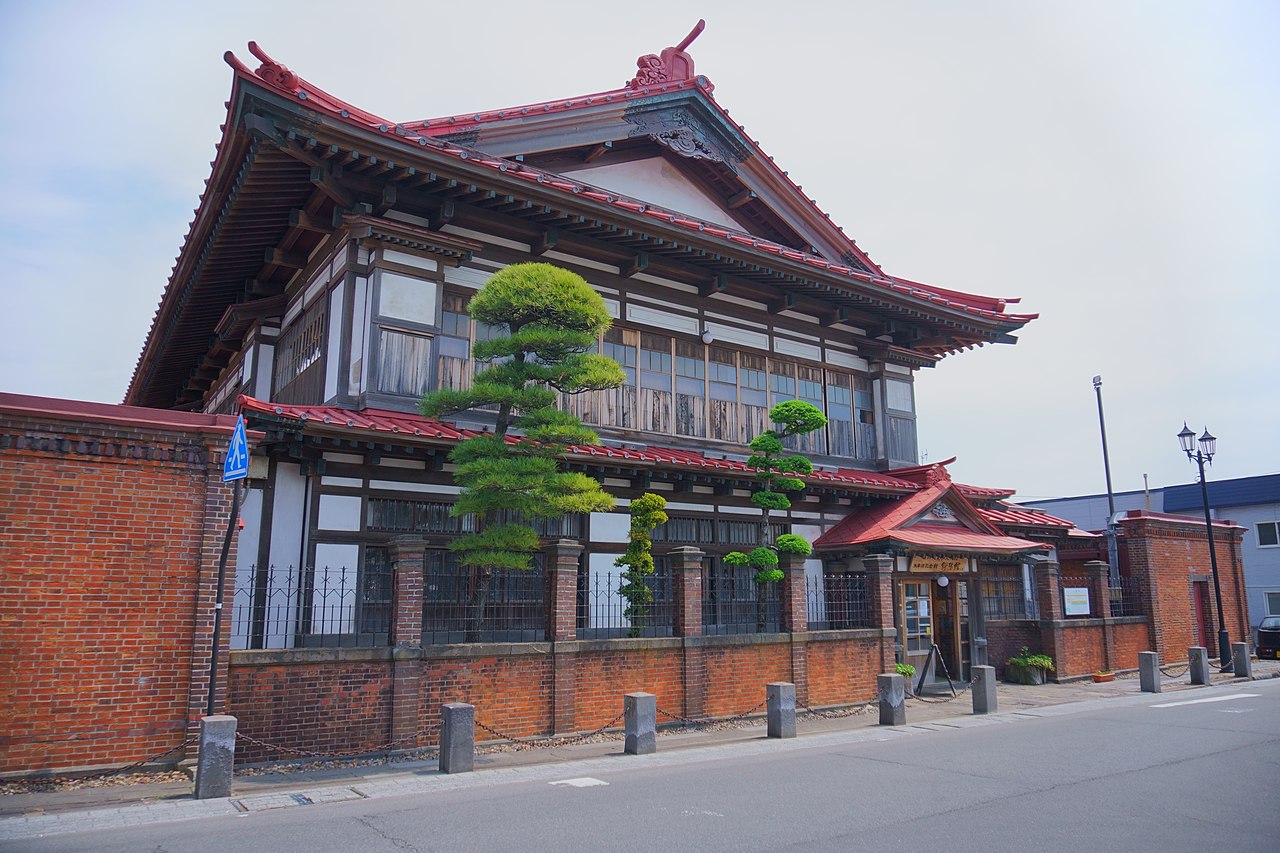
Former Hirayama Residence, Goshogawara City
Article

02205 / ごしょがわらし

Aomori Prefecture

Goshogawara City

Home of rich farmers who also served as headmen.

Former Hirayama Residence

Photo by 午前四時 (CC0)

01 / Kiln site

Most of the pottery bears letters or marksincised with a spatula.

The Agency for Cultural Affairs describes the Goshogawara Sue Pottery Kiln Site as about 50 Heian-period kilns scattered over hills at the northeast edge of the Tsugaru Plain. Most of the vessels carry letters or marks incised with a spatula, such as the characters for god, six and thousand.

  • National Historic Site, 2004
  • About 50 kilns scattered (Agency for Cultural Affairs)
  • In operation roughly from the late 9th to late 10th century
02 / Residence

A residence that follows the Tsugaru townhouse formand adds Western-style design.

Residence in Goshogawara City
Photo by 掬茶 (CC BY-SA 4.0)

The Agency for Cultural Affairs describes the Former Tsushima Residence as following the traditional townhouse form of the Tsugaru region while introducing Western-style design. The main house was raised in 1907 and has a Western-style reception room upstairs; a brick wall runs along the front. Osamu Dazai was born here.

  • Important Cultural Property, 2004
  • Main house: framework raised in 1907
  • Brick wall: about 61.9 m north, about 42.6 m south

03 / Port site

On a sandbar between Lake Jusan and a lagoon,a port was run from the 13th to the 15th century.

Port site in Goshogawara City
Photo by Thirteen-fri (CC BY-SA 3.0)

The Agency for Cultural Affairs describes the Tosaminato Site as a medieval site on the sandbar tip at the west shore of Lake Jusan. It measures about 2 km north to south and up to 500 m east to west. A large earthwork divides the central area, and the north side is presumed to have been a residential area for the lord and his circle.

  • National Historic Site, 2005
  • About 2 km north-south, up to 500 m east-west
  • Active from the early 13th to late 15th century

Goshogawara City from the sky

Now and 1974–78. Tap a photo to zoom in.

Wide (about 6 km across)

Close (about 1.5 km across)

Now (shot June–August 2014)Shot 1974–78

Source: Geospatial Information Authority of Japan (GSI) GSI Tiles(全国最新写真(シームレス)/国土画像情報(第一期:1974〜1978年撮影))

Open in GSI Maps (now)Open in GSI Maps (1974–78)

Living here

About an hour from Shin-Aomori with a change of trains.

  • about 50,000 people

The city tourism site gives about 3 hours from Tokyo to Shin-Aomori on the Tohoku Shinkansen, then about 1 hour to Goshogawara changing between the Ou Main Line and the Gono Line (transfer time not included). From Akita, it is the Ou Main Line to Hirosaki and then about 40 minutes on the Gono Line.

People living here
51,415people
20052020

−6.8% since 2015

62,181 → 51,415

Area
404.2km²

171.08km² of it habitable

2024

Households
20,908households

2.5 people per household

2020

Rent (average for rentals)
36,017yen

National average 60,630 yen

2023

Healthcare
6 hospitals / 41 clinics

9.1 per 10,000 people

2023

Area404.2km²Habitable land171.08km² / 42%
Area and habitable land at the same scalee-Stat B1101 / B1103

Population from 2005 onward (municipal boundary changed).2005-03-28 に合併。2005年調査から市域が変わっている。

Children waiting for childcare
—21 nurseries and similar
Home purchase subsidy
—
Average annual temperature
—

These 3 items are waiting on a nationwide data source. We do not fill them with estimates.

Shape

Borders 8 municipalities.

Goshogawara City in Japan40.808°N 140.446°E
TokyoOsakaGoshogawara City
Territory of Goshogawara City
Boundaries: National Land Numerical Information (Administrative Area Data), MLIT. Processed by Machigatari.Lakes: National Land Numerical Information (Lake Data), MLIT. Processed by Machigatari. Prepared with the approval of the Director-General of the Geospatial Information Authority of Japan, using its Digital Map 25000 (Spatial Data Framework) and Digital Map 25000 (Place Names and Public Facilities). (承認番号 平27情使、第585号)

North to south

44.3km

Travel times per leg are not published by the municipality, so they are not shown.

Goshogawara City isthis kind of town.

  1. 01The Former Hirayama Residence belonged to a wealthy farming family that served as a chief village headman, and the Agency for Cultural Affairs notes that its main house has a front 17 ken wide including the earth-floored area; the main house dates from 1769 and it has been an Important Cultural Property since 1978
  2. 02At the Goshogawara Sue Pottery Kiln Site, a National Historic Site, most of the vessels carry incised letters or marks; the Former Tsushima Residence adds Western-style design to the Tsugaru townhouse form, and its main house was raised in 1907
  3. 03The Tosaminato Site is a National Historic Site: a medieval port on the sandbar at the west shore of Lake Jusan, active from the early 13th to late 15th century; the city tourism site gives about an hour from Shin-Aomori with a change of trains

If something caught your eye, ask the town itself.

From this town's themes