Nojimazaki Lighthouse, Minamiboso City
Article

12234 / みなみぼうそうし

Chiba Prefecture

Minamiboso City

An octagonal tower, a round lamp room.

Nojimazaki Lighthouse

Photo by Ucheniitza (CC BY-SA 4.0)

01 / Picture scroll

Only the last Tenjin scrollis on local handmade paper.

Picture scroll in Minamiboso City
Photo by Koda6029 (CC BY-SA 4.0)

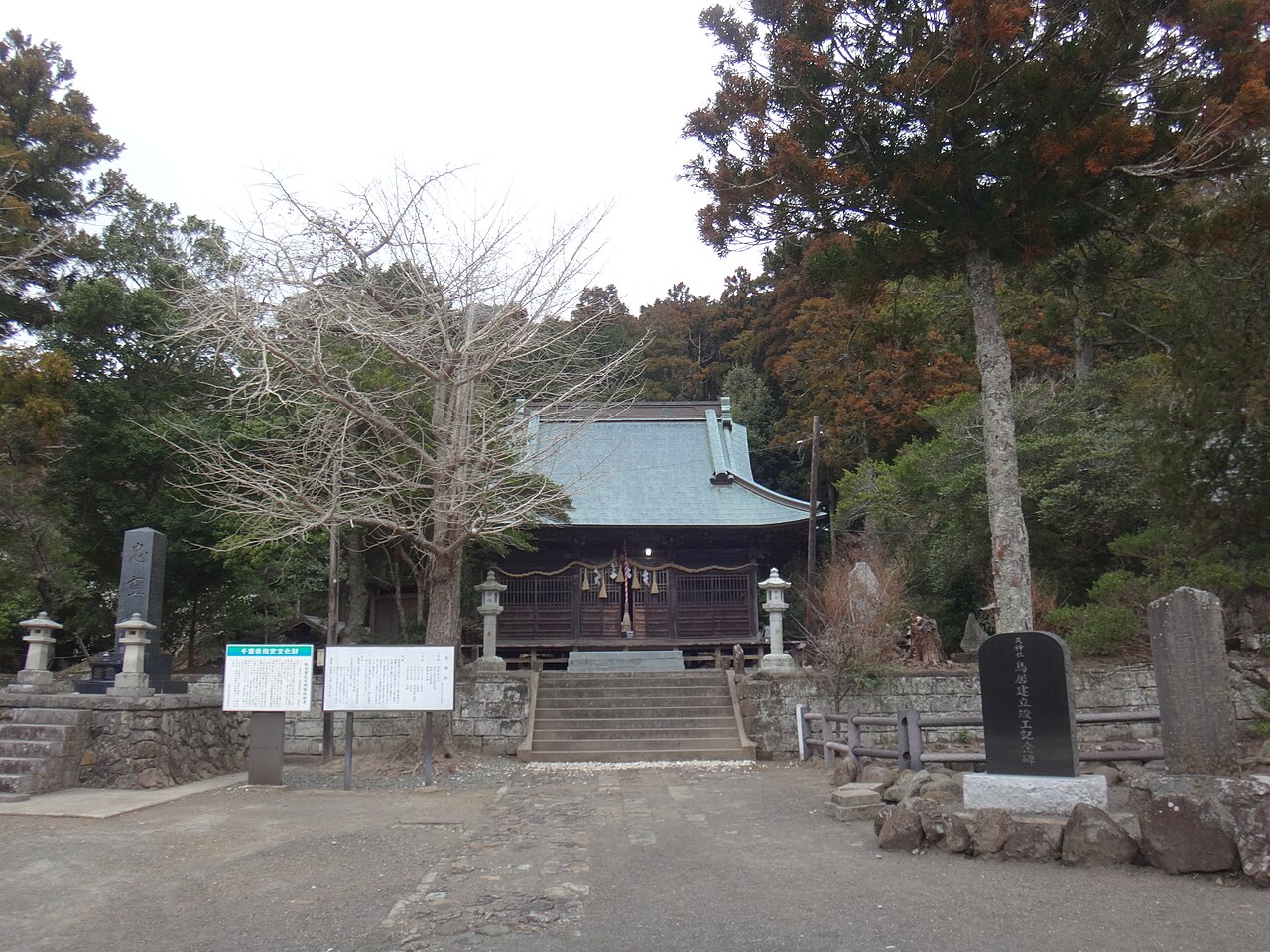
Three Tenjin engi scrolls are held by a Tenjin shrine in Minamiboso. The first two use hishi paper made mainly from gampi; the last uses local paper, handmade from kozo and mitsumata and produced here until about the Taisho era.

  • Prefectural Tangible Cultural Property (painting)
  • Three scrolls
  • Last scroll on local paper

02 / Farmhouse

Ink inscriptions on a pillardated it to the Kyoho 13 era.

A large farmhouse of the Awa region, designated an Important Cultural Property. The main house and the earthen-floor building stand as separate structures, and a 1971-72 dismantling survey found ink inscriptions on a pillar. The prefecture notes that an L-shaped “ima” room is rare in Chiba.

  • Built in Kyoho 13 (1728)
  • Important Cultural Property (1969)
  • Moved to Ishido-ji Temple grounds

03 / Festival

A boys’ Sanbaso danceis followed by girls’ Hanaodori.

Festival in Minamiboso City
Photo by Towacoco (CC BY-SA 4.0)

Performed at the festival of Kamo Shrine held each August, called Hassaku Matsuri. In the Kamo Sanbaso, boys play the three roles of Chitose, Okina and Sanbaso; in the Kamo Hanaodori, eight girls dance in white robes and scarlet hakama. Both are Prefectural Intangible Folk Cultural Properties.

  • Hassaku Matsuri, each August
  • Three boys’ roles in Sanbaso
  • Eight girls, five dances

Minamiboso City from the sky

Now and 1974–78. Tap a photo to zoom in.

Wide (about 6 km across)

Close (about 1.5 km across)

2017 (shot FY2017)Shot 1974–78

Source: Geospatial Information Authority of Japan (GSI) GSI Tiles(年度別空中写真(2017年度)/国土画像情報(第一期:1974〜1978年撮影))

Open in GSI Maps (now)Open in GSI Maps (1974–78)

Living here

97 minutes from Tokyo Station by highway bus.

  • about 40,000 people
  • 2 hours to a city centre

The city’s gateway is Tomiura Station on the Uchibo Line. The Boso Nanohana bus leaves the Yaesu South Exit of Tokyo Station at 6:20 and reaches the Tomiura Biwa Club stop at 7:57. From Busta Shinjuku, the Shinjuku Nanohana takes 107 minutes. Counted from the timetable revised on 12 December 2025, for buses running every day.

People living here
35,831people
2010

−8.2% since 2015

42,104 → 35,831

Area
229.55km²

106.47km² of it habitable

2024

Households
14,720households

2.4 people per household

2020

Rent (average for rentals)
42,049yen

National average 60,630 yen

2023

Healthcare
3 hospitals / 23 clinics

7.3 per 10,000 people

2023

Area229.55km²Habitable land106.47km² / 46%
Area and habitable land at the same scalee-Stat B1101 / B1103
Children waiting for childcare
—8 nurseries and similar
Home purchase subsidy
—
Average annual temperature
—

These 3 items are waiting on a nationwide data source. We do not fill them with estimates.

ACCESS

Where you can go from here.

Minamiboso City in Japan35.043°N 139.840°E
OsakaMinamiboso City
Tomiura Station
富浦駅2022
  • to TokyoHighway bus97min
  • to ShinjukuHighway bus107min

Travel times follow 日東交通・ジェイアールバス関東の共同運行。『房総なのはな号』時刻表(2025年12月12日改正・【全日】)の下り:東京駅八重洲南口 6:20 発 → とみうら枇杷倶楽部 7:57 着=97分(毎日運転の最速)。『新宿なのはな号』時刻表(同改正・全日)の下り:バスタ新宿 8:50 発 → とみうら枇杷倶楽部 10:37 着=107分(全便が同じ所要) (checked 2026-10-22). They vary by time of day.

Shape

Borders 3 municipalities.

Territory of Minamiboso City
Boundaries: National Land Numerical Information (Administrative Area Data), MLIT. Processed by Machigatari.Lakes: National Land Numerical Information (Lake Data), MLIT. Processed by Machigatari. Prepared with the approval of the Director-General of the Geospatial Information Authority of Japan, using its Digital Map 25000 (Spatial Data Framework) and Digital Map 25000 (Place Names and Public Facilities). (承認番号 平27情使、第585号)

Minamiboso City isthis kind of town.

  1. 01Nojimazaki Lighthouse has an octagonal tower and a round lamp room, and is a Registered Tangible Cultural Property
  2. 02Of the three Tenjin scrolls, only the last is on local handmade paper
  3. 03An Important Cultural Property farmhouse, and the Sanbaso and Hanaodori of Kamo Shrine

See the town as it is now.

Source: Wikidata (P2002, P2003, P2013, P2397)

If something caught your eye, ask the town itself.