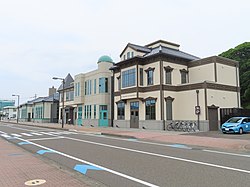
学校給食用漆器.jpg
Article

18207 / さばえし

Fukui Prefecture

Sabae City

School lunch here comes in lacquerware.

Echizen lacquerware lunches

Photo by 漱石の猫 (CC BY-SA 4.0)

01 / Kyōyōkei

The lord took up a hoe himselfand opened a garden to his people.

Nishiyama Park.JPG
Photo by Tomomori (CC BY-SA 3.0)

Manabe Akikatsu (間部詮勝), seventh lord of the Sabae domain, became a senior councillor (rōjū) in 1840 and was allowed to build a castle, with 5,000 ryō granted by the shogunate, but Sabae Castle was never built. In 1856 Akikatsu took up a spade and hoe himself to lay out a garden on a hill as a place of rest for the people of his domain, and named it Kyōyōkei (嚮陽渓). It is today's Nishiyama Park, one of Japan's 100 Historic Parks.

  • Kyōyōkei, 1856
  • 5,000 ryō for a castle
  • 100 Historic Parks of Japan

02 / Head temples

Of the ten Shin Buddhist head temples,two stand in the same city.

Jyoshoji Temple.JPG
Photo by 藤谷良秀 (CC BY-SA 3.0)

Of the ten branches of Shin Buddhism that honour Shinran as their founder, two have their head temples in Sabae: Jōshō-ji (誠照寺) of the Jōshōji branch and Shōjō-ji (證誠寺) of the Yamamoto branch. The town of Sabae grew up as the temple town of Jōshō-ji, also called the "Sabae head temple". Its Founder's Hall, rebuilt in 1877, is 30.12 m wide, and in 2024 it and the Amida Hall were designated prefectural cultural properties.

  • 2 of the 10 head temples
  • Founder's Hall 30.12 m wide
  • Prefectural designation, 2024

03 / Yuton

A summer mat of layered paper,now made by one shop in all Japan.

Yuton (油団) is a summer mat laid over tatami, made of layered washi paper whose surface is coated with perilla oil. Thirteen to fifteen sheets of washi are pasted onto the back of a torinoko paper face, each beaten in with a brush, then coated with persimmon tannin and oil and left to rest for about a month. A mat is said to last 70 to 100 years. Today a single mounting shop in Tamura-chō (田村町), Sabae, is the only maker in Japan.

  • 13 to 15 sheets of washi
  • The only maker in Japan
  • Prefectural intangible folk property, 2014

Living here

Two rail lines cross the city: Hapi-Line Fukui and Fukui Railway.

  • about 70,000 people

The city is served by Sabae and Kita-Sabae stations on the Hapi-Line Fukui and by the Fukui Railway, and the city says Sabae Station is 15 minutes from Fukui Station. From fiscal 2001 the Echizen lacquerware cooperative in Kawada (河和田) developed wooden lacquered bowls that survive dishwashers. Two elementary schools adopted them in 2004, and today every elementary school in the city uses lacquerware for school lunch.

People living here
68,302people
19952020

0% since 2015

62,890 → 68,302

Area
84.59km²

53.11km² of it habitable

2024

Households
23,915households

2.9 people per household

2020

Rent (average for rentals)
52,518yen

National average 60,630 yen

2023

Healthcare
7 hospitals / 39 clinics

6.7 per 10,000 people

2023

Area84.59km²Habitable land53.11km² / 63%
Area and habitable land at the same scalee-Stat B1101 / B1103
Children waiting for childcare
—21 nurseries and similar
Home purchase subsidy
—
Average annual temperature
—

These 3 items are waiting on a nationwide data source. We do not fill them with estimates.

Shape

Borders 3 municipalities.

Sabae City in Japan35.956°N 136.184°E
TokyoSabae City
Territory of Sabae City
Boundaries: National Land Numerical Information (N03)

North to south

8.3km

福井市, 越前市, 越前町

Travel times per leg are not published by the municipality, so they are not shown.

Sabae City isthis kind of town.

  1. 01A centre of Echizen lacquerware, where a Katayama lacquerer is said to have repaired Emperor Keitai's crown, it serves lunch from lacquerware at every elementary school
  2. 02It has the garden that former senior councillor Manabe Akikatsu dug himself and opened to his people (now Nishiyama Park), and two of the ten Shin Buddhist head temples
  3. 03It has Japan's only maker of yuton paper mats, and is the "town of eyeglasses", with eyeglasses, textiles and lacquerware as its three local industries

See the town as it is now.

Source: Wikidata (P2002, P2003, P2013, P2397)

If something caught your eye, ask the town itself.