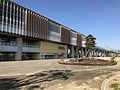
Funagoya Mineral spring place.jpg
Article

40211 / ちくごし

Fukuoka Prefecture

Chikugo City

Sparrows over the spring often fell.

Funagoya Kosen-jo, Suzume-jigoku

Photo by Kotaro (CC BY-SA 4.0)

01 / Sanshika (山梔窩)

Confined here for 9 years and 9 months,Maki Izumi-no-kami devoted himself to teaching.

Sanshika in Chikugo.jpg
Photo by Peka (CC BY-SA 4.0)

A single-storey wooden building in Mizuta. Maki Izumi-no-kami Yasuomi, confined after failing in the reform of the Kurume domain, taught disciples here until he escaped to Satsuma without the domain's permission in February 1862. The name is said to come from the gardenias (kuchinashi) in the garden, or from the word kuchinashi (口なし, "without a mouth").

  • Prefectural Historic Site (Showa 44, 1969)
  • Confined for 9 years and 9 months
  • Free admission

02 / Mizoguchi Kiseru Festival (溝口のきせる祭り)

Following the tale of a castle lord who fled,people smoke tobacco from bamboo tubes.

Held every December 13 at Kamado Shrine (竈門神社) in Mizoguchi. It follows a tale from 1578 (Tensho 6): Mizoguchi Masashige, lord of Mizoguchi Castle, was attacked by Ryuzoji Takanobu and driven from his castle, hid in a bamboo grove, and used green bamboo packed with tobacco in place of a kiseru pipe. Worshippers also smoke chopped tobacco in green bamboo about 30 cm long.

  • Every December 13
  • The tale of 1578 (Tensho 6)
  • Open to worshippers

03 / Kumano Shrine's Spectacle Bridge and Oni no Shujoe (熊野神社の眼鏡橋と鬼の修正会)

A stone spectacle bridge spans the pond,and in January three great torches are hauled.

Stone arch bridge of Kumano Shrine, Chikugo.jpg
Photo by Peka (CC BY-SA 4.0)

A prefecturally designated stone spectacle bridge (眼鏡橋) spans the pond on the approach to Kumano Shrine. In the prefecturally designated Oni no Shujoe and Tsuinasai (鬼の修正会・追儺祭, also called Oniyosai), 300 young men haul three great torches, each 13 m long and weighing 500 kg, and circle the shrine hall three times. The tourism association announces the next one for Saturday, January 9, 2027.

  • Spectacle bridge: prefectural tangible cultural property
  • Great torches: 13 m long, 500 kg
  • Next: Saturday, January 9, 2027

Living here

At the centre of the nearly flat Chikugo Plain, with three stations.

  • about 50,000 people
  • Shinkansen stops here

Chikugo lies in the centre of the Chikugo Plain in south-western Fukuoka Prefecture, bordering Kurume to the north, Yame to the east, Miyama to the south and Oki to the west. The land is almost flat; the Yabe River runs through the south and a creek district spreads across the south-west. The city has three JR stations: Nishimuta, Hainuzuka and Chikugo-Funagoya.

People living here
48,827people
19952020

+1% since 2015

45,289 → 48,827

Area
41.78km²

41.71km² of it habitable

2024

Households
18,752households

2.6 people per household

2020

Rent (average for rentals)
48,599yen

National average 60,630 yen

2023

Healthcare
2 hospitals / 50 clinics

10.6 per 10,000 people

2023

Almost entirely flat.Almost all of it is habitable land (99.8%)
Area and habitable land at the same scalee-Stat B1101 / B1103
Children waiting for childcare
—14 nurseries and similar
Home purchase subsidy
—
Average annual temperature
—

These 3 items are waiting on a nationwide data source. We do not fill them with estimates.

ACCESS

Where you can go from here.

Chikugo City in Japan33.212°N 130.502°E
TokyoOsakaChikugo City
Chikugo-Funagoya Station
筑後船小屋駅2016
  • to OsakaSanyo-Kyushu Shinkansen186min

Travel times follow JR西日本「JRおでかけネット」区間時刻表『東海道・山陽・九州新幹線(東京~博多~鹿児島中央)』(https://timetable.jr-odekake.net/line-timetable/1796)から本体が2026-09-29に保存した下りの表($SP/jr-shinkansen-down-20260929.json)で、新大阪『発』→筑後船小屋『発』を数えた:さくら769号 新大阪18:20発→筑後船小屋21:26発=3時間6分=186分(さくら773号 20:20→23:26発も186分)。九州新幹線区間の駅は表に『着』の行が無いので『発』の時刻で数えた(停車時間ぶん長く出る)。運転日注意の欄は空。乗り換えなしで市内の筑後船小屋駅に着く (checked 2026-09-30). They vary by time of day.

Shape

Borders 6 municipalities.

Territory of Chikugo City
Boundaries: National Land Numerical Information (N03)

North to south

9.3km

八女市, 久留米市, みやま市, 広川町, 大木町, 柳川市

Chikugo City isthis kind of town.

  1. 01The Funagoya Mineral Spring House (船小屋鉱泉場) is in Funagoya, Chikugo. The city records that it was a place where sparrows flying over the bubbling spring water often fell, so that it was called Suzume-jigoku ("Sparrow Hell", 雀地獄) and feared, and that a well there was completed in 1824 (Bunsei 7). The present building was newly built next to the old one in 1990 (Heisei 2); the carbonated water can be drunk, or taken home, free of charge.
  2. 02On August 14 the Hisatomi Bon-tsuna-hiki (久富の盆綱曳き) is held, a prefecturally designated Intangible Folk Cultural Property. The thousand-lamp festival (千燈明) of Kamado Shrine, a city-designated Intangible Folk Cultural Property, is held two days before Respect for the Aged Day. In Tsushima stands the memorial tower of the Edo-period sumo wrestler Akitsushima Namiemon (秋津嶋浪右衛門), and Masuda Sohei (益田素平) worked out a stubble-burning method of pest control and devised a tool called the kaburikiri (かぶきり).
  3. 03The name Hainuzuka comes from the legend of the winged dog (羽犬), and a mound remains at Sogaku-ji (宗岳寺) temple. Hainuzuka Rokusho Shrine (羽犬塚六所宮) enshrines a pair of Ebisu statues, and together with Koinoki Shrine (恋木神社) the city uses "the land of love" (恋のくに) as its tourism slogan. The Funagoya Genji firefly habitat is a national Natural Monument, and the farm-team base of the Fukuoka SoftBank Hawks has been in Chikugo since 2016.

See the town as it is now.

Source: Wikidata (P2002, P2003, P2013, P2397)

If something caught your eye, ask the town itself.