Fuyu-gaki genboku.jpg
Article

21216 / みずほし

Gifu Prefecture

Mizuho City

A persimmon in Ikura was named in 1892.

Fuyu mother tree, Ikura

Photo by by Monado (CC BY-SA 3.0)

01 / Mieji-juku site

Mieji Temple was moved to Gifu in the Sengoku period,yet its name stayed on as the post town's place name.

Mieji-juku Ato2008-1.jpg
Photo by Monami (CC BY-SA 3.0)

This small post town was the 55th of the 69 on the Nakasendo. Mieji Temple (Mieji Kannon) once stood here, and in the Sengoku period it was moved to Gifu by Saito Dosan. The road bends at a right angle in front of Mieji Shrine, and in 1984 a monument marking the site of Mieji-juku on the Nakasendo was erected in its grounds.

  • 55th of the 69 Nakasendo post towns
  • Honjin and ichirizuka sites are City Historic Sites
  • 1984: monument to the post town site erected

02 / Ikuragawa no Miya site

The Yamatohime-no-mikoto Seiki has passages to the effect thatAmaterasu was enshrined four years at Ikuragawa no Miya in Mino.

Tenjin jinja2007-2.jpg
Photo by Monami (CC BY-SA 3.0)

The city explains that Tenjin Shrine in Ikura stands on the site of Ikuragawa no Miya, and that its grounds hold Mifunashiro-ishi, stones regarded as an ancient ritual site. The Kotaijingu Gishikicho lists "Ikuragawa no Miya in Mino" among the places to which Kotaijingu moved. In 1849, part of a Kofun-period mirror with divine beasts was unearthed from the off-limits sacred ground.

  • City Historic Site
  • Mifunashiro-ishi
  • 1849: part of a divine-beast mirror unearthed

03 / Ushiki Lock

Weathered granite mixed with lime and pounded hard,faced with natural stones: a sluice gate.

This sluice gate on the Goroku River keeps backwater from downstream out of the Ushiki waju, a ring-dike settlement. Built in 1907 (Meiji 40) by the jinzoseki (artificial stone) method, which applies the plasterers' technique "tataki" to large civil works, it is faced with natural stones. In fiscal 2020 it was chosen as a Selected Civil Engineering Heritage by the Japan Society of Civil Engineers.

  • Completed 1907 (Meiji 40)
  • Jinzoseki (artificial stone) method
  • Selected Civil Engineering Heritage, FY2020

Living here

Between Gifu and Ogaki, 26 minutes from Nagoya.

  • about 60,000 people
  • 30 min to a city centre

In the northwest of the Nobi Plain, between Gifu City and Ogaki City, this is a riverside district of ring dikes (waju), with the Nagara River to the east and the Ibi River to the west. The city was formed in May 2003 by the merger of the towns of Hozumi and Sunami. Its area is 28.19 km². From JR Hozumi Station, the gateway, Nagoya is 26 minutes by the fastest timetable service.

People living here
56,388people
20052020

+3.7% since 2015

50,009 → 56,388

Area
28.19km²

28.19km² of it habitable

2024

Households
22,502households

2.5 people per household

2020

Rent (average for rentals)
48,568yen

National average 60,630 yen

2023

Healthcare
0 hospitals / 35 clinics

6.2 per 10,000 people

2023

Almost entirely flat.Almost all of it is habitable land (100.0%)
Area and habitable land at the same scalee-Stat B1101 / B1103
Children waiting for childcare
—10 nurseries and similar
Home purchase subsidy
—
Average annual temperature
—

These 3 items are waiting on a nationwide data source. We do not fill them with estimates.

ACCESS

Where you can go from here.

Mizuho City in Japan35.392°N 136.691°E
TokyoMizuho City
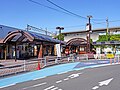
Hozumi Station
穂積駅2022
  • to NagoyaJR Tōkaidō Main Line26min

Travel times follow JR東海『各駅の時刻表』穂積駅(東海道線 平日・休日 上り下り。2026年3月版のPDF)で停車種別を確かめ、所要分は Yahoo!路線情報(JRの時刻データによる乗換案内)の 2026-10-16〜19 の検索で数えた (checked 2026-10-15). They vary by time of day.

Shape

Borders 7 municipalities.

Territory of Mizuho City
Boundaries: National Land Numerical Information (N03)

North to south

6.9km

岐阜市, 本巣市, 大垣市, 安八町, 大野町, 神戸町, 北方町

Mizuho City isthis kind of town.

  1. 01The mother tree of the Fuyu persimmon in Ikura is a City Natural Monument. The city says Fukushima Saiji of Ikura obtained scions from the best of the local Ikura Gosho trees, multiplied them, and named the variety Fuyu in 1892 (Meiji 25); the city's contributed essay traces the name to the phrase "fuyu shikai no uchi" in the Chinese classic the Doctrine of the Mean
  2. 02Mieji-juku was the 55th of the 69 Nakasendo post towns, and the sites of its honjin and ichirizuka are City Historic Sites. Ozukoen in Roku was completed in 1929 (Showa 4) to commemorate the poem Princess Kazunomiya composed while crossing the Roku River by boat, the city says
  3. 03Of the passages under the JR Tokaido Main Line embankment, called "manpo," seven in the city can be walked through, and in Yokoya there is a "twisted manpo" with bricks laid at a slant. The city introduces the Silkworm Festival of Mieji Kannon, with its float carrying a shojo figure and a divination with a ladle

See the town as it is now.

Source: Wikidata (P2002, P2003, P2013, P2397)

If something caught your eye, ask the town itself.