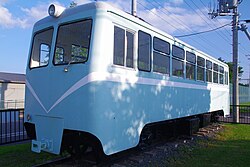
Kofuku Station, old Hiroo Line, Obihiro City
Article

01207 / おびひろし

Hokkaido

Obihiro City

Tickets to Kofuku sold 10 million in four years.

Kofuku Station, old Hiroo Line

Photo by MaedaAkihiko (CC BY-SA 4.0)

01 / Aikoku Station

Hiroo Line's Aikoku Station is nowa museum of tickets and a steam locomotive.

Aikoku Station in Obihiro City
Photo by Rsa (CC BY-SA 3.0)

Aikoku Station is a former Japan National Railways Hiroo Line station. The city says it now serves as a transport museum displaying the tickets, panels and steam locomotive of its day. In front of the station stands a monument shaped like a ticket to Kofuku.

  • Former Hiroo Line station
  • Exhibits in a transport museum
  • Ticket-shaped monument

02 / Tokachi Railway

Tokachi Railway carried sugar beets;its steam locomotive No. 4 survives.

Tokachi Railway in Obihiro City
Photo by 100yen (CC BY-SA 3.0)

The Tokachi Railway opened in 1920 as a private line of Hokkaido Seito to carry sugar beets, the raw material for sugar. Steam locomotive No. 4, a 12-ton C-type tank engine built that year, is the only survivor among its sister engines No. 3 and No. 5. It became a city-designated cultural property in 1994.

  • Built in 1920
  • Only No. 4 survives
  • City cultural property since 1994

03 / Former Futaba Kindergarten

A domed, octagonal play hall ina 1922 Important Cultural Property.

The former Futaba Kindergarten building is a wooden kindergarten said to have been built in 1922 from a design by an educator of the time. An octagonal play hall sits at the center of the square building, with nursery rooms attached on its four sides, and the hall carries a domed roof. It was designated an Important Cultural Property in 2017.

  • 1922
  • Octagonal play hall
  • Important Cultural Property since 2017

Obihiro City from the sky

Now and 1974–78. Tap a photo to zoom in.

Wide (about 6 km across)

Close (about 1.5 km across)

Now (shot July–November 2023)Shot 1974–78

Source: Geospatial Information Authority of Japan (GSI) GSI Tiles(全国最新写真(シームレス)/国土画像情報(第一期:1974〜1978年撮影))

Open in GSI Maps (now)Open in GSI Maps (1974–78)

Living here

Roughly the area of Tokyo's 23 wards,with its urban area at the northeast edge.

  • about 170,000 people

According to the city's profile (updated April 9, 2025), the area is 619.34 km², almost the same as Tokyo's 23 wards. The Hidaka Mountains occupy the southwest, and the urban area lies at the northeast edge of the city, next to the Tokachi and Satsunai rivers. The gateway is Obihiro Station.

People living here
166,536people
19952020

−1.6% since 2015

171,715 → 166,536

Area
619.34km²

381.3km² of it habitable

2024

Households
80,175households

2.1 people per household

2020

Rent (average for rentals)
44,615yen

National average 60,630 yen

2023

Healthcare
18 hospitals / 111 clinics

7.7 per 10,000 people

2023

Area619.34km²Habitable land381.3km² / 62%
Area and habitable land at the same scalee-Stat B1101 / B1103
Children waiting for childcare
—31 nurseries and similar
Home purchase subsidy
—
Average annual temperature
—

These 3 items are waiting on a nationwide data source. We do not fill them with estimates.

Shape

Borders 8 municipalities.

Obihiro City in Japan42.924°N 143.196°E
TokyoOsakaObihiro City
Territory of Obihiro City
Boundaries: National Land Numerical Information (Administrative Area Data), MLIT. Processed by Machigatari.Lakes: National Land Numerical Information (Lake Data), MLIT. Processed by Machigatari. Prepared with the approval of the Director-General of the Geospatial Information Authority of Japan, using its Digital Map 25000 (Spatial Data Framework) and Digital Map 25000 (Place Names and Public Facilities). (承認番号 平27情使、第585号)

North to south

37.5km

Travel times per leg are not published by the municipality, so they are not shown.

Obihiro City isthis kind of town.

  1. 01Kofuku Station was a Japan National Railways Hiroo Line station that opened in 1956 and closed with the line in 1987; the city says tickets from Aikoku to Kofuku sold 10 million in four peak years
  2. 02Aikoku Station is now a transport museum displaying tickets, panels and a steam locomotive; Tokachi Railway steam locomotive No. 4, built in 1920, is the only survivor among its sister engines No. 3 and No. 5
  3. 03The former Futaba Kindergarten building is a wooden kindergarten from 1922 with an octagonal play hall under a dome, designated an Important Cultural Property in 2017

See the town as it is now.

Source: Wikidata (P2002, P2003, P2013, P2397)

If something caught your eye, ask the town itself.

From this town's themes