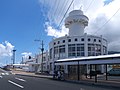
Ushidoko Moisho (Yakushima) 03.jpg
Article

46505 / やくしまちょう

Kagoshima Prefecture 熊毛郡

Yakushima Town

Many pilgrimage stone towers remain.

Ushidoko Moisho, pilgrim stones

Photo by Higa4 (CC0)

01 / Tomari Jochiku

Tomari Jochiku asked to be buried in Anbō,to protect the village from calamity.

Tomari Jochiku was born in Anbō in 1570 and, the explanation carried on the town site says, lived his whole life in a monk's garb. He worked on improving rice cultivation, digging a waterworks canal (the Jochiku Canal), and making yakusugi cedar a tribute. His grave (the Jochiku Mausoleum) is a prefectural Historic Site, and the canal a town-designated one.

  • 1570–1655
  • Grave (Jochiku Mausoleum): prefectural Historic Site
  • Jochiku Canal: town-designated Historic Site

02 / Kosugidani Village Site

Kosugidani was the home of the peoplewho cut yakusugi cedar.

Kosugidani Bridge Anbo Forest Railway.jpg
Photo by KQuhen (CC BY-SA 4.0)

In 1924 Kosugidani was set up on the upper Anbō River as a base for loggers, and an elementary and junior high school were built. The trolley line that carried the timber was built in 1923. The Yakushima Environmental and Cultural Foundation records 133 households and 540 people at the 1960 peak, and a closure in 1970.

  • 1924: set up on the upper Anbō River
  • 1960: 133 households, 540 people
  • Closed in 1970

03 / Hirauchi Undersea Hot Spring

In natural hollows on the shore,hot water wells up from the sea.

Hirauchi kaichu onsen.jpg
Photo by Somey (CC BY 3.0)

A hot spring on the shore of the Hirauchi settlement. The tourism site describes a rare spring that appears only around low tide, twice a day. It has two baths made by lightly shaping natural hollows, and the water is a simple alkaline spring.

  • Shore of Hirauchi settlement
  • Two baths
  • Simple alkaline spring

Living here

110 minutes from Kagoshima by high-speed boat.

  • about 10,000 people
  • Rural district town

Yakushima has no railway; the town's gateway is Miyanoura Port. The direct Tane-Yaku Highspeed Ferry takes 110 minutes from Kagoshima (the operator's timetable, October 2026), and the town site lists flights from Kagoshima at as little as 35 minutes. Kuchinoerabu Island is reached by a town-run ferry.

People living here
11,858people
2010

−8.2% since 2015

13,589 → 11,858

Area
540.45km²

56.68km² of it habitable

2024

Households
5,847households

2.0 people per household

2020

Rent (average for rentals)
—
Healthcare
1 hospital / 11 clinics

10.1 per 10,000 people

2023

Area540.45km²Habitable land56.68km² / 10%
Area and habitable land at the same scalee-Stat B1101 / B1103
Children waiting for childcare
—6 nurseries and similar
Home purchase subsidy
—
Average annual temperature
—

These 3 items are waiting on a nationwide data source. We do not fill them with estimates.

ACCESS

Where you can go from here.

Yakushima Town in Japan30.390°N 130.651°E
TokyoOsakaYakushima Town
Port of Miyanoura
宮之浦港2010
  • to KagoshimaTane-Yaku Highspeed Ferry110min

Travel times follow 島の町の決め(上島町・五島市と同じ。町内の玄関口の港へ乗り換えなしで着く船の起点を都市名に、事業者名だけを mode に)。事業者公式・種子屋久高速船『運賃・時刻表』(https://www.tykousoku.jp/fare_time/ ・2026-10-07 に開いた)の『鹿児島 屋久島』の表のうち、冬ダイヤ(2026年10月1日〜2027年2月28日)にあたる3つ目の表(3つの表は 春夏・夏秋・冬 の順とみて、種子島の表の臨時便の注記〈113便は12/29-30,1/2-3 など〉と照らして決めた)で、鹿児島(鹿児島本港南埠頭)発→屋久島(宮之浦)着の直行は 112便 8:00→9:50 と 117便 13:30→15:20 の2本で、どちらも110分。西之表を経由する便は 111便 7:30→10:20(170分・宮之浦)・127便 13:00→15:30(150分・宮之浦)・114便 10:00→12:40(160分・安房)・118便 14:45→17:20(155分・安房)。春夏・夏秋の表でも直行は 7:45→9:35(110分)/8:00→9:50(110分)・13:35→15:25(110分)で一致するが、春夏の表の112便だけ 7:45→9:45(指宿経由・120分)。**町公式『交通アクセス』(更新2026-03-10・『2026年3月現在』)は『鹿児島⇔屋久島 種子屋久高速船 最短1時間45分・6便』と書き、事業者の表の110分と食い違う**(事業者の表では最短110分・1日6便のうち直行は2本)。事業者の表を採った。表の頭には『(申請中)』の字が残る(ダイヤの認可の表記とみられる。2026-10-07 時点の最新かは事業者に確かめていない)。 (checked 2026-10-07). They vary by time of day.

Shape

Borders 0 municipalities.

Territory of Yakushima Town
Boundaries: National Land Numerical Information (N03)

North to south

29.3km

Yakushima Town isthis kind of town.

  1. 01Ushidoko Moisho in the Miyanoura settlement is a town-designated Historic Site where many old stone towers offered during Takemairi, a mountain pilgrimage, remain; Takemairi is still held in almost every settlement on Yakushima
  2. 02Yakushima was inscribed in 1993 as Japan's first World Natural Heritage site, and Nagata Beach became a Ramsar wetland in 2005; the Nagata settlement has a folk dance said to mimic sea turtles coming ashore, laying eggs and returning to the sea
  3. 03The Kusugawa Bon Dance became a prefectural-designated property in 2024 and is held on August 13 and 15; the habitat of Yakushima kawagoromo, a river plant, is a national Natural Monument

See the town as it is now.

Source: Wikidata (P2002, P2003, P2013, P2397)

If something caught your eye, ask the town itself.