Gion Bridge ac (2).jpg
Article

43215 / あまくさし

Kumamoto Prefecture

Amakusa City

Stone pillars line up in water, 5 by 9.

Gion Bridge, 45 stone pillars

Photo by Asturio Cantabrio (CC BY-SA 4.0)

01 / Sakitsu Kake

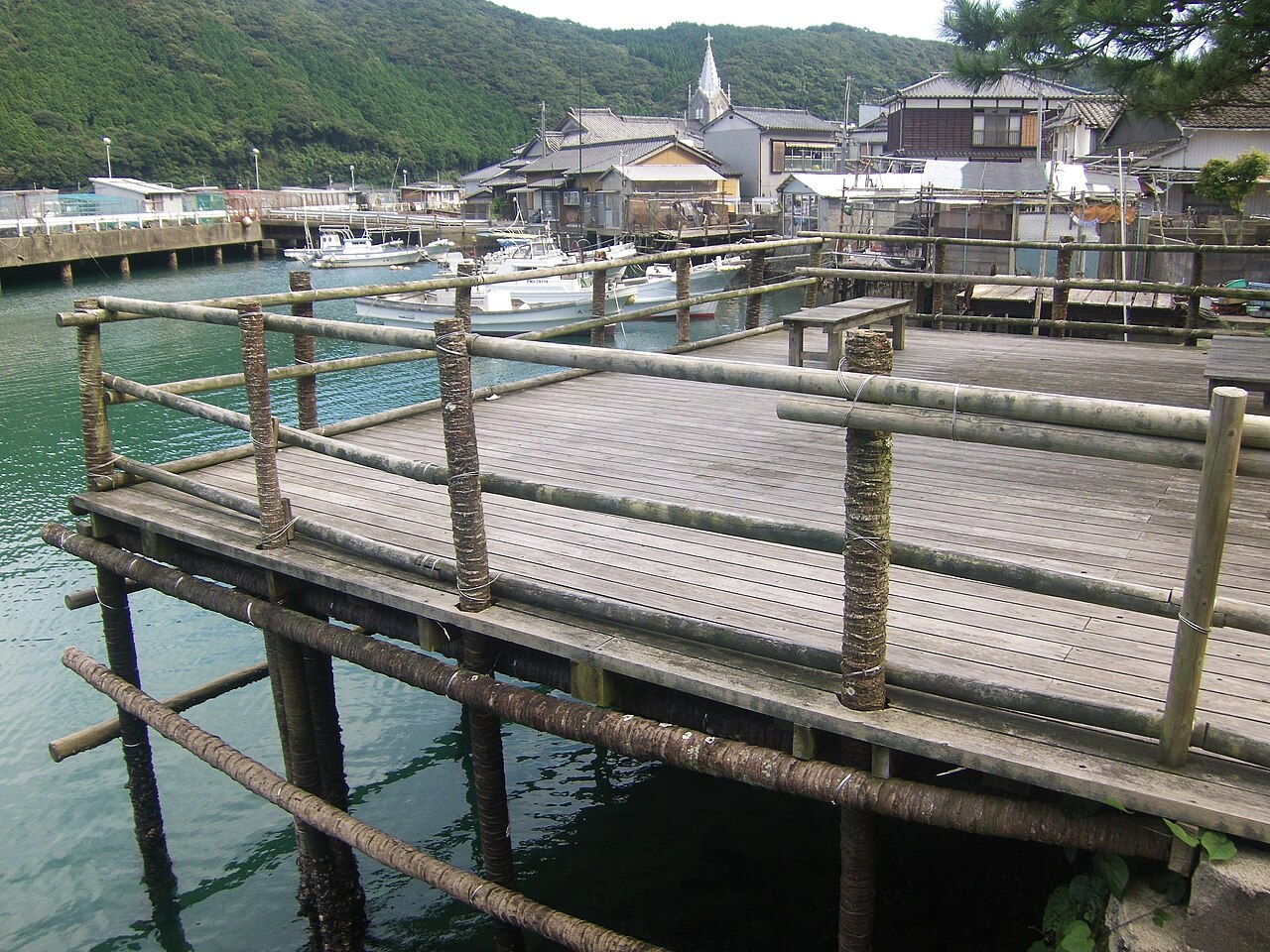
Over the sea, a "kake" of bamboo and palmhas served as a workplace for fishermen.
Sakitsu Smakusa1.JPG
Photo by Indiana jo (CC BY-SA 4.0)

Sakitsu is a harbor settlement in an inlet of Yokaku Bay (羊角湾), with little flat land and densely packed houses. Between the houses, narrow paths about 1 m wide called "toya" (トウヤ) run toward the sea. In the Showa 30s (1955-1964), large kake (カケ) of about 30 m by 50 m were used to dry chirimen (small dried fish).

  • National Important Cultural Landscape
  • Toya paths about 1 m wide
  • Showa 30s: large kake, 30 m x 50 m

02 / Takahama Ware Kiln Site

Takahama ware, begun by the headman's Ueda family,was allowed a branch office at Dejima.

In 1762 (Horeki 12), Dengoemon (伝五右衛門), sixth head of the Ueda (上田) family, headman of Takahama Village (高浜村), invited a potter from Nagayo (長与) in Hizen and opened the kiln. In 1778 (An'ei 7) it was allowed to open a branch office at Dejima (出島) in Nagasaki, and its wares are thought to have been exported to China and the Netherlands. The surviving kiln is a multi-chamber climbing kiln, with 4 of 7 chambers left, 26.4 m long.

  • Kiln opened 1762
  • 1778: branch office at Dejima
  • Kiln site 26.4 m long (prefectural historic site)

03 / Nummulite Site

A sea creature of about 50 million years agobecame an ohajiki-shaped fossil at Miyanokawachi.

Nummulites are fossils of benthic foraminifera that lived in a warm sea about 50 million years ago, relatives of the "star sand" of Iriomote Island. The Miyanokawachi (宮野河内) kind is Nummulites amakusensis, which the city records as the first found in Japan, in 1925. It is 2 to 14 mm across, shaped like a thinned ohajiki (flat round game piece).

  • About 50 million years ago
  • 2 to 14 mm across
  • Prefectural natural monument (Miyanokawachi, Kawaura)

Living here

Kumamoto is 155 minutes away by bus.

  • about 80,000 people

There is no railway station in the city; the gateway is the Kyushu Sanko Bus stop Hondo Bus Center (本渡バスセンター). The Kaisoku Amakusa-go (快速あまくさ号) local bus from Kumamoto Sakuramachi Bus Terminal (熊本桜町バスターミナル) takes 155 minutes on 5 of 10 weekday runs. On weekends and holidays it takes 149 to 168 minutes, and it does not use the expressway.

People living here
75,783people
2010

−8.4% since 2015

89,065 → 75,783

Area
683.82km²

221.8km² of it habitable

2024

Households
31,873households

2.4 people per household

2020

Rent (average for rentals)
37,066yen

National average 60,630 yen

2023

Healthcare
14 hospitals / 72 clinics

11.3 per 10,000 people

2023

Area683.82km²Habitable land221.8km² / 32%
Area and habitable land at the same scalee-Stat B1101 / B1103
Children waiting for childcare
—48 nurseries and similar
Home purchase subsidy
—
Average annual temperature
—

These 3 items are waiting on a nationwide data source. We do not fill them with estimates.

ACCESS

Where you can go from here.

Amakusa City in Japan32.459°N 130.193°E
TokyoOsakaAmakusa City
Hondo Bus Center
本渡バスセンター2016
  • to KumamotoLocal bus155min

Travel times follow 九州産交バス(産交バス情報サイト)『熊本⇔天草(本渡) 快速あまくさ号』の時刻表(https://www.sankobus.jp/bus/amakusa/jikoku/ 。『2025年10月1日 改正』・2026-10-03 00:05 時点で『運行状況:通常運行』)。熊本桜町バスターミナル[5番のりば]発→本渡バスセンター着を平日の全10便で読むと、6:25→8:58(153分)・7:55→10:32(157)・9:25→12:00(155)・10:55→13:30(155)・12:25→15:00(155)・13:55→16:30(155)・15:25→18:00(155)・16:55→19:33(158)・18:25→20:59(154)・19:55→22:25(150)で、最頻は155分(10便中5便)、中央値155。土曜は149〜168分(最頻166)、日祝は149〜166分(最頻160・166)。逆向きの本渡バスセンター発→桜町バスターミナル着は平日153〜160分。事業者の運行概要は『所要時間 快速 熊本~天草(本渡)約2時間40分/便数 平土日祝10往復20便/予約不要/高速道路は走行しません(乗合バス〈路線バス〉)』。 (checked 2026-10-03). They vary by time of day.

Shape

Borders 2 municipalities.

Territory of Amakusa City
Boundaries: National Land Numerical Information (N03)

North to south

45.7km

苓北町, 上天草市

Amakusa City isthis kind of town.

  1. 01Gion Bridge (衹園橋), a national Important Cultural Property over a river in Hondo (本渡), rests on 45 square pillars in 5 columns and 9 rows. Completed in 1832 (Tenpo 3) on a headman's initiative, its stone came from Shimoura and its mason was a Shimoura stonemason (辰右衛門)
  2. 02Sakitsu, a component of the World Heritage "Hidden Christian Sites in the Nagasaki Region", is a fishing-village landscape with kake set up over the sea, selected as a national Important Cultural Landscape
  3. 03The city has the Takahama ware kiln site (prefectural historic site), the nummulite site (prefectural natural monument) and Tanasoko Castle ruins (national historic site). The Ushibuka Haiya song and the Ubushima Hachimangu festival are city-designated intangible folk cultural properties

If something caught your eye, ask the town itself.