Gorogataki Waterfall.jpg
Article

43447 / やまとちょう

Kumamoto Prefecture 上益城郡

Yamato Town

The lord's falls began Higo's paintings.

Gorogataki, Ryonai Meisho Zukan

Photo by Ozizo (CC BY-SA 3.0)

01 / Tsujun Bridge joints

The pipe joints are pounded from soil,white lime, sand, salt and pine-needle broth.

Tsujyunkyo.jpg
Photo by masamic (CC BY-SA 3.0)

Tsujun Bridge (通潤橋), a stone arch aqueduct built in 1854, is a National Treasure. The plaster for the joints of its stone water pipes is recorded as Hatto Shikkui (八斗漆喰). Per the construction manual, five materials are pounded, left to rest two days and two nights, then pounded again. The soft plaster also keeps repairs confined to the joints.

  • Soil, white lime, sand, salt, pine-needle broth
  • Rested two days and two nights
  • Built 1854

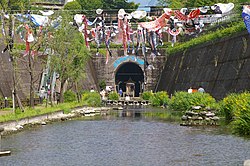
02 / Hibuse Jizo Festival

Made without nails or paste,so they can be dismantled and sold.

At the Hibuse Jizo Festival (火伏地蔵祭), held each year in late August along Mamihara's shopping street (馬見原商店街), each neighborhood dedicates a tsukurimono (造り物), a handmade display. Once each merchant house made its own, using everyday goods such as teacups. So they could be sold after being taken apart, no nails or paste were used, and the method is still passed down.

  • Late August every year
  • Said to date from Eiroku 6 (1563)
  • No nails or paste

03 / Seiwa Bunraku

Puppet theater from Awaji is reportedto have arrived by the mid-19th century.

Seiwa bunraku puppet theater 1.jpg
Photo by MK Products (CC BY-SA 3.0)

The Seiwa Bunraku Ningyo Shibai Preservation Society (清和文楽人形芝居保存会) carries on the Seiwa Bunraku (清和文楽人形芝居), an Important Intangible Cultural Property of Kumamoto Prefecture. Its six-year survey report says the Awaji-derived puppet theater arrived by the mid-19th century, possibly via a troupe from Oita, with puppet heads of Awa origin.

  • Kumamoto Prefecture Important Intangible Cultural Property
  • From Awaji, by the mid-19th century
  • Puppet heads of Awa origin

Living here

Yabe, Seiwa and Soyo became one town.

  • about 10,000 people
  • Rural district town

Yabe Town, Seiwa Village and Soyo Town merged on February 11, 2005. Tsujun Bridge lies in former Yabe, Seiwa Bunraku in former Seiwa and Mamihara in former Soyo. The town's own materials describe hilly and mountainous land at 200 to 1,700m elevation, with 40% of residents working in the primary sector (2021).

People living here
13,503people
20052020

−10.9% since 2015

18,761 → 13,503

Area
544.67km²

139.65km² of it habitable

2024

Households
5,252households

2.6 people per household

2020

Rent (average for rentals)
—
Healthcare
4 hospitals / 12 clinics

11.8 per 10,000 people

2023

Area544.67km²Habitable land139.65km² / 26%
Area and habitable land at the same scalee-Stat B1101 / B1103
Children waiting for childcare
—10 nurseries and similar
Home purchase subsidy
—
Average annual temperature
—

These 3 items are waiting on a nationwide data source. We do not fill them with estimates.

ACCESS

Where you can go from here.

Yamato Town in Japan32.686°N 130.986°E
TokyoOsakaYamato Town
ふれあいバスセンター
ふれあいバスセンター2022
  • to KumamotoLocal bus93min

Travel times follow 山都町公式『総合時刻表 R8.10.1現在』(まちづくり課・2026-10-01更新。熊本バス・西鉄バス・宮崎交通・九州産交バスの時刻を町がまとめたもの)。熊本バス山荘線(M3-2)の桜町バスターミナル発→浜町着は、平日 6:28→7:59(91分)・7:40→9:16(96)・10:35→12:11(96)・13:15→14:51(96)・16:40→18:21(101)・18:30→20:03(93)・19:40→21:13(93)、土曜 6:50→8:20(90)・8:25→9:58(93)・11:15→12:50(95)・15:05→16:46(101)・18:50→20:23(93)、日曜 6:50→8:19(89)・11:05→12:38(93)・14:30→16:04(94)・16:30→18:09(99)。高速バス『ごかせ号』は博多バスターミナル発→山都町着が 8:25→10:51・10:25→12:51・15:50→18:16・17:50→20:16 のどれも146分(西鉄天神高速バスターミナル発は 8:05→10:51 などで166分) (checked 2026-10-03). They vary by time of day.

Shape

Borders 9 municipalities across 1 prefectures.

Territory of Yamato Town
Boundaries: National Land Numerical Information (N03)

North to south

30.1km

Kumamoto Prefecture
高森町, 美里町, 御船町, 南阿蘇村, 西原村, 八代市
Miyazaki Prefecture
五ヶ瀬町, 椎葉村, 高千穂町

Yamato Town isthis kind of town.

  1. 01Gorogataki (五郎ガ瀧) is a waterfall of about 36m on a river of the Midori River system (五老滝川). After Lord Hosokawa Narishige saw the falls at Yabe in 1791, an order came to paint waterfalls and landscapes across the domain, producing the Ryonai Meisho Zukan (領内名勝図巻). In 2015 it was designated a Place of Scenic Beauty as one of the scenic sites in the album.
  2. 02The joints of Tsujun Bridge use a plaster of soil, white lime, sand, salt and pine-needle broth. The tsukurimono of Mamihara's Hibuse Jizo Festival use no nails or paste, and at the September Hassaku Festival large tsukurimono of bamboo and cedar are pulled through Hamamachi.
  3. 03Seiwa Bunraku is an Important Intangible Cultural Property of Kumamoto Prefecture, and its preservation society's survey report says Awaji-derived puppet theater arrived by the mid-19th century.

See the town as it is now.

Source: Wikidata (P2002, P2003, P2013, P2397)

If something caught your eye, ask the town itself.