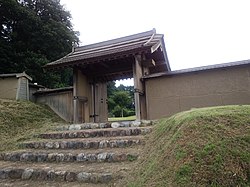
Birthplace of Eiichi Shibusawa 001.jpg
Article

11218 / ふかやし

Saitama Prefecture

Fukaya City

Born here: the father of Japan's economy.

Shibusawa Eiichi's birthplace

Photo by Ocdp (CC0)

01 / Shibusawa Eiichi

The man behind some 500 companiesstayed here when he came home.

Birthplace of Eiichi Shibusawa 002.jpg
Photo by Ocdp (CC0)

Shibusawa Eiichi was born in 1840 to a farming family in Chiaraijima village (血洗島, now part of Fukaya). He helped with the family trade in indigo balls and silkworms while studying the Analects of Confucius with his cousin Odaka Junchū (尾高惇忠). He went on to be involved in some 500 companies over his life. Nakanchi (中の家), built on his birthplace by his younger sister and her husband in 1895, is where he stayed on visits home.

  • Born 1840 in Chiaraijima
  • Involved in some 500 companies
  • Nakanchi raised 1895

02 / Bricks

Tokyo Station's red brickswere fired in kilns here.

Fukaya Hoffmann Style Ring Kiln interior 01.JPG
Photo by Abasaa (Public domain)

In 1887 Shibusawa Eiichi and his partners opened Japan's first large-scale machine brickworks at Jōshikimen (上敷免). Hoffmann Kiln No. 6, built in 1907, lines up 18 firing chambers in a kiln 56.5 m long and is said to have fired 650,000 bricks a month. Red bricks for Tokyo Station and the Akasaka Palace (now the State Guest House) were made here, and the works became an Important Cultural Property in 1997.

  • Founded 1887
  • 650,000 bricks a month
  • Important Cultural Property, 1997

03 / Fukaya negi

The leek took its namefrom the station it left from.

JAふかや 深谷ねぎ (4100531049).jpg
Photo by Martin Abegglen (CC BY-SA 2.0)

Negi (Welsh onion) growing in Fukaya began around 1897 on the fertile lowlands along the Tone River. In the Taishō era, when prices fell, a village leader turned to a dried-goods merchant, who shipped negi from Fukaya Station to Shinshū, Tōhoku and beyond; he is said to have branded them "Fukaya negi" (深谷葱) after the station. Winter negi are especially sweet, said to reach a sugar content of around 10 to 15 degrees Brix.

  • Began around 1897
  • Named after the station
  • Around 10–15 degrees Brix

Living here

Childcare fees are free from age zero.

  • about 140,000 people
  • 90 min to a city centre

In April 2023 the city, the first in the prefecture to do so, used its own funds to make childcare free for children aged 0 to 2 in tax-paying households too, so that no child pays childcare fees regardless of age or family income. City Hall is about a 10-minute walk from the north exit of Fukaya Station. Following a city policy, the station building has a red-brick look, and Ueno is as little as 68 minutes away by rapid train.

People living here
141,268people
2010

−1.8% since 2015

144,618 → 141,268

Area
138.37km²

135.1km² of it habitable

2024

Households
55,854households

2.5 people per household

2020

Rent (average for rentals)
50,861yen

National average 60,630 yen

2023

Healthcare
9 hospitals / 92 clinics

7.1 per 10,000 people

2023

Almost entirely flat.Almost all of it is habitable land (97.6%)
Area and habitable land at the same scalee-Stat B1101 / B1103

Population from 2010 onward (municipal boundary changed).2006-01-01 に新設合併(岡部町・川本町・花園町)。2010年調査から市域が変わっている。

Children waiting for childcare
—36 nurseries and similar
Home purchase subsidy
—
Average annual temperature
—

These 3 items are waiting on a nationwide data source. We do not fill them with estimates.

ACCESS

Where you can go from here.

Fukaya City in Japan36.197°N 139.281°E
OsakaFukaya City
Fukaya Station
深谷駅2013
  • to UenoJR Takasaki Line68min

Travel times follow 市公式「深谷市役所へのアクセス」(2023-03-31 更新)の「上野駅から68分(JR高崎線通勤快速)」。JR東日本の深谷駅の時刻表(2026年10月版・平日下り)に通勤快速はもう無いが、快速アーバン(小田原発高崎行き)の上野09:28発→深谷10:36着が68分(乗り換え無し)で値が合う (checked 2026-09-24). They vary by time of day.

Shape

Borders 7 municipalities across 1 prefectures.

Territory of Fukaya City
Boundaries: National Land Numerical Information (N03)

North to south

16.2km

Saitama Prefecture
寄居町, 熊谷市, 本庄市, 美里町, 嵐山町
Gunma Prefecture
太田市, 伊勢崎市

Fukaya City isthis kind of town.

  1. 01The birthplace of Shibusawa Eiichi, "the father of Japan's modern economy", where the Nakanchi house he stayed in on visits home is open to the public
  2. 02The remains of the Japan Brick Manufacturing works that Shibusawa helped found survive, and the Hoffmann kiln that fired Tokyo Station's red bricks is an Important Cultural Property
  3. 03Fukaya negi, grown since around 1897, took the name "Fukaya" from the station it was shipped from

If something caught your eye, ask the town itself.