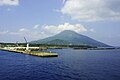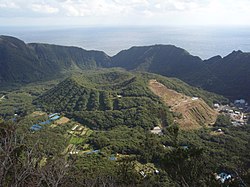
Tamaishigaki, island office site, Hachijo Town
Article

13401 / はちじょうまち

Tokyo

Hachijo Town

Rokuho-zumi walls ring an island office.

Tamaishigaki, island office site

Photo by Geomr (CC BY-SA 3.0)

01 / Kashitate no Te-odori

A dance stitching together Obon dancesbrought by exiles and drifters.

Tokyo's cultural property database says the Kashitate no Te-odori stitches together Obon dances from many regions brought by exiles and drifters in the Edo period. A Tokyo-designated Intangible Folk Cultural Property, it is danced at Obon and the moon-viewing, after the dance that precedes it.

  • Tokyo Intangible Folk Cultural Property (Feb. 13, 1960)
  • Lunar Aug. 15 and Sept. 13
  • Danced after the preceding dance

02 / Northern Limit of Hego Habitat

The northern limit of habitat of thetree-trunked fern hego lies on Hachijojima.

Northern Limit of Hego Habitat in Hachijo Town
Photo by さかおり (CC BY-SA 4.0)

The town says hego is a fern with a woody trunk, and Hachijojima is designated as its northern limit habitat. It became a national Natural Monument in 1926, at Mt. Kamogawa, Mt. Narusawa and Nanzawa in Hachijo, and in three other prefectures.

  • National Natural Monument (Oct. 27, 1926)
  • Mt. Kamogawa, Mt. Narusawa, Nanzawa
  • Also designated in 3 other prefectures

03 / Kihachijo dyeing

Island plants' lye and bark dye silkyellow, brown and black.

The Agency for Cultural Affairs explains that Kihachijo, a striped silk, is dyed yellow with lye from kobunagusa grass and camellia and sakaki leaves, brown with the bark of inugusu and lye, and black with shii bark and mud. It is a nationally selected Intangible Cultural Property.

  • Yellow: Hachijo kariyasu (kobunagusa)
  • Brown: madami (inugusu)
  • National selection (Mar. 30, 1957)

Hachijo Town from the sky

Now and 1974–78. Tap a photo to zoom in.

Wide (about 6 km across)

Close (about 1.5 km across)

Now (shot May 2013)Shot 1974–78

Source: Geospatial Information Authority of Japan (GSI) GSI Tiles(全国最新写真(シームレス)/国土画像情報(第一期:1974〜1978年撮影))

Open in GSI Maps (now)Open in GSI Maps (1974–78)

Living here

Hachijojima is reached by ship or by air.

  • about 7,000 people

The town says Tokai Kisen's scheduled ship runs once a day from Takeshiba Pier in Tokyo to Sokodo Port or Yaene Port, about 11 hours one way. ANA flies three round trips a day from Haneda Airport, about 55 minutes.

People living here
7,042people
19952020

−7.5% since 2015

9,476 → 7,042

Area
72.24km²

32.63km² of it habitable

2024

Households
3,767households

1.9 people per household

2020

Rent (average for rentals)
—
Healthcare
1 hospital / 2 clinics

4.3 per 10,000 people

2023

Area72.24km²Habitable land32.63km² / 45%
Area and habitable land at the same scalee-Stat B1101 / B1103
Children waiting for childcare
—3 nurseries and similar
Home purchase subsidy
—
Average annual temperature
—

These 3 items are waiting on a nationwide data source. We do not fill them with estimates.

ACCESS

Where you can go from here.

Hachijo Town in Japan33.109°N 139.791°E
TokyoOsakaHachijo Town
Port of Sokodo
底土港2008
  • to TokyoTokai Kisen625min

Travel times follow 東海汽船公式の時刻表(https://www.tokaikisen.co.jp/boarding/timetable/10-1%ef%bd%9e2027-1-31/ 、乗船日 10/29~2027/1/31 の表。2026-10-22 に読んだ)の大型客船(運航便コード3400『東京~三宅島・御蔵島・八丈島航路』)。運航日『毎日』。東京(竹芝)発22:30→八丈島着 翌8:55=625分(上りは便コード2400『毎日』八丈島発9:40→東京着19:50) (checked 2026-10-22). They vary by time of day.

Shape

Borders 0 municipalities.

Territory of Hachijo Town
Boundaries: National Land Numerical Information (Administrative Area Data), MLIT. Processed by Machigatari.

North to south

12.8km

Hachijo Town isthis kind of town.

  1. 01Hachijojima Magistrate's Office site is in Osato; a jinya was set up in 1529 and was the island's political center for 380 years until the branch office moved elsewhere on the island in 1908. The tamaishigaki wall around it is laid in the rokuho-zumi technique
  2. 02The Metto Well in Yaene is a spiral well about 8 m deep, estimated from its monument inscription to date from around 1880. The Sueyoshi water monument commemorates a waterworks laid in 1848
  3. 03The takakura is a raised-floor storehouse that protects harvests from the damp and from rats; the six-legged and twelve-legged ones are Tokyo-designated. The Yubama site shows obsidian from Kozushima carried in, and is now backfilled

If something caught your eye, ask the town itself.