Sekibanbuki, Ogatsu slate, Ishinomaki City
Article

04202 / いしのまきし

Miyagi Prefecture

Ishinomaki City

Split stone plates nailed on as a roof.

Sekibanbuki, Ogatsu slate

Photo by 石巻敎祖 (CC BY 4.0)

01 / Lock

Planned by the Dutchman Van Doorn,the start of the Kitakami Canal was completed in 1880.

Lock in Ishinomaki City
Photo by Ebiebi2 (CC BY-SA 4.0)

This lock stands where the Kitakami Canal begins, at its fork from the old Kitakami River, running roughly parallel to the Ishinomaki Bay coast. It has a stone lock chamber, used as a holding basin when water levels are adjusted, and a brick head section housing the gates. The Agency for Cultural Affairs calls it a model for modern locks.

  • Important Cultural Property (2002)
  • Begun 1878, completed 1880
  • Stone chamber, brick head section

02 / Garden

A deep cave at the foot of the slope behind the hall;its spring also feeds the pond.

Garden in Ishinomaki City
Photo by ToshiJapon (CC BY-SA 4.0)

The Saito garden in Maeyachi sets a hall at the heart of the view against a hillside, with flat gardens and ponds around it. At the foot of the slope north of the hall lies a deep rock cave, and the spring from it also serves as a source of water for the garden pond.

  • Place of Scenic Beauty (designated 14 July 2005)
  • Hall and five other buildings remain in place
  • Cave spring feeds the pond

03 / Modern architecture

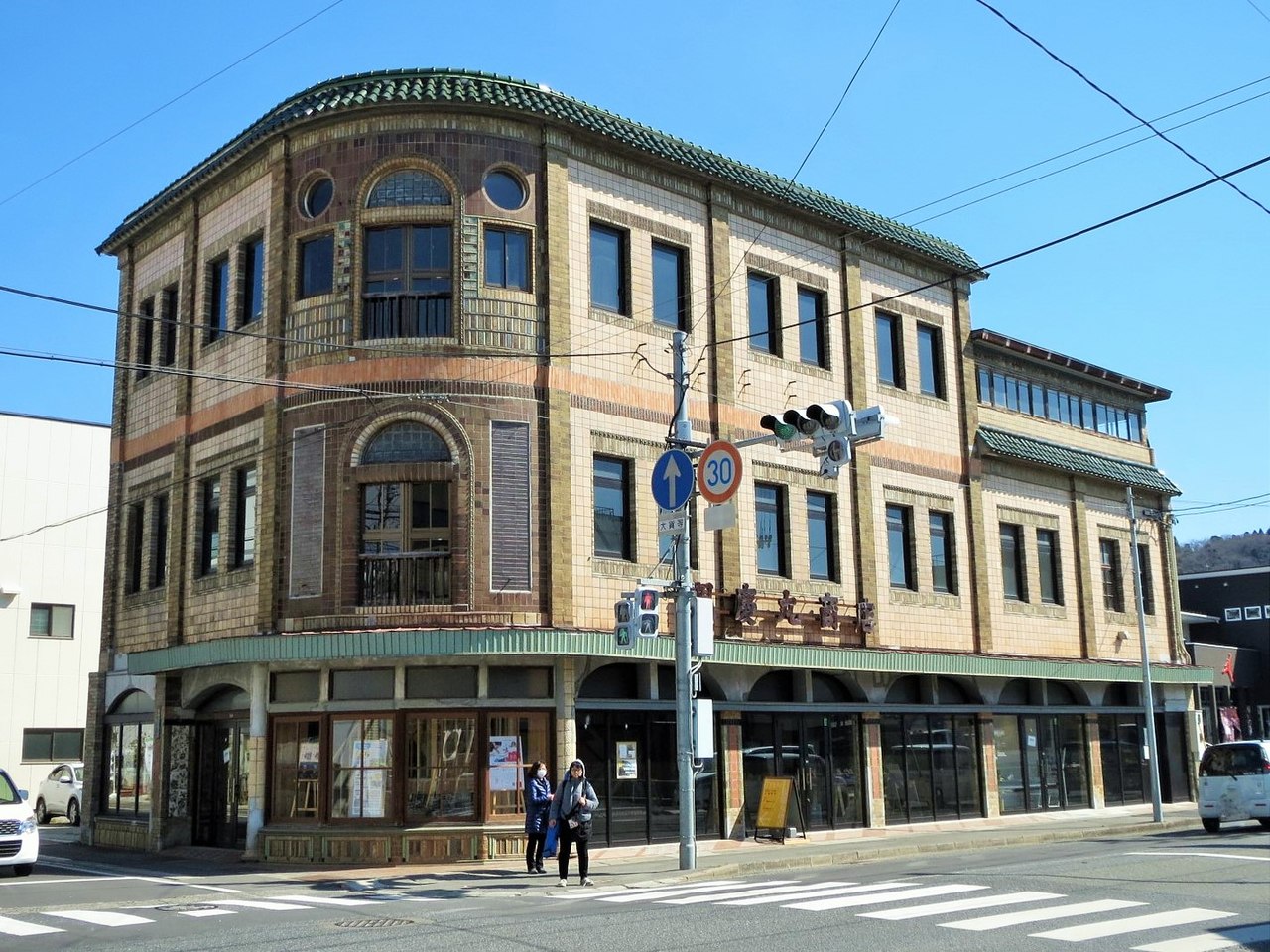
A timber building clad in many kinds of tile,with Spanish roof tiles and round windows.

Modern architecture in Ishinomaki City
Photo by Ty19080914 (CC BY-SA 4.0)

Built in 1930 as Ishinomaki's first department store. Though wooden, its walls are covered in many kinds of tile, and it has Spanish roof tiles, round windows and arched windows. The city describes it as a signboard building, whose street-facing front serves as its advertisement.

  • City-designated tangible cultural property (28 Oct 2015)
  • Built 1930
  • Walls clad in many kinds of tile

Ishinomaki City from the sky

Now and 1974–78. Tap a photo to zoom in.

Wide (about 6 km across)

Close (about 1.5 km across)

Now (shot May 2020)Shot 1974–78

Source: Geospatial Information Authority of Japan (GSI) GSI Tiles(全国最新写真(シームレス)/国土画像情報(第一期:1974〜1978年撮影))

Open in GSI Maps (now)Open in GSI Maps (1974–78)

Living here

Ishinomaki Station serves the Senseki and Ishinomaki lines.

  • about 140,000 people

The city's visitor guide tells travelers on the JR Senseki Line, the Senseki-Tohoku Line or the Ishinomaki Line to get off at Ishinomaki Station. The city gives a ten-minute walk from the station to the former Kankeimaru shop.

People living here
140,151people
20052020

−4.8% since 2015

167,324 → 140,151

Area
554.55km²

244.12km² of it habitable

2024

Households
56,768households

2.5 people per household

2020

Rent (average for rentals)
38,790yen

National average 60,630 yen

2023

Healthcare
8 hospitals / 96 clinics

7.4 per 10,000 people

2023

Area554.55km²Habitable land244.12km² / 44%
Area and habitable land at the same scalee-Stat B1101 / B1103

Population from 2005 onward (municipal boundary changed).2005-04-01 に新設合併(河北町・雄勝町・河南町・桃生町・北上町・牡鹿町)。2005年調査から市域が変わっている。

Children waiting for childcare
—37 nurseries and similar
Home purchase subsidy
—
Average annual temperature
—

These 3 items are waiting on a nationwide data source. We do not fill them with estimates.

Shape

Borders 6 municipalities.

Ishinomaki City in Japan38.434°N 141.303°E
TokyoOsakaIshinomaki City
Territory of Ishinomaki City
Boundaries: National Land Numerical Information (Administrative Area Data), MLIT. Processed by Machigatari.Lakes: National Land Numerical Information (Lake Data), MLIT. Processed by Machigatari. Prepared with the approval of the Director-General of the Geospatial Information Authority of Japan, using its Digital Map 25000 (Spatial Data Framework) and Digital Map 25000 (Place Names and Public Facilities). (承認番号 平27情使、第585号)

North to south

43.1km

Travel times per leg are not published by the municipality, so they are not shown.

Ishinomaki City isthis kind of town.

  1. 01Sekibanbuki is the craft of roofing with thin split slate nailed onto the roof base; the Agency for Cultural Affairs explains that Ogatsu slate is regarded as the best and that most slate used in repairs of cultural properties is from Ogatsu (a nationally selected conservation technique)
  2. 02The Ishii Lock at the start of the Kitakami Canal is a national Important Cultural Property, the Saito garden in Maeyachi is a national Place of Scenic Beauty, and the former Kankeimaru shop, built in 1930 as the city's first department store, is a city cultural property
  3. 03The city's list of cultural properties includes the nationally registered Abe house on Tashiro Island and granaries in Jusanhama, and the city-designated former Ishinomaki Orthodox church

If something caught your eye, ask the town itself.