Inogata-Ogawazuka Kofun, Komae City
Article

13219 / こまえし

Tokyo

Komae City

A survey turned up a cut-stone chamber.

Inogata-Ogawazuka Kofun

Photo by イカしたイカ (CC BY-SA 4.0)

01 / Tamagawa Monument

Matsudaira Sadanobu, of the Kansei reforms,wrote the poem on the monument.

Tamagawa Monument in Komae City
Photo by イカしたイカ (CC BY-SA 4.0)

In 1805 a village headman of Inogata and a man staying at his house raised funds to erect the Tamagawa Monument, a Manyoshu poem stele. It was lost and later rebuilt. Tokyo designates the site a historic site, the Remains of the Tamagawa Monument.

  • Monument erected in 1805
  • Inscription by Matsudaira Sadanobu
  • Tokyo-designated historic site

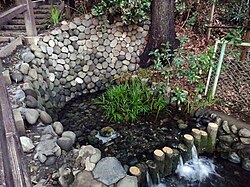
02 / Benzaiten Pond

A spring said to rise at Roben's rain prayer,as the Edo Meisho Zue records.

Benzaiten Pond in Komae City
Photo by アリオト (CC BY-SA 4.0)

The Edo Meisho Zue, published in 1834 and 1836, records a legend: the priest Roben prayed for rain in a drought, a dragon-serpent appeared and brought rain, and the sacred spring that welled up then is Benzaiten Pond. The pond is a city-designated historic site.

  • Legend recorded in the Edo Meisho Zue
  • Said to date to Roben's rain prayer
  • City-designated historic site (1973)

03 / Etegami

A class held at a post office in 1981:the city claims the birthplace of etegami.

Etegami in Komae City
Photo by Lover of Romance (CC BY-SA 3.0)

In 1981 Japan's first etegami class was held at Komae Post Office. In fiscal 2007 "Komae, birthplace of etegami" became a city project, and 24 manholes with etegami designs line the pavement in front of Komae Station.

  • Etegami class of 1981
  • City project since fiscal 2007
  • 24 etegami manholes near the station

Komae City from the sky

Now and 1974–78. Tap a photo to zoom in.

Wide (about 6 km across)

Close (about 1.5 km across)

Now (shot June–November 2019)Shot 1974–78

Source: Geospatial Information Authority of Japan (GSI) GSI Tiles(全国最新写真(シームレス)/国土画像情報(第一期:1974〜1978年撮影))

Open in GSI Maps (now)Open in GSI Maps (1974–78)

Living here

Shinjuku to Komae in 26 minutes on the Odakyu Line.

  • about 80,000 people
  • 30 min to a city centre

On the Odakyu Odawara Line, the fastest daily train from Shinjuku Station to Komae Station takes 26 minutes (October 2026 timetable; most trains take 27 to 29). City Hall is a 3-minute walk from Komae Station, and the city also has Izumi-Tamagawa Station. Both stations opened in 1927 with the line.

People living here
84,772people
19952020

+5.6% since 2015

74,656 → 84,772

Area
6.39km²

6.38km² of it habitable

2024

Households
42,616households

2.0 people per household

2020

Rent (average for rentals)
68,428yen

National average 60,630 yen

2023

Healthcare
1 hospital / 66 clinics

7.9 per 10,000 people

2023

Almost entirely flat.Almost all of it is habitable land (99.8%)
Area and habitable land at the same scalee-Stat B1101 / B1103
Children waiting for childcare
—16 nurseries and similar
Home purchase subsidy
—
Average annual temperature
—

These 3 items are waiting on a nationwide data source. We do not fill them with estimates.

ACCESS

Where you can go from here.

Komae City in Japan35.635°N 139.579°E
OsakaKomae City
Komae Station
狛江駅2019
  • to ShinjukuOdakyu Odawara Line26min

Travel times follow 小田急電鉄の新宿駅 下り時刻表(NAVITIME 配信 https://transfer.navitime.biz/odakyu-transit/smart/diagram/Search?startId=00004254&linkId=00000686&direction=down&nodeType=train 。2026年10月22日現在)の平日(10/22-23)・土休日(10/25-26)の小田原線各停系・急行の全394本について、列車ごとの停車駅ページ(StopListDiagram)で新宿の発と狛江の着の差を数えた (checked 2026-10-22). They vary by time of day.

Shape

Borders 3 municipalities across 1 prefectures.

Territory of Komae City
Boundaries: National Land Numerical Information (Administrative Area Data), MLIT. Processed by Machigatari.

North to south

3.6km

Kanagawa Prefecture
Kawasaki City

Komae City isthis kind of town.

  1. 01Inogata-Ogawazuka Kofun was found in a survey ahead of housing development in 2011. Its stone chamber, of cut mudstone with a main and front room, became a Tokyo historic site in 2021
  2. 02The Tamagawa Monument is a Manyoshu poem stele first erected in 1805, with an inscription by Matsudaira Sadanobu; the present monument is a rebuild. Its site is a Tokyo-designated historic site
  3. 03Senryu-ji's Benzaiten Pond, a city historic site, has a legend of a spring raised by a rain prayer, recorded in the Edo Meisho Zue. In 1981 Japan's first etegami class was held at Komae Post Office

See the town as it is now.

Source: Wikidata (P2002, P2003, P2013, P2397)

If something caught your eye, ask the town itself.

From this town's themes