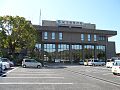
13jinjya (Wakayama) - Important Cultural Property 001.jpg
Article

30304 / きみのちょう

Wakayama Prefecture 海草郡

Kimino Town

Thirteen deities, three halls in a row.

Jusan Shrine, three halls

Photo by Thirteen-fri (CC BY-SA 3.0)

01 / Hidarimaki-gaya

Left-spiral torreyas are thought to have beenplanted widely for oil paid to Koyasan.

Hidarimaki-gaya is a variety of torreya whose seeds carry left-handed spiral lines. The town's explanation says torreya oil, which does not freeze in winter, was prized at Koyasan for lamps, and that seeds and oil were paid as tribute. Thirteen trees in the town became a prefectural Natural Monument in 2019.

  • Prefectural designation, 7 February 2019
  • Thirteen trees designated
  • Seeds 3.3 to 5 cm long

02 / Tozanguchi Station

A line for shuro goods reached OishiguchiStation, later Tozanguchi, in 1928.

Nokami Electric Railway-10.jpg
Photo by Gohachiyasu1214 (CC BY-SA 4.0)

The Nokami Light Railway opened in 1916 to carry shuro (hemp-palm) goods and more from the Nokami Valley to Hikata in Kainan. It later became the Nokami Electric Railway and closed in March 1994. The town's guidebook records five remains of bridge piers from the unfinished eastward extension.

  • Extended to Oishiguchi Station, 1928
  • Closed March 1994
  • Five bridge-pier remains

03 / Nokami Hachimangu

Five Important Cultural Properties standat a shrine made a branch of Iwashimizu.

NokamiHachimangu.jpg
Photo by kouko0515 (CC BY-SA 3.0)

The town's guidebook records that Nokami Hachimangu became a branch shrine of Iwashimizu Hachimangu in 987. The main hall, the worship hall and the main halls of the sub-shrines Takeuchi, Hirano-Imaki and Koratamadare were designated Important Cultural Properties in 1944.

  • Branch shrine from Eien 1 (987)
  • Five Important Cultural Properties, 1944
  • Worship hall: five bays by four

Living here

From Kainan Station, 20 minutes by bus.

  • about 8,000 people
  • Rural district town

There is no railway station in the town. From Kainan Station in Kainan it is 20 minutes by Daijyu Bus to the Taisei Kosha-mae stop, and the town also says about 20 minutes. The town was formed on 1 January 2006 by the merger of the former towns of Nokami and Misato.

People living here
8,256people
2010

−10.3% since 2015

10,391 → 8,256

Area
128.34km²

31.76km² of it habitable

2024

Households
3,474households

2.4 people per household

2020

Rent (average for rentals)
—
Healthcare
1 hospital / 12 clinics

15.7 per 10,000 people

2023

Area128.34km²Habitable land31.76km² / 25%
Area and habitable land at the same scalee-Stat B1101 / B1103
Children waiting for childcare
—2 nurseries and similar
Home purchase subsidy
—
Average annual temperature
—

These 3 items are waiting on a nationwide data source. We do not fill them with estimates.

ACCESS

Where you can go from here.

Kimino Town in Japan34.167°N 135.308°E
TokyoKimino Town
大成校舎前
大成校舎前2007
  • to KainanLocal bus20min

Travel times follow 大十バス株式会社(大十オレンジバス。公式 https://www.daijyu-bus.co.jp/service/ の『路線バス案内』〈オレンジバス時刻表〉)の『各停留所時刻表(平日下り)』(38477ee7b3b22875212b09396b440913.pdf)と『各停留所時刻表(土日下り)』(90d6e6e3dc804b20c6479c19ed8c6070.pdf)。どちらも『(令和8年)2026年4月1日改定』。『海南駅から登山口』の列の『海南駅前発』→『大成校舎前』を数えた (checked 2026-10-14). They vary by time of day.

Shape

Borders 4 municipalities.

Territory of Kimino Town
Boundaries: National Land Numerical Information (N03)

North to south

10.8km

有田川町, 紀の川市, 海南市, かつらぎ町

Kimino Town isthis kind of town.

  1. 01Jusan Shrine stands in Nonaka; the town's guidebook gives its name as coming from the thirteen deities enshrined there. Its main hall and the two sub-shrine halls, Niu and Hachiman, are Important Cultural Properties, and the Agency for Cultural Affairs' explanation says the main hall and two sub-shrine halls stand side by side
  2. 02The Hidarimaki-gaya grove of thirteen trees and the original Budohaze tree (a variety grown for wax) are prefectural Natural Monuments. The original Budohaze was designated a prefectural Natural Monument in 1934 but later not re-registered; a local high-school survey confirmed the tree, and it was designated again in 2020
  3. 03The Nokami Electric Railway closed in March 1994, and the main hall, worship hall and three sub-shrine halls of Nokami Hachimangu are Important Cultural Properties. The bell of Senpuku-ji Temple, with an Angen 2 (1176) cast inscription naming Chogen, is an Important Cultural Property, and Oishi Plateau straddles Arida River Town, with about 13 ha of pampas grass on its 870 m summit

See the town as it is now.

Source: Wikidata (P2002, P2003, P2013, P2397)

If something caught your eye, ask the town itself.