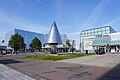
Snowy Region Research Institute, Shinjo City
Article

06205 / しんじょうし

Yamagata Prefecture

Shinjo City

A hall whose steep roof allows for snow.

Snowy Region Research Institute

Photo by Ebiebi2 (CC BY-SA 4.0)

01 / Yukicho and folk craft

In October 1940, Perriand came to Shinjo,told local farmers the forms and sizes, and chaises took shape.

The institute surveyed the economy of farming villages in snowy regions and studied how to promote it. In October 1940 (Showa 15), the French designer Charlotte Perriand visited Shinjo and passed the forms, sizes and uses to local farmers, and chaises longues and other pieces were completed.

  • Visit in October 1940 (Showa 15)
  • Folk crafts collected from snowy regions
  • Chaises longues and other pieces completed

02 / Main hall

The main hall on the Torigoe fort siteis recorded on its ridge tablet as built in Kanei 15 (1638).

Main hall in Shinjo City
Photo by Suz-b (CC BY-SA 3.0)

The Hachiman Shrine main hall and worship hall, a nationally Important Cultural Property, stand on the Torigoe fort site in the southeast of the city. According to the ridge tablet, the main hall was built by Sadamori, adopted son of the domain founder Tozawa Masamori, and the worship hall in Genroku 4 (1691) by the second lord, Masanobu.

  • Main hall built in Kanei 15 (1638)
  • Worship hall built in Genroku 4 (1691)
  • Designated a national Important Cultural Property in 1986

03 / Tomb site

Ten domain lords rest in six thatched mausoleumsat Zuiunin.

Tomb site in Shinjo City
Photo by MChew (CC BY-SA 4.0)

The Tozawa Family Tomb Site of the Shinjo domain lords is a national historic site. Six mausoleums at Zuiunin hold ten lords, all but the second lord Masanobu. Each is a single-story hogyo-zukuri building with a thatched roof. The city notes it is very rare for a lord, wife and children to rest together.

  • National historic site (May 12, 1987)
  • Six mausoleums at Zuiunin
  • Ten lords, all but the second lord Masanobu

Shinjo City from the sky

Now and 1974–78. Tap a photo to zoom in.

Wide (about 6 km across)

Close (about 1.5 km across)

2013 (shot FY2013)Shot 1974–78

Source: Geospatial Information Authority of Japan (GSI) GSI Tiles(年度別空中写真(2013年度)/国土画像情報(第一期:1974〜1978年撮影))

Open in GSI Maps (now)Open in GSI Maps (1974–78)

Living here

Tokyo in 3 h 7 min by Yamagata Shinkansen.

  • about 30,000 people
  • Shinkansen stops here

The fastest through train on the Yamagata Shinkansen from Tokyo Station to Shinjo Station takes 3 hours 7 minutes with no change (Tsubasa No. 131). The city also gives 3 hours 7 minutes as the shortest by Yamagata Shinkansen.

People living here
34,432people
19952020

−6.7% since 2015

42,896 → 34,432

Area
222.85km²

94.53km² of it habitable

2024

Households
12,857households

2.7 people per household

2020

Rent (average for rentals)
40,677yen

National average 60,630 yen

2023

Healthcare
2 hospitals / 30 clinics

9.3 per 10,000 people

2023

Area222.85km²Habitable land94.53km² / 42%
Area and habitable land at the same scalee-Stat B1101 / B1103
Children waiting for childcare
—7 nurseries and similar
Home purchase subsidy
—
Average annual temperature
—

These 3 items are waiting on a nationwide data source. We do not fill them with estimates.

ACCESS

Where you can go from here.

Shinjo City in Japan38.765°N 140.302°E
TokyoOsakaShinjo City
Shinjo Station
新庄駅2024
  • to TokyoYamagata Shinkansen187min

Travel times follow JR東日本「駅の時刻表」(2026年11月号=2611)。東京駅の山形新幹線の下りの列車ページ(東京駅 tt1039・方向04)から、東京の発→新庄の着を数えた。毎日運転(平日・土休日の両方に同じ時刻で載り、運転日の日付注記が無い)の最速は、つばさ131号(東京 9:24発→新庄 12:31着)の187分。同じ列車ページ(train/020/021951.html)を直接読んで確かめた(東京 09:24発・大宮 09:46着・福島 10:42着10:50発・山形 11:46着11:48発・大石田 12:16着12:17発・新庄 12:31着)。平日と土休日で分数が同じ。臨時(運転日が日付で列挙されたやまびこ177号208分・つばさ91号218分ほか)は外した (checked 2026-10-28). They vary by time of day.

Shape

Borders 8 municipalities across 1 prefectures.

Territory of Shinjo City
Boundaries: National Land Numerical Information (Administrative Area Data), MLIT. Processed by Machigatari.

Shinjo City isthis kind of town.

  1. 01The former Ministry of Agriculture and Forestry Snowy Region Rural Economic Research Institute building (Yukicho) is a two-story wooden building with a steep gabled roof built to allow for snow and a row of dormer windows, and was registered as a national Registered Tangible Cultural Property (building) in 2014
  2. 02According to the city, Yukicho was an institute that surveyed the economy of farming villages in snowy regions and studied how to promote it, and in October 1940 the French designer Charlotte Perriand visited Shinjo
  3. 03In the city, the Hachiman Shrine main hall and worship hall are a national Important Cultural Property and the Tozawa Family Tomb Site of the Shinjo domain lords is a national historic site, with six thatched mausoleums at Zuiunin

See the town as it is now.

Source: Wikidata (P2002, P2003, P2013, P2397)

If something caught your eye, ask the town itself.