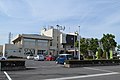
View of Gojo-gawa River from the Top of Heiwa-hashi Bridge, Shimo-oguchi Oguchi Town 2023.jpg
Article

23361 / おおぐちちょう

Aichi Prefecture 丹羽郡

Oguchi Town

Saplings a village head bought himself became the Gojo cherries.

Gojo cherries, Shamoto Etsuro

Photo by Tomio344456 (CC BY-SA 4.0)

01 / Tokurin-ji gate

The first black gate of Inuyama Castlewas moved here as Tokurin-ji's main gate in 1876.

Tokurin-ji.jpg
Photo by Bariston (CC BY-SA 4.0)

The main gate of Tokurin-ji is the first black gate of Inuyama Castle, moved here in 1876 (Meiji 9), and is of the yakui-mon type. The middle gate is thought to date from 1475, judging by an inscription on a timber. The middle gate was designated a town cultural property in 1973 and the main gate in 1985.

  • Moved in 1876
  • Middle gate thought to date from 1475
  • Main gate: town-designated in 1985

02 / Horio Yoshiharu's residence site

West of the site said to be Horio Yoshiharu's residence,a moat thought to date from the Sengoku period was found.

Hakkensha.jpg
Photo by Bariston (CC BY-SA 4.0)

The grounds of a shrine here are said to have been the residence site of the Horio clan, including Horio Yoshiharu. In 2009 (Heisei 21), a dig ahead of prefectural road construction 100 m west of the shrine confirmed a moat about 5 m wide, dated to the Sengoku period, and a group of post-set building remains.

  • Excavated in 2009
  • Moat about 5 m wide
  • Memorial stone raised in 1915 in the grounds

03 / Sweating Jizo

The temple tells that it shed sweat one New Year,a cast-iron Jizo at Chosho-ji.

The cast-iron standing Jizo Bosatsu at Chosho-ji is popularly called the Sweating Jizo. It stands 97.4 cm tall, was made in front and back molds joined together, and has no hollow inside, so it is very heavy. The temple tradition says it shed sweat in the New Year after the temple's founding. The work is dated to the late sixteenth century.

  • 97.4 cm tall
  • Temple tradition: sweat the New Year after founding
  • Dated to the late 16th century

Living here

5 minutes by town bus from Kashiwamori Station.

  • about 20,000 people
  • Rural district town

There is no railway station in the town. From Kashiwamori Station (in Fuso Town) on the Meitetsu Inuyama Line, the Oguchi community bus's main route reaches Oguchi Town Office in 5 minutes. The daily buses do not run from December 29 to January 3 (timetable as of June 1, 2026).

People living here
24,305people
19952020

+4.4% since 2015

19,031 → 24,305

Area
13.61km²

13.61km² of it habitable

2024

Households
9,150households

2.7 people per household

2020

Rent (average for rentals)
40,851yen

National average 60,630 yen

2023

Healthcare
1 hospital / 17 clinics

7.4 per 10,000 people

2023

Almost entirely flat.Almost all of it is habitable land (100.0%)
Area and habitable land at the same scalee-Stat B1101 / B1103
Children waiting for childcare
—4 nurseries and similar
Home purchase subsidy
—
Average annual temperature
—

These 3 items are waiting on a nationwide data source. We do not fill them with estimates.

ACCESS

Where you can go from here.

Oguchi Town in Japan35.333°N 136.908°E
TokyoOguchi Town
Oguchi Town Office
大口町役場2018
  • to KashiwamoriLocal bus5min

Travel times follow 町公式『大口町コミュニティバス時刻表・乗り換え検索』(https://www.town.oguchi.lg.jp/2289.htm。更新 2026-06-02。『令和8年6月1日現在』の時刻表)の基幹ルート時刻表PDF(https://www.town.oguchi.lg.jp/secure/16723/基幹ルート.pdf)。『毎日運行便(12/29〜1/3は運休)』の柏森駅(発)→大口町役場の列 (checked 2026-10-19). They vary by time of day.

Shape

Borders 4 municipalities.

Territory of Oguchi Town
Boundaries: National Land Numerical Information (N03)

North to south

6.3km

小牧市, 犬山市, 扶桑町, 江南市

Oguchi Town isthis kind of town.

  1. 01In 1952 the village head Shamoto Etsuro bought Somei-yoshino saplings with his own money, to bring the village together and give it a place of rest, and called on villagers to plant them on the Gojo River embankment. The saplings grew, and the Gojo River came to be called a cherry-blossom spot
  2. 02The main gate of Tokurin-ji is the first black gate of Inuyama Castle, moved here, and west of a shrine said to stand on the Horio Yoshiharu residence site, a moat thought to date from the Sengoku period was found
  3. 03The cast-iron Jizo at Chosho-ji is the Sweating Jizo, which the temple tradition says shed sweat. The town also has other cultural properties, such as the ceramic guardian dogs of Yono Shrine and the Nishonno site

See the town as it is now.

Source: Wikidata (P2002, P2003, P2013, P2397)

If something caught your eye, ask the town itself.