Ishi-no-to, a border boulder, Owani Town
Article

02362 / おおわにまち

Aomori Prefecture 南津軽郡

Owani Town

No big talk before seeing Ishi-no-to.

Ishi-no-to, a border boulder

Photo by らんで (CC BY-SA 4.0)

01 / Hot-spring bean sprouts

No tap water at all,only hot-spring water grows them.

The sprouts are grown in soil beds warmed only by the heat of the hot spring, and from growing to washing and finishing the town uses hot-spring water, never tap water. The beans for the bean sprouts are a local native variety called Kohachi-mame. The whole process takes about a week, and because quality is decided by the growth on the fourth day after sowing, controlling the soil-bed temperature takes skill.

  • Soil beds warmed by hot-spring heat
  • Native bean, Kohachi-mame
  • About one week, start to finish

02 / Daienji

A great Amida statue is saidto lie behind the name Owani.

Daienji in Owani Town
Photo by 663highland (CC BY 2.5)

The principal image of Daienji is a wooden seated Amida Nyorai, traditionally called Dainichi Nyorai, designated an Important Cultural Property as a work of the Kamakura period. The town says the place was called Oamida because of a large Amida image, and that it came to be written Owani later, as the story is handed down.

  • Kamakura-period work
  • Important Cultural Property, 1920
  • Name's origin: Owani town history

03 / Yudamaishi Yakushido

Tamenobu is said to have builta shrine on the great rock.

Yudamaishi Yakushido in Owani Town
Photo by 掬茶 (CC BY-SA 4.0)

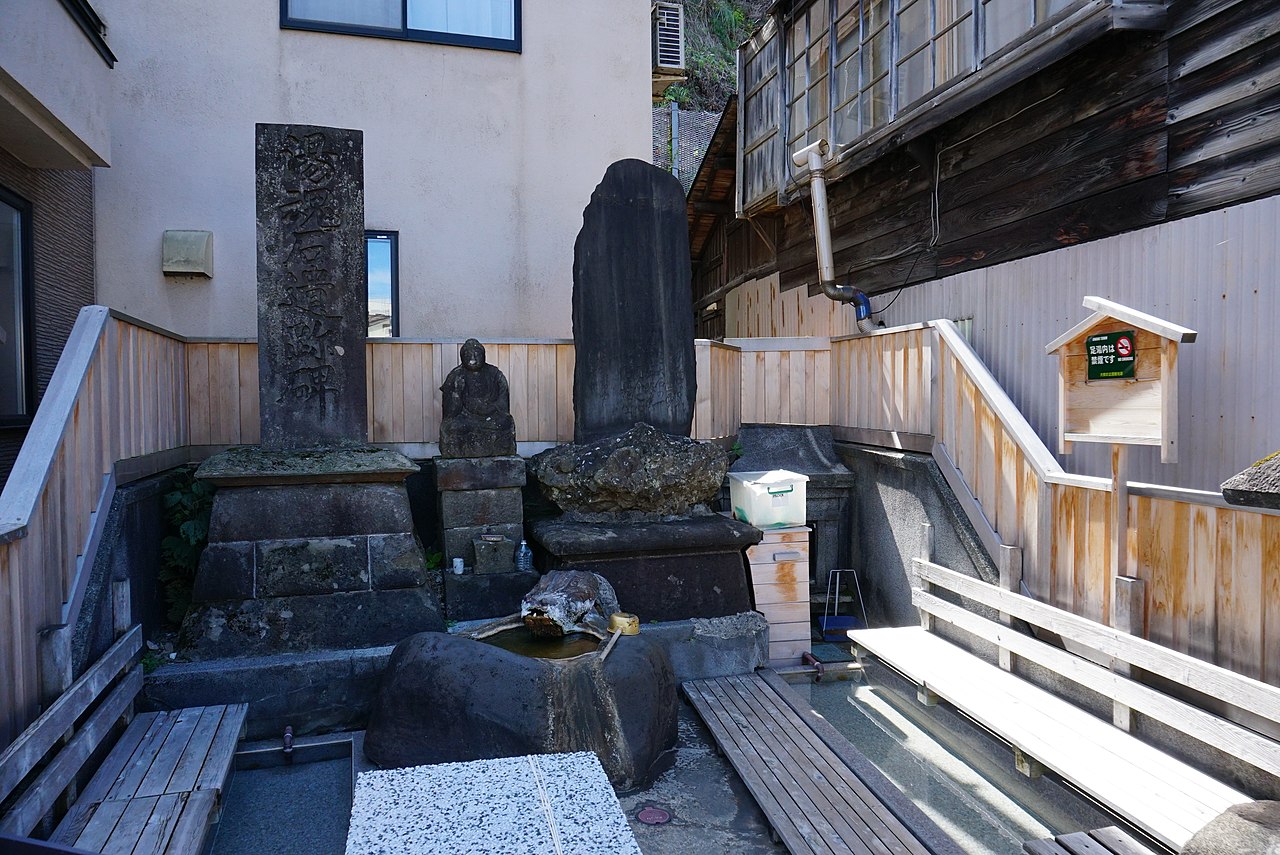
The town records a story that Tsugaru Tamenobu, suffering from an eye disease, washed his eyes in hot water welling up under a great rock after a dream message from Yakushi Nyorai, and was cured. Out of gratitude he built a shrine on the rock, and a footbath now stands beside it. The third lord, Nobuyoshi, built an official lodge in Owani and spent half his stay in Tsugaru there during the alternate-attendance years.

  • Tamenobu's eye-disease story
  • Shrine on the great rock
  • Nobuyoshi's lodge

Owani Town from the sky

Now and 1974–78. Tap a photo to zoom in.

Wide (about 6 km across)

Close (about 1.5 km across)

Now (shot June 2024)Shot 1974–78

Source: Geospatial Information Authority of Japan (GSI) GSI Tiles(全国最新写真(シームレス)/国土画像情報(第一期:1974〜1978年撮影))

Open in GSI Maps (now)Open in GSI Maps (1974–78)

Living here

About a five-minute walk from Owani-onsen Station to the town office.

  • about 9,000 people
  • Rural district town

The town's office guide gives its access as about a five-minute walk from Owani-onsen Station. The station is on the JR Ou Main Line; the town also has Nagamine Station (JR) and, on the Konan Railway Owani Line, Shukugawara and Sabaishi stations.

People living here
8,665people
19952020

−10.4% since 2015

13,990 → 8,665

Area
163.43km²

37.66km² of it habitable

2024

Households
3,228households

2.7 people per household

2020

Rent (average for rentals)
—
Healthcare
0 hospitals / 5 clinics

5.8 per 10,000 people

2023

Area163.43km²Habitable land37.66km² / 23%
Area and habitable land at the same scalee-Stat B1101 / B1103
Children waiting for childcare
—4 nurseries and similar
Home purchase subsidy
—
Average annual temperature
—

These 3 items are waiting on a nationwide data source. We do not fill them with estimates.

Shape

Borders 3 municipalities across 1 prefectures.

Owani Town in Japan40.518°N 140.568°E
TokyoOsakaOwani Town
Territory of Owani Town
Boundaries: National Land Numerical Information (Administrative Area Data), MLIT. Processed by Machigatari.Lakes: National Land Numerical Information (Lake Data), MLIT. Processed by Machigatari. Prepared with the approval of the Director-General of the Geospatial Information Authority of Japan, using its Digital Map 25000 (Spatial Data Framework) and Digital Map 25000 (Place Names and Public Facilities). (承認番号 平27情使、第585号)

North to south

17.0km

Aomori Prefecture
Hirakawa City, Hirosaki City
Akita Prefecture
Odate City

Travel times per leg are not published by the municipality, so they are not shown.

Owani Town isthis kind of town.

  1. 01Ishi-no-to is a boulder 24 m high and 74 m around on a mountaintop in a national-forest reserve on the Akita border, and Tsugaru has a saying that you cannot talk big until you have seen it
  2. 02The town has hot-spring bean sprouts grown in soil with only hot-spring heat and water, a name said to come from a great Amida statue, and Yudamaishi Yakushido, built on a great rock
  3. 03The town office is about a five-minute walk from the station, and the town has stations on the JR Ou Main Line and the Konan Railway Owani Line

If something caught your eye, ask the town itself.