Niida cliff-carved Amida images, Kagamiishi Town
Article

07342 / かがみいしまち

Fukushima Prefecture 岩瀬郡

Kagamiishi Town

Two Amida sets carved in a cliff face.

Niida cliff-carved Amida images

Photo by Duff Figgy (CC BY-SA 3.0)

01 / Pond site

Kagaminuma, also called Kagenuma,survives as a pond site in the fields.
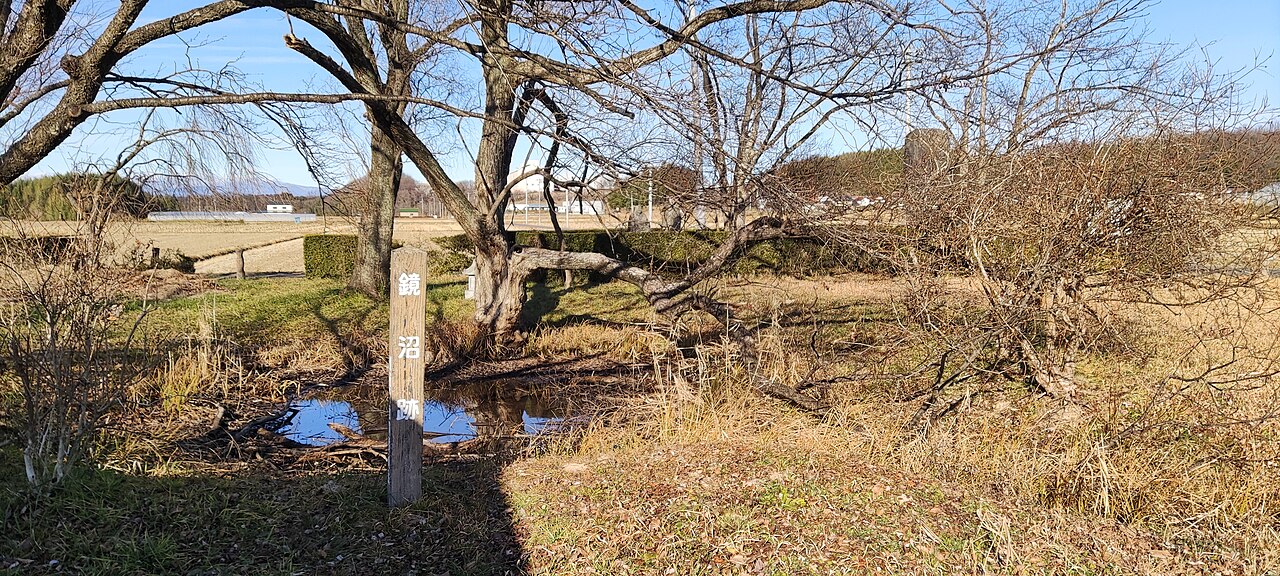
Pond site in Kagamiishi Town
Photo by C2revenge (CC0)

The town describes Kagaminuma, also called Kagenuma, as taking its name from a sad legend of the Kamakura period. The pond's site remains in the fields, and the town adds that Basho wrote of a place called Kagenuma in his Narrow Road to the Deep North. The town crest comes from the legend.

  • Also called Kagenuma
  • Town crest drawn from the legend
  • Named in the Narrow Road to the Deep North

02 / Archaeological site

A Paleolithic and Jomon site,known for its stone tools.

The town introduces Jingaoka as a site known for both the Paleolithic and Jomon periods, noting that it drew attention for a fine group of Paleolithic stone tools. Magatama beads, pottery and clay figurines were also unearthed there.

  • Paleolithic and Jomon site
  • Magatama, pottery, figurines also found
  • Located in Suwamachi

03 / Cedar-door paintings

Cedar-door paintings said to be by the monk-painter Hakuunare kept at Saiko-ji Temple.

Cedar-door paintings in Kagamiishi Town
Photo by Duff Figgy (CC BY-SA 3.0)

The town says the cedar-door paintings, said to have been painted in 1797 by the monk-painter Hakuun, are kept at Saiko-ji Temple. The prefecture's list separately includes "Itae Ryoenkaku Kosho Gazo", 8 panels on 12 faces owned by the temple and the town, as a prefectural important cultural property (painting).

  • Said to be painted in 1797
  • Prefectural important cultural property (painting), 8 panels on 12 faces
  • Designated March 23, 1984

Kagamiishi Town from the sky

Now and 1974–78. Tap a photo to zoom in.

Wide (about 6 km across)

Close (about 1.5 km across)

Now (shot July–September 2022)Shot 1974–78

Source: Geospatial Information Authority of Japan (GSI) GSI Tiles(全国最新写真(シームレス)/国土画像情報(第一期:1974〜1978年撮影))

Open in GSI Maps (now)Open in GSI Maps (1974–78)

Living here

The town's station, Kagamiishi, opened in 1911.

  • about 10,000 people
  • Rural district town

The only railway station in the town is Kagamiishi Station on the Tohoku Main Line. The town's chronology records its opening in 1911. The town says the Machi-no-Eki Kankanterasu stands inside the community center attached to the station.

People living here
12,318people
19952020

−1.3% since 2015

12,378 → 12,318

Area
31.3km²

27.85km² of it habitable

2024

Households
4,382households

2.8 people per household

2020

Rent (average for rentals)
—
Healthcare
0 hospitals / 10 clinics

8.1 per 10,000 people

2023

Area31.3km²Habitable land27.85km² / 89%
Area and habitable land at the same scalee-Stat B1101 / B1103
Children waiting for childcare
—3 nurseries and similar
Home purchase subsidy
—
Average annual temperature
—

These 3 items are waiting on a nationwide data source. We do not fill them with estimates.

Shape

Borders 4 municipalities.

Kagamiishi Town in Japan37.253°N 140.343°E
TokyoOsakaKagamiishi Town
Territory of Kagamiishi Town
Boundaries: National Land Numerical Information (Administrative Area Data), MLIT. Processed by Machigatari.Lakes: National Land Numerical Information (Lake Data), MLIT. Processed by Machigatari. Prepared with the approval of the Director-General of the Geospatial Information Authority of Japan, using its Digital Map 25000 (Spatial Data Framework) and Digital Map 25000 (Place Names and Public Facilities). (承認番号 平27情使、第585号)

North to south

7.5km

Travel times per leg are not published by the municipality, so they are not shown.

Kagamiishi Town isthis kind of town.

  1. 01On a cliff face in Niida, along the Shakadogawa River, two sets of Amida figures are carved in relief; the town says they are said to date back about 650 years
  2. 02Kagaminuma, from a sad legend of the Kamakura period, is also called Kagenuma; its site remains in the fields and the town crest comes from the legend
  3. 03Jingaoka is a Paleolithic and Jomon site, and Saiko-ji Temple keeps cedar-door paintings said to be by the monk-painter Hakuun

See the town as it is now.

Source: Wikidata (P2002, P2003, P2013, P2397)

If something caught your eye, ask the town itself.

From this town's themes