Former Kunitachi Station, Kunitachi City
Article

13215 / くにたちし

Tokyo

Kunitachi City

Old rails are reused as eave posts.

Former Kunitachi Station

Photo by Suikotei (CC BY-SA 4.0)

01 / Jomon stone rods

Four stone rods, each over 1 m long,lay side by side on a stone-paved floor.

About 4,000 years ago, in the Jomon period, four large stone rods were found laid side by side, heads pointing southwest, on the floor of a stone-paved feature. They are nearly intact, each over 1 m long, the heaviest 30.8 kg. Kunitachi City owns them as a national Important Cultural Property.

  • Four rods found side by side
  • Over 1 m long; heaviest 30.8 kg
  • National Important Cultural Property (2017)
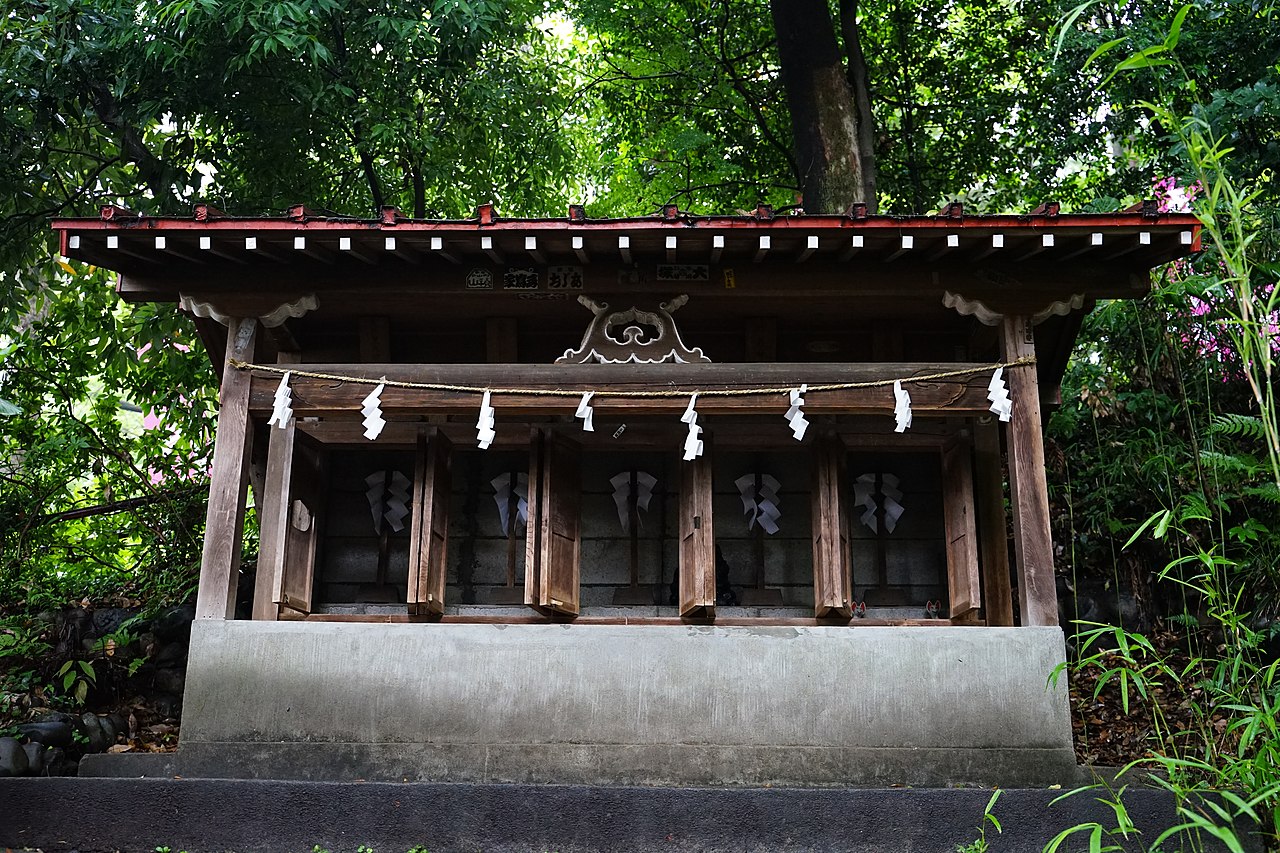
02 / Yabo Tenmangu forest

When the Koshu Kaido moved onto the terrace,the approach ran through the shrine forest.

Yabo Tenmangu forest in Kunitachi City
Photo by Taisuke.Kasuya (CC BY-SA 3.0)

Until some time in the 17th century the Koshu Kaido ran below the Tachikawa terrace, so the main and worship halls were built facing the road, to the south. When the road moved up onto the terrace, the approach came to pass through the shrine forest. The forest is a Tokyo-designated natural monument, and the grounds hold Tokiwa no Shimizu, one of Tokyo's 57 Famous Springs.

  • Road moved from below the terrace to above it
  • Forest: Tokyo-designated natural monument (1924)
  • Tokiwa no Shimizu: one of Tokyo's 57 Famous Springs

03 / Former Honda residence

A gate said to admit a rider on horsebackwas moved aside when the road was widened.

The front gate of the former Honda residence is said to have let a rider pass through on horseback, and the Honda family called it Oumamon. In 1932 it was moved to the southeast corner of the site when the Koshu Kaido was widened. Until the mid-Edo period the family trained horses and worked as horse doctors, later turning to herbal medicine; successive heads served as village headmen and elders.

  • Front gate moved in 1932
  • Horse training and veterinary work, then herbal medicine
  • Tokyo-designated tangible cultural property (2020)

Kunitachi City from the sky

Now and 1974–78. Tap a photo to zoom in.

Wide (about 6 km across)

Close (about 1.5 km across)

Now (shot June–November 2019)Shot 1974–78

Source: Geospatial Information Authority of Japan (GSI) GSI Tiles(全国最新写真(シームレス)/国土画像情報(第一期:1974〜1978年撮影))

Open in GSI Maps (now)Open in GSI Maps (1974–78)

Living here

Shinjuku in 32 minutes, Tokyo in 46.

  • about 80,000 people

On the JR Chuo Line (Rapid), the fastest weekday train takes 32 minutes from Shinjuku Station and 46 from Tokyo Station (October 2026 timetable; on weekends and holidays there are trains of 29 and 44 minutes). From the station, University Street, about 44 m wide, runs south, and the Nambu Line's Yaho and Yagawa stations are also in the city.

People living here
77,130people
19952020

+4.7% since 2015

66,719 → 77,130

Area
8.15km²

8.12km² of it habitable

2024

Households
38,275households

2.0 people per household

2020

Rent (average for rentals)
66,451yen

National average 60,630 yen

2023

Healthcare
2 hospitals / 84 clinics

11.2 per 10,000 people

2023

Almost entirely flat.Almost all of it is habitable land (99.6%)
Area and habitable land at the same scalee-Stat B1101 / B1103
Children waiting for childcare
—15 nurseries and similar
Home purchase subsidy
—
Average annual temperature
—

These 3 items are waiting on a nationwide data source. We do not fill them with estimates.

ACCESS

Where you can go from here.

Kunitachi City in Japan35.684°N 139.441°E
OsakaKunitachi City
Kunitachi Station
国立駅2022
  • to TokyoJR Chuo Line (Rapid)46min
  • to ShinjukuJR Chuo Line (Rapid)32min

Travel times follow JR東日本の駅時刻表(timetables.jreast.co.jp・2610版)国立駅 中央本線・中央線快速(下り)の平日表(tt0622/0622010・219本)・土曜休日表(0622011・178本)の全列車ページ。東京・新宿の発から国立の着までを数えた(全列車。第2段で数え直し済み) (checked 2026-10-23). They vary by time of day.

Shape

Borders 4 municipalities.

Territory of Kunitachi City
Boundaries: National Land Numerical Information (Administrative Area Data), MLIT. Processed by Machigatari.

Kunitachi City isthis kind of town.

  1. 01The Former Kunitachi Station Building is a red-roofed station of 1926. The city says it seems to have been meant as an advertisement for the housing lots. It was dismantled in 2006 and rebuilt in 2020 at nearly the same spot; old rails are reused in the south eave posts
  2. 02Four large stone rods from the Midorikawa-higashi site were found side by side on the floor of a Jomon stone-paved feature. They are a national Important Cultural Property, owned by the city and kept at the Kunitachi Local Museum
  3. 03The Yabo Tenmangu forest is a Tokyo-designated natural monument, and Tokiwa no Shimizu springs in the grounds. The former Honda residence is a Tokyo-designated tangible cultural property; its front gate was moved in 1932 when the Koshu Kaido was widened

See the town as it is now.

Source: Wikidata (P2002, P2003, P2013, P2397)

If something caught your eye, ask the town itself.

From this town's themes