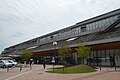
Kodama Gentaro Birthplace Park 2021-08 ac (1).jpg
Article

35215 / しゅうなんし

Yamaguchi Prefecture

Shunan City

Bought back his home, opened a library.

Kodama Bunko, site of his home

Photo by Asturio Cantabrio (CC BY-SA 4.0)

01 / Yashiro Cranes

After a crane was shot,catching cranes in the village was banned.

熊毛町八代のナベヅル.jpg
Photo by Misotti (CC BY-SA 4.0)

In January 1887 a hunter from another village shot a crane. The Yamaguchi prefectural governor then banned catching cranes within Yashiro village, and the city calls the place the "birthplace of Japan's modern nature conservation system." Mainly hooded cranes winter here, at the only such site on Honshu; it became a Special Natural Monument in 1955.

  • Jan. 1887: governor bans catching cranes in the village
  • Special Natural Monument since 1955
  • Cranes arrive around late Oct. to late Mar.

02 / Choon-do (潮音洞)

At his own cost he cut through a hillto bring upper Nishiki River water in.

For the water-poor Kano plateau, Iwasaki Sozaemon Shigetomo began in 1651 to dig a tunnel of about 89 m into the hill behind Kanyo-ji (漢陽寺). An 870 m channel carried in water from the upper Nishiki River, finished in 1654. It opened 62 chobu of rice paddies and supplied 300 households.

  • Tunnel about 89 m, channel 870 m
  • Begun 1651, finished 1654
  • 62 chobu of paddies, 300 households' water

03 / Nisho-Yamada Shrine (二所山田神社)

To fund the magazine Joshido,its chief priest began making omikuji.

Nisyoyamada shrine jyoshido 2.jpg
Photo by Lumi iori (CC BY-SA 3.0)

Chief priest Miyamoto Shigetane founded the "Dai Nippon Keishin Fujinkai" to support women's independence and launched its magazine Joshido (女子道) in 1906. He began making omikuji fortune slips to fund it. Joshido-sha (女子道社) still makes them, and is said to have devised the omikuji vending machines seen at shrines and temples nationwide.

  • Magazine Joshido launched in 1906
  • Organ of the "Dai Nippon Keishin Fujinkai"
  • Omikuji still made by Joshido-sha

Living here

656.29 km², from island shores to mountain valleys.

  • about 140,000 people
  • 2 hours to a city centre
  • Shinkansen stops here

The city faces the Seto Inland Sea, with islands such as Sukumojima (粭島) and Otsushima (大津島) offshore. Kano and Yashiro in the north are mountain valleys, near the Kano interchange of the Chugoku Expressway. The city's tourism page features the lines of coastal factories as "Shunan factory night views." Local buses leave for all parts of the city from in front of Tokuyama Station, a Shinkansen stop.

People living here
137,540people
20052020

−5% since 2015

152,387 → 137,540

Area
656.29km²

145.84km² of it habitable

2024

Households
63,289households

2.2 people per household

2020

Rent (average for rentals)
41,925yen

National average 60,630 yen

2023

Healthcare
14 hospitals / 110 clinics

9.0 per 10,000 people

2023

Area656.29km²Habitable land145.84km² / 22%
Area and habitable land at the same scalee-Stat B1101 / B1103
Children waiting for childcare
—26 nurseries and similar
Home purchase subsidy
—
Average annual temperature
—

These 3 items are waiting on a nationwide data source. We do not fill them with estimates.

ACCESS

Where you can go from here.

Shunan City in Japan34.055°N 131.806°E
TokyoOsakaShunan City
Tokuyama Station
徳山駅2021
  • to TokyoTokaido-Sanyo Shinkansen254min
  • to NagoyaTokaido-Sanyo Shinkansen154min
  • to OsakaSanyo Shinkansen104min

Travel times follow JR西日本「JRおでかけネット」区間時刻表『東海道・山陽・九州新幹線(東京~博多~鹿児島中央) 下り』(https://timetable.jr-odekake.net/line-timetable/1796 ・2026年9月29日〈火〉のダイヤ。この日にページを開き直して、徳山『発』の欄が保存した表($SP/jr-shinkansen-down-20260929.json)と同じことを確かめた)。徳山に停まり、東京・名古屋・新大阪を出て乗り換えなしで着くのは『のぞみ』だけ (checked 2026-09-29). They vary by time of day.

Shape

Borders 6 municipalities across 1 prefectures.

Territory of Shunan City
Boundaries: National Land Numerical Information (N03)

North to south

43.1km

Yamaguchi Prefecture
岩国市, 山口市, 下松市, 防府市, 光市
Shimane Prefecture
吉賀町

Shunan City isthis kind of town.

  1. 01In Shunan stood Kodama Bunko (児玉文庫), a private library that Kodama Gentaro opened in 1903 on his bought-back birthplace; the site is now Kodama Gentaro Birthplace Park, where his birth-water well remains.
  2. 02The Yashiro basin where hooded cranes winter, the Choon-do (潮音洞) tunnel at Kano that brought in upper Nishiki River water, and Nisho-Yamada Shrine, whose omikuji began as funding for the magazine Joshido, each hold a small piece of history.
  3. 03There are also Mitsukuri Kagura (三作神楽), performed as 23 dances at ceremonies held in rabbit and rooster years, Sukumojima, known as the birthplace of fugu longline fishing, and the Wakayama Castle ruins, a castle of the Sue (陶) clan, Ouchi retainers.

If something caught your eye, ask the town itself.