Kashima Fumyoji romon.jpg
Article

41207 / かしまし

Saga Prefecture

Kashima City

The gate and hall form a dragon's belly.

Fumyoji, dragon-shaped precinct

Photo by Peka (CC BY-SA 4.0)

01 / Hama-Shozumachi and Hama-Kanayamachi

Where merchants, sailors and craftsmen lived,the bustle earned the name "Hama-sengen."

Hamashozumachi Kayabuki-machiya houses.JPG
Photo by Pekachu (CC BY-SA 4.0)

On the right bank of the Hama River mouth, Hama-Shozumachi (浜庄津町) was a port town of merchants and sailors, and Hama-Kanayamachi (浜金屋町) a craftsmen's town of blacksmiths, carpenters, plasterers and others. The largest commercial and industrial town in the Kashima domain, it still has thatched and tile-roofed townhouses side by side.

  • Important Preservation District for Groups of Traditional Buildings, selected 2006 (Agency for Cultural Affairs)
  • Preservation district of about 2.0 hectares (Agency for Cultural Affairs)
  • Called "Hama-sengen" (city)

02 / Funa Market

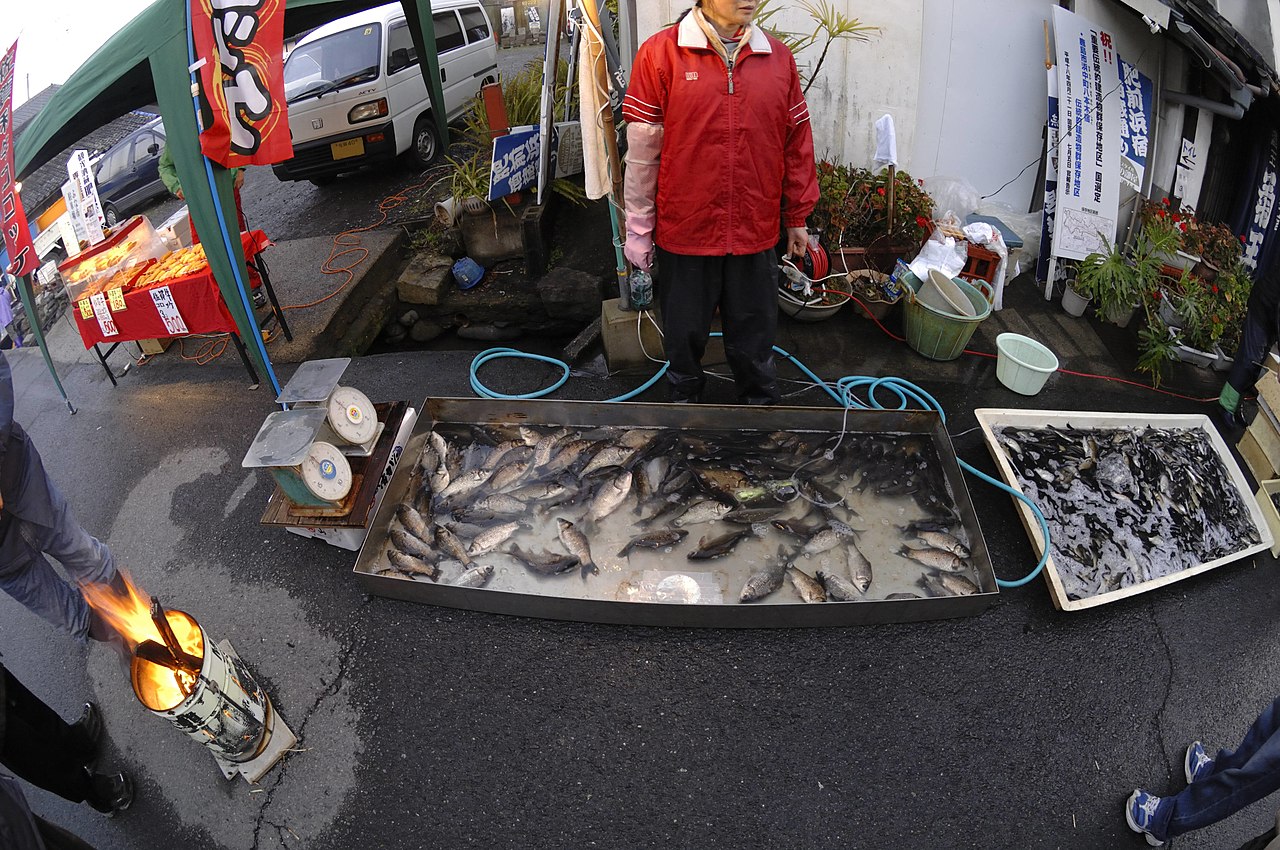
In the dark of early morning on Sakagura-dori,a market sells crucian carp for Hatsuka Shōgatsu.

鹿島ふな市 090119.jpg
Photo by Ffish.asia (CC BY 4.0)

A market selling live crucian carp (funa) as offerings for Hatsuka Shōgatsu (二十日正月), the 20th day of the New Year. The tourism association calls it a tradition of over 300 years in the area, and says a market centered on funa is very rare even nationwide. The fish are simmered wrapped in kelp and offered to Ebisu and Daikoku.

  • Funa sold for cooking on Hatsuka Shōgatsu (tourism association)
  • 2026: Jan. 19, from 6 a.m. to about noon (tourism association)
  • Funankoguii (ふなんこぐい) offered to Ebisu and Daikoku (tourism association)

03 / Otonashi Men-buryū

Said to keep the oldest form,Otonashi's men-buryū has few entertainment pieces.

It is offered every year on the second Sunday of September at Tenshi Shrine (天子神社) in Otonashi, Nanaura. Its eight pieces include Hōgandō and Kami no Mae, and 20 to 40 kakeuchi dancers take part. In 1978 the national government selected it as an intangible folk cultural property requiring record-making measures. The Hōgaura men-buryū, also in Nanaura, wears happi coats patterned with waves and anchors.

  • Offered every second Sunday of September (city)
  • Selected by the national government on Jan. 31, 1978 (Agency for Cultural Affairs)
  • Both Otonashi and Hōgaura are prefectural Important Intangible Folk Cultural Properties (tourism association)

Living here

Ariake Sea to the east, the Tara range to the west: 112.12 km².

  • about 30,000 people

The Ariake Sea spreads to the east and the Tara mountain range surrounds the west. The area is 112.12 km², and Mt. Kyōgatake, one of its main mountains, stands 1,075.7 m high. Five towns and villages began city government in 1954, and Nanaura Village joined the next year, giving the city its present shape.

People living here
27,892people
19952020

−6% since 2015

34,083 → 27,892

Area
112.12km²

58.96km² of it habitable

2024

Households
10,046households

2.8 people per household

2020

Rent (average for rentals)
40,702yen

National average 60,630 yen

2023

Healthcare
4 hospitals / 18 clinics

7.9 per 10,000 people

2023

Area112.12km²Habitable land58.96km² / 53%
Area and habitable land at the same scalee-Stat B1101 / B1103
Children waiting for childcare
—12 nurseries and similar
Home purchase subsidy
—
Average annual temperature
—

These 3 items are waiting on a nationwide data source. We do not fill them with estimates.

Shape

Borders 4 municipalities across 1 prefectures.

Kashima City in Japan33.104°N 130.099°E
TokyoOsakaKashima City
Territory of Kashima City
Boundaries: National Land Numerical Information (N03)

North to south

16.2km

Saga Prefecture
嬉野市, 太良町, 白石町
Nagasaki Prefecture
大村市

Travel times per leg are not published by the municipality, so they are not shown.

Kashima City isthis kind of town.

  1. 01Fumyoji Temple (普明寺) is an Obaku Zen temple opened in 1677 (Enpō 5), the family temple of the Kashima Nabeshima clan. The whole precinct is likened to a dragon: the entrance, its head, holds the "Ryūgan" pond, the approach is the neck, the gate, corridor and main hall are the belly, and the graveyard path is the tail. The precinct is a city Historic Site.
  2. 02The Akamon and Otemon gates of Kashima Castle are prefectural Important Cultural Properties; the Akamon was built in 1808 (Bunka 5) and is now the school gate of Kashima High School. The Hizen-Kashima tidal flat on the Ariake Sea was registered as a Ramsar wetland on May 28, 2015.
  3. 03At the Kinro Shrine (琴路神社) festival, horses race the portable shrine around the sanctuary in the "umakake." The Heian-period go master Kanren (寛蓮) is said to have had a former home in Kashima, and Yūtoku Inari Shrine originates with Manko, the widow of the third Kashima lord.

See the town as it is now.

Source: Wikidata (P2002, P2003, P2013, P2397)

If something caught your eye, ask the town itself.