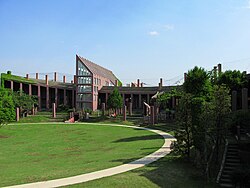
Shiraoka Blossom Of Pears 1.JPG
Article

11246 / しらおかし

Saitama Prefecture

Shiraoka City

In April, pear blossoms turn the city white.

Photo by 京浜にけ (CC BY-SA 3.0)

01 / Pears

Even in the year of the great flood,pears were picked from boats.

Pear growing in Shiraoka began in 1903, when a farming family in Araishinden (荒井新田) planted 230 pear trees on 30 ares. In the great flood of 1910, other crops were devastated, but the pears, trained on overhead trellises, came through almost unharmed, and people are said to have picked them from boats. Today twelve varieties are grown, and pears from Shiraoka are called Shiraoka Bijin (白岡美人).

  • Growing began in 1903
  • The great flood of 1910
  • 12 varieties

02 / Milestone mounds

On the shogun's road to Nikkō,both milestone mounds survive.

Shiraoka Nikko Onari Kaido Shimonoda Ichiriduka 1.JPG
Photo by 京浜にけ (CC BY-SA 3.0)

The Nikkō Onari-michi (日光御成道) was the road the shogun took to worship at Nikkō Tōshō-gū. The Shimonoda ichirizuka (下野田の一里塚) is the 11th milestone mound counting from Nihonbashi in Edo. It is the only one in Saitama Prefecture where the pair of mounds on the east and west sides of the road both remain, and it became a prefectural historic site in 1927. An enoki tree stands on one mound, and a muku tree, planted after the other enoki died, on the other.

  • 11th from Nihonbashi
  • The only pair left in the prefecture
  • Prefectural historic site, 1927

03 / Arai Hakuseki

Arai Hakuseki of the Shōtoku reformswas lord of Yagyū Village.

Yagyu Hisaizu Jinja Inscribed Board.JPG
Photo by Abasaa (Public domain)

Arai Hakuseki (新井白石), who served the sixth shogun Ienobu, held 500 of his 1,000 koku of land in Yagyū Village (野牛村), and in 1713 he dug a drainage channel for the village that is still called the Hakuseki-bori (白石堀). The plaque reading "Hisaizu-sha" at Yagyū Hisaizu Shrine (野牛久伊豆神社) was dedicated by Hakuseki, and its characters were written by Yi Hyeon (李礥) of the Korean embassy that came to Japan in 1711.

  • 500 koku in Yagyū Village
  • Hakuseki-bori, 1713
  • Written by a Korean envoy, 1711

Living here

Ueno in 42 minutes from Shiraoka Station.

  • about 50,000 people

The city has two stations on the JR Utsunomiya Line, Shiraoka and Shin-Shiraoka. From Shiraoka Station it is 14 minutes to Ōmiya, 42 minutes to Ueno on the Ueno-Tokyo Line and 41 minutes to Ikebukuro on the Shōnan-Shinjuku Line, all without changing trains. City Hall is about a 15-minute walk from the east exit of Shiraoka Station. By car, there is the Shiraoka-Shōbu interchange on the Ken-Ō Expressway.

People living here
52,214people

2020

Area
24.92km²

24.69km² of it habitable

2024

Households
20,513households

2.5 people per household

2020

Rent (average for rentals)
63,191yen

National average 60,630 yen

2023

Healthcare
4 hospitals / 29 clinics

6.3 per 10,000 people

2023

Almost entirely flat.Almost all of it is habitable land (99.1%)
Area and habitable land at the same scalee-Stat B1101 / B1103
Children waiting for childcare
—6 nurseries and similar
Home purchase subsidy
—
Average annual temperature
—

These 3 items are waiting on a nationwide data source. We do not fill them with estimates.

ACCESS

Where you can go from here.

Shiraoka City in Japan36.019°N 139.677°E
OsakaShiraoka City
Shiraoka Station
白岡駅2007
  • to UenoJR Ueno-Tokyo Line42min
  • to IkebukuroJR Shonan-Shinjuku Line41min
  • to ŌmiyaJR Utsunomiya Line14min

Travel times follow 市公式の魅力発信サイト「アクセス」の本文と路線図(白岡駅からの所要時間)に載っている値。JR東日本の白岡駅の時刻表(2026年10月分)で、上野東京ライン(東京方面)と湘南新宿ライン(新宿方面)の直通があることを確かめた (checked 2026-09-24). They vary by time of day.

Shape

Borders 5 municipalities.

Territory of Shiraoka City
Boundaries: National Land Numerical Information (N03)

North to south

6.0km

久喜市, 蓮田市, 宮代町, さいたま市, 春日部市

Shiraoka City isthis kind of town.

  1. 01Pear growing that began in 1903 continues, and pears from Shiraoka are called Shiraoka Bijin
  2. 02The Shimonoda milestone mounds on the Nikkō Onari-michi are the only pair in the prefecture with both mounds still standing
  3. 03In Yagyū, once ruled by Arai Hakuseki, his drainage channel and a plaque written by a Korean envoy remain

See the town as it is now.

Source: Wikidata (P2002, P2003, P2013, P2397)

If something caught your eye, ask the town itself.