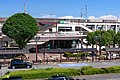
Kuki Chōchin Matsuri 04.jpg
Article

11232 / くきし

Saitama Prefecture

Kuki City

Floats wrapped in 500 lanterns spin at night.

Kuki Lantern Festival

Photo by Ocdp (CC0)

01 / Lantern festival

After Mount Asama erupted,the town began pulling floats.

Kuki Chōchin Matsuri 05.jpg
Photo by Ocdp (CC0)

The Kuki Lantern Festival, Kuki Chōchin Matsuri (久喜提燈祭り), known locally as Tennō-sama (天王様), is the festival of Yakumo Shrine (八雲神社), guardian of the old town of Kuki. It is said to have begun after the great eruption of Mount Asama in 1783 wiped out the summer crops, when people pulled floats through the streets to pray for a good harvest. Every year on 12 and 18 July, seven floats from seven neighbourhoods carry dolls by day; at night each is hung with about 500 lanterns on all four sides and spun around at the west exit of Kuki Station.

  • Began after the 1783 eruption
  • Seven floats
  • 12 and 18 July every year

02 / Kagura

Among the first to be designated,the wellspring of Kantō kagura.

Washimiyajinja haiden.jpg
Photo by Ocdp (CC BY-SA 3.0)

Washinomiya Shrine (鷲宮神社), said to be one of the oldest shrines in the Kantō region, preserves the Washinomiya Saibara Kagura (鷲宮催馬楽神楽), regarded as the source of Kantō's kagura sacred dance. The twelve dances, reorganised by 1726, are still offered in the kagura hall six times a year. In 1976 it was in the very first group designated as Important Intangible Folk Cultural Properties, and it is part of "Kagura", which Japan decided in 2025 to nominate to UNESCO.

  • Important Intangible Folk Cultural Property, 1976
  • Twelve dances
  • Performed six times a year

03 / Irises and lavender

In June, Shōbufills with blue and purple.

Kuki Shobu Ruined Castle 1.JPG
Photo by 京浜にけ (CC BY-SA 3.0)

The old town of Shōbu (菖蒲町) is said by one account to take its name from Shōbu Castle, built in 1456 and completed on the Boys' Festival of 5 May, the day of irises (shōbu). About 2,600 iris plants bloom in the iris garden on the castle ruins, and about 9,600 lavender plants grow around the Shōbu Administrative Center and Shirasagi Park. Each June the Blue Festival celebrates both flowers; 2026 was its 32nd year.

  • About 2,600 irises
  • About 9,600 lavender plants
  • 32nd festival in 2026

Living here

Ōmiya in about 20 minutes on the JR Utsunomiya Line.

  • about 150,000 people

Three lines run through the city, the JR Utsunomiya Line, the Tobu Isesaki Line and the Tobu Nikko Line, with five stations. From Kuki Station to Ōmiya Station takes about 20 minutes on the JR Utsunomiya Line. City Hall is about 6 minutes by the city loop bus from the west exit of Kuki Station. In 2010 Kuki merged with the towns of Shōbu, Kurihashi and Washimiya to form the present city.

People living here
150,582people
2010

−1.1% since 2015

154,310 → 150,582

Area
82.41km²

82.29km² of it habitable

2024

Households
62,578households

2.4 people per household

2020

Rent (average for rentals)
52,715yen

National average 60,630 yen

2023

Healthcare
7 hospitals / 83 clinics

6.0 per 10,000 people

2023

Almost entirely flat.Almost all of it is habitable land (99.9%)
Area and habitable land at the same scalee-Stat B1101 / B1103

Population from 2010 onward (municipal boundary changed).2010-03-23 に新設合併(菖蒲町・栗橋町・鷲宮町)。2010年調査から市域が変わっている。

Children waiting for childcare
—23 nurseries and similar
Home purchase subsidy
—
Average annual temperature
—

These 3 items are waiting on a nationwide data source. We do not fill them with estimates.

ACCESS

Where you can go from here.

Kuki City in Japan36.062°N 139.667°E
OsakaKuki City
Kuki Station
久喜駅2022
  • to ŌmiyaJR Utsunomiya Line20min

Travel times follow 市の移住パンフレット「くきの暮らし 都会×田舎でのんびりライフ」(令和6年12月発行・市公式に掲載のPDF)の路線図に、久喜〜大宮の区間として載っている値 (checked 2026-09-24). They vary by time of day.

Shape

Borders 10 municipalities across 1 prefectures.

Territory of Kuki City
Boundaries: National Land Numerical Information (N03)

North to south

12.9km

Saitama Prefecture
加須市, 白岡市, 幸手市, 鴻巣市, 宮代町, 桶川市, 蓮田市, 杉戸町
Ibaraki Prefecture
五霞町, 古河市

Kuki City isthis kind of town.

  1. 01Every July, seven floats hung at night with about 500 lanterns each spin at the west exit of Kuki Station
  2. 02Washinomiya Shrine preserves the Saibara Kagura, among the first designated as Important Intangible Folk Cultural Properties in 1976
  3. 03In June, irises bloom on the Shōbu Castle ruins alongside about 9,600 lavender plants

If something caught your eye, ask the town itself.