乳保神社のイチョウ.jpeg
Article

36405 / かみいたちょう

Tokushima Prefecture 板野郡

Kamiita Town

Knobs hang, so it's also “milk ginkgo.”

Nyubo Shrine ginkgo

Photo by Sorrysorry (CC0)

01 / Awa wasanbon

He brought back three sugarcane cuttings from Hyuga.Tokuya is said to have spread Awa wasanbon.

Born to a farming family in Hikino, Kamiita, Maruyama Tokuya brought back three joints of sugarcane seedlings from Hyuga, grew them in his garden and, the town records, perfected wasanbon sugar through repeated study. The prefecture says Maruyama Tokuya, a mountain ascetic of Kamiita, is said to have spread it some 220 years ago.

  • Brought back three sugarcane seedling joints from Hyuga (town website)
  • Said to have spread some 220 years ago (Tokushima Prefecture)
  • The lord Hachisuka permitted a surname and sword, and appointed him sugar magistrate (town website)
02 / Taisanji

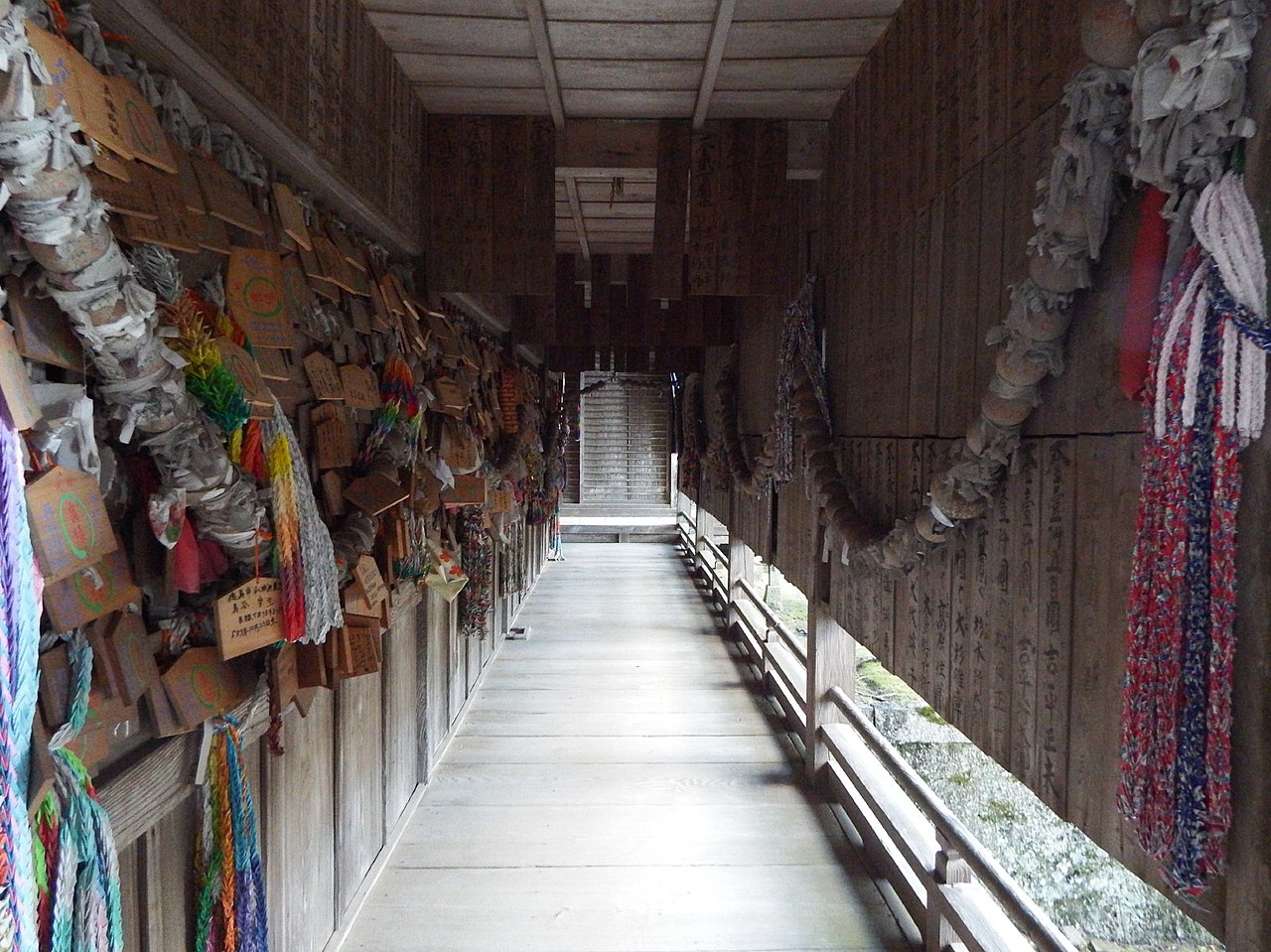
In the corridor joining the main halland the Daishi Hall, 33 Kannon are enshrined.

Taisanzi 07.jpg
Photo by Dokudami (CC BY-SA 4.0)

Taisanji's corridor is a north-south passage joining the main hall and the Daishi Hall; its aisle is partitioned to make a platform where 33 Kannon are enshrined. The Agency for Cultural Affairs calls it a special hall that made a corridor a place of worship. Rikimochi has been held in the precinct on the third Sunday of January each year.

  • The corridor was built between 1830 and 1868 (Agency for Cultural Affairs)
  • Registered Tangible Cultural Property on 26 January 2011 (same source)
  • Rikimochi is said to have a 400-year history; its origin is unknown (town website)

03 / Nakagawa Toranosuke

Nakagawa Toranosuke, from Kanyake (神宅) village,came to Ishigaki in 1893 to introduce sugar-making.

Toranosuke Nakagawa.jpg
Photo by 衆議院事務局 (Public domain)

Nakagawa Toranosuke was from 入徳, Kanyake (神宅) village (now Kanyake, Kamiita). The town records that the tie with Ishigaki City began when he came to the island in 1893 to encourage land clearing and introduce the sugar industry, and that he then ran the Yaeyama Sugar Industry Company.

  • Came to the island in 1893 (Meiji 26) (town website)
  • Ran Yaeyama Sugar Industry Company (same source)
  • "Yukari no machi" (town ties) agreement signed 6 October 2000 (same source)

Living here

The Yoshino River lies to the south, the Sanuki Mountains to the north.

  • about 10,000 people
  • Rural district town

About 20 km northwest of the prefectural office. The town says it divides into two areas: an alluvial fan formed by sediment from six rivers such as the Izumidani, and a flat area on the Yoshino River alluvium. There is no railway station; a Tokushima Bus line runs toward the town office.

People living here
11,384people
19952020

−5.4% since 2015

12,721 → 11,384

Area
34.58km²

22.43km² of it habitable

2024

Households
4,246households

2.7 people per household

2020

Rent (average for rentals)
—
Healthcare
1 hospital / 7 clinics

7.0 per 10,000 people

2023

Area34.58km²Habitable land22.43km² / 65%
Area and habitable land at the same scalee-Stat B1101 / B1103
Children waiting for childcare
—1 nurseries and similar
Home purchase subsidy
—
Average annual temperature
—

These 3 items are waiting on a nationwide data source. We do not fill them with estimates.

Shape

Borders 6 municipalities across 1 prefectures.

Kamiita Town in Japan34.121°N 134.405°E
TokyoKamiita Town
Territory of Kamiita Town
Boundaries: National Land Numerical Information (N03)

North to south

9.4km

Tokushima Prefecture
阿波市, 板野町, 石井町, 吉野川市, 藍住町
Kagawa Prefecture
東かがわ市

Travel times per leg are not published by the municipality, so they are not shown.

Kamiita Town isthis kind of town.

  1. 01The ginkgo of Nyubo Shrine (乳保神社) stands in the shrine precinct in Kamiita. The Tokushima Shimbun gives its age as an estimated 800–1,000 years, its trunk girth as about 17 m and its height as about 28 m; it was designated a national natural monument in 1944. Aerial roots hanging from its trunk and branches are likened to breasts, so it is also called the “milk ginkgo” (乳イチョウ), and it has long been venerated as a tree of nursing; tying paper to the lumps is said to bring breast milk.
  2. 02Awa wasanbon is said to have been spread by Maruyama Tokuya of Hikino, and the town's Historical and Folk Museum shows materials on Awa wasanbon sugar and Awa indigo. The corridor of Taisanji (大山寺) is a registered Tangible Cultural Property, and Rikimochi has been held in its precinct on the third Sunday of January each year. On the north bank of the Yoshino River stands the indigo-merchant house Toda-ke Jutaku, whose main house is a national Important Cultural Property.
  3. 03A town in Itano District on the north bank of the Yoshino River, bordering Higashikagawa City in Kagawa across the Sanuki Mountains. There is no railway station; the town says to take the Tokushima Bus Kajiyabara Line from JR Itano Station and get off at Kamiita Yakuba-mae. It has a vacant-house bank system.

If something caught your eye, ask the town itself.