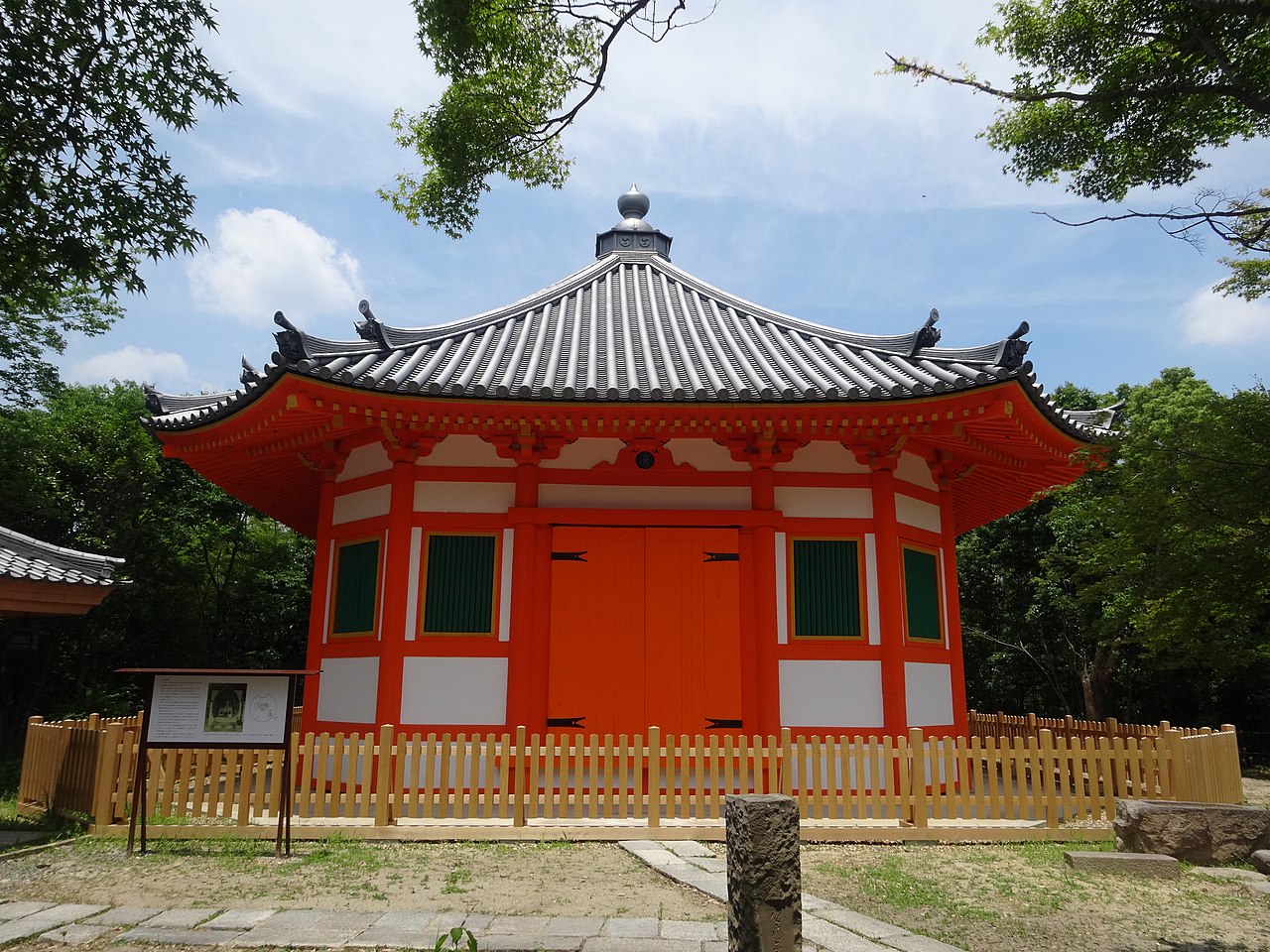
Hiko-Jinja Honden 01.jpg
Article

26210 / やわたし

Kyoto Prefecture

Yawata City

Left aircraft work, he built a shrine.

Hiko Shrine, Ninomiya Chuhachi

Photo by Brakeet (CC0)

01 / Octagonal hall

Hakkakudo stood in the grounds of Iwashimizu Hachimangu,then was moved onto a burial mound at the Shinto-Buddhist separation.
Hakkakudo Yawata city Reformed.jpg
Photo by うぃき野郎 (CC BY-SA 4.0)

Built in the grounds of Iwashimizu Hachimangu in the Kenpo era (1213–1219), it was rebuilt by Toyotomi Hideyori in 1607 (Keicho 12). In 1870 (Meiji 3) it was moved onto the rear circular mound of Nishikurumazuka Kofun. The city describes its plan as a square with the four corners cut off, with few comparable examples.

  • Founded in the Kenpo era (1213–1219)
  • Rebuilt in 1607 (Keicho 12)
  • Moved to its present site in 1870
  • Nishikurumazuka Kofun: mound 120 m long

02 / Monument

An Edison monument stands in the grounds of Iwashimizu Hachimangu,owing to Yawata bamboo used in his light bulb.

Thomas Edison Monument at Yawata.jpg
Photo by L26 (CC BY-SA 4.0)

Edison used Yawata bamboo (madake) for the filament of his incandescent bulb. Iwashimizu Hachimangu says bulbs made with madake from around Mount Otokoyama kept shining for more than 1,000 hours on average. The monument was built in 1934 (Showa 9) and moved to its present spot in 1958 (Showa 33).

  • Built 1934 (Showa 9)
  • Moved to present spot 1958 (Showa 33)
  • More than 1,000 hours on average (as Iwashimizu Hachimangu tells it)

03 / Bridge

When the river rises, the deck planks and girders float and drift off,still tied to the piers by wire rope.

2016年6月現在の流れ橋の側面.jpg
Photo by Nodaunji (CC BY-SA 4.0)

A wooden bridge over the Kizu River, 356.5 m long and 3.3 m wide, officially Kozuya Bridge on Prefectural Road Yawata-Joyo Line. It was built in 1953 (Showa 28) to replace a ferry. Today the deck is raised 75 cm and the pile sections of the piers are concrete, so it is less likely to wash away.

  • 356.5 m long, 3.3 m wide
  • Built 1953 (Showa 28)
  • Deck raised 75 cm

Living here

From Keihan's Iwashimizu-hachimangu Station, City Hall is about 5 minutes by bus.

  • about 70,000 people

The nearest station is Iwashimizu-hachimangu on the Keihan Main Line. From there, Keihan Bus route Kuzuha-Yawata Line 32 reaches the Yawata-shiyakusho-mae stop in about 5 minutes. The city's access page gives routes from Kyoto, Nara and Osaka but no travel times, so this guide lists no minutes.

People living here
70,433people
19952020

−3.1% since 2015

75,779 → 70,433

Area
24.35km²

22.6km² of it habitable

2024

Households
30,554households

2.3 people per household

2020

Rent (average for rentals)
50,902yen

National average 60,630 yen

2023

Healthcare
4 hospitals / 40 clinics

6.2 per 10,000 people

2023

Area24.35km²Habitable land22.6km² / 93%
Area and habitable land at the same scalee-Stat B1101 / B1103
Children waiting for childcare
—14 nurseries and similar
Home purchase subsidy
—
Average annual temperature
—

These 3 items are waiting on a nationwide data source. We do not fill them with estimates.

Shape

Borders 7 municipalities across 1 prefectures.

Yawata City in Japan34.876°N 135.708°E
TokyoYawata City
Territory of Yawata City
Boundaries: National Land Numerical Information (N03)Lakes: National Land Numerical Information (Lake Data), MLIT. Processed by Machigatari. Prepared with the approval of the Director-General of the Geospatial Information Authority of Japan, using its Digital Map 25000 (Spatial Data Framework) and Digital Map 25000 (Place Names and Public Facilities). (承認番号 平27情使、第585号)

North to south

8.5km

Kyoto Prefecture
京都市, 京田辺市, 久御山町, 城陽市, 大山崎町
Osaka Prefecture
枚方市, 島本町

Travel times per leg are not published by the municipality, so they are not shown.

Yawata City isthis kind of town.

  1. 01Hiko Shrine was founded in 1915 (Taisho 4) by Ninomiya Chuhachi on his own property. He learned of the Wright brothers' success, left aircraft development, and built it to console victims of air accidents. He was from Yawatahama, Ehime Prefecture
  2. 02Iwashimizu Hachimangu on Mount Otokoyama is a National Treasure, the gorinto near its first torii gate is an Important Cultural Property, and Misono Shrine's zuiki mikoshi is a Kyoto Prefecture folk cultural property (intangible). Ango Bridge is where the release of living creatures takes place at the Iwashimizu Festival
  3. 03Nagarebashi is a component of the Japan Heritage story 'A Walk through 800 Years of Japanese Tea History'. On the Sewaritei levee, which divides the Uji and Kizu rivers, a 1.4 km line of cherry trees blooms in spring

If something caught your eye, ask the town itself.