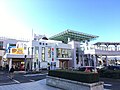
Mizukuraido, aqueduct works site, Fussa City
Article

13218 / ふっさし

Tokyo

Fussa City

A park named for water-eating earth.

Mizukuraido, aqueduct works site

Photo by clvs7 (CC0)

01 / Rerouting

To escape Tama River floods, the aqueductis said to have been dug anew.

About 90 years after it was completed, in 1740, one section of the Tamagawa Aqueduct is said to have been rerouted into a new channel to avoid flood damage from the Tama River. Going upstream from Miyamoto Bridge, you reach a spot where the channel bends sharply, where the new channel meets the original one. The old channel's remains are a city historic site.

  • Rerouted in 1740
  • About 90 years after completion
  • Old channel: city historic site

02 / Shrine

Seven deities, once enshrinedapart, now share one shrine.

Shrine in Fussa City
Photo by Suikotei (CC BY-SA 4.0)

Fussa Shinmeisha is a combined shrine of seven deities once worshipped in the districts of old Fussa Village, and it is known as Shinmei-sama and Yakushi-sama. Four stone works from the Meiji and Taisho eras, including the torii of 1874, a Basho haiku monument and a stone lantern, are city-registered cultural properties (tangible folk cultural properties).

  • Seven deities, one shrine
  • Torii of 1874
  • 4 stone works, city-registered

03 / Main hall

A main hall 171.9 cm wide,large for a misedana-zukuri.

The main hall of Kumagawa Shrine is a one-bay, nagare-style building in the misedana-zukuri form, 171.9 cm wide and 153.8 cm deep in its inner room. The form is simple, but large for a misedana-zukuri hall. Its construction is said to be the work of the carpenter Tamura Sukedaro, named on a ridge tablet of 1597. It became a Tokyo Metropolitan tangible cultural property in 1980.

  • 171.9 cm wide
  • Ridge tablet of 1597
  • Metropolitan property, 1980

Fussa City from the sky

Now and 1974–78. Tap a photo to zoom in.

Wide (about 6 km across)

Close (about 1.5 km across)

Now (shot June–November 2019)Shot 1974–78

Source: Geospatial Information Authority of Japan (GSI) GSI Tiles(全国最新写真(シームレス)/国土画像情報(第一期:1974〜1978年撮影))

Open in GSI Maps (now)Open in GSI Maps (1974–78)

Living here

44 minutes to Shinjuku, 59 to Tokyo.

  • about 60,000 people

From Fussa Station, through trains on the Chuo Line (Rapid) and Ome Line take 44 minutes at the fastest to Shinjuku Station and 59 minutes to Tokyo Station (fastest by timetable; the slower of weekdays and weekends). The Tamagawa Aqueduct runs the length of the city, and the Kumagawa branch channel, completed in 1890, in part became the city's first "key landscape resource". City Hall is about a 7-minute walk from Fussa Station.

People living here
56,414people
19952020

−3.4% since 2015

61,497 → 56,414

Area
10.16km²

9.95km² of it habitable

2024

Households
28,148households

2.0 people per household

2020

Rent (average for rentals)
52,426yen

National average 60,630 yen

2023

Healthcare
4 hospitals / 45 clinics

8.7 per 10,000 people

2023

Almost entirely flat.Almost all of it is habitable land (97.9%)
Area and habitable land at the same scalee-Stat B1101 / B1103
Children waiting for childcare
—14 nurseries and similar
Home purchase subsidy
—
Average annual temperature
—

These 3 items are waiting on a nationwide data source. We do not fill them with estimates.

ACCESS

Where you can go from here.

Fussa City in Japan35.739°N 139.327°E
OsakaFussa City
Fussa Station
福生駅2019
  • to TokyoJR Chuo Line (Rapid) and Ome Line59min
  • to ShinjukuJR Chuo Line (Rapid) and Ome Line44min

Travel times follow JR東日本 駅の時刻表(2026年10月版・URL に 2610)。東京駅『中央線快速 新宿・八王子・甲府・松本方面(下り)』(tt1039・方向09)と新宿駅『中央線快速(下り)』(tt0866・方向06)の平日(末尾0)・土曜休日(末尾1)の列車ページから、行き先が青梅・奥多摩の列車を全部引き、起点の発→福生の着で数えた(第2段で新宿を数え、奥多摩行を足して東京も数え直した。値は変わらず) (checked 2026-10-23). They vary by time of day.

Shape

Borders 7 municipalities.

Fussa City isthis kind of town.

  1. 01In Kumagawa, Mizukuraido Park keeps the remains of a channel said to have swallowed the aqueduct's water; it is a city historic site, and the city newsletter notes a debate over whether the rerouting really happened
  2. 02In 1740 one section of the Tamagawa Aqueduct was rerouted to avoid Tama River floods, and the old channel's remains survive
  3. 03The main hall of Kumagawa Shrine, a 171.9 cm-wide misedana-zukuri, is a Tokyo Metropolitan cultural property; Fussa Shinmeisha combines seven village deities

If something caught your eye, ask the town itself.