Hongokuji no Ohatsuki Icho A.jpg
Article

19365 / みのぶちょう

Yamanashi Prefecture 南巨摩郡

Minobu Town

One town has three national ginkgos.

Ohatsuki ginkgo, Minobu's three

Photo by さかおり (CC BY-SA 4.0)

01 / Honnonji

An early Edo-period main hall,donated by the Kishu Tokugawa.

本遠寺本堂.JPG
Photo by Sijoking (CC BY-SA 4.0)

Honnonji, a Nichiren temple, is said to have been founded in 1609. Its main hall is 5 ken wide and 7 ken deep with a hip-and-gable roof, and the town considers it built in 1650. With the bell tower it is a national Important Cultural Property; a restoration in the 2000s returned the roof to cypress bark. The grave of Yojuin, a consort of Tokugawa Ieyasu, is a prefectural historic site.

  • 5 ken wide, 7 ken deep
  • Built around 1650
  • Important Cultural Property, with the bell tower

02 / Nakayama gold mine

On the middle slope of Mt. Kenashi,the terraces of a gold mine spread out.

湯之奥金山跡.JPG
Photo by Indiana jo (CC BY-SA 4.0)

The Nakayama gold mine, part of the national historic site Kai Kinzan ruins, spreads across the middle slope of Mt. Kenashi at 1,400 to 1,600 m. Within the designated 16.36 ha, 124 terraces have been identified. The town explains that the flat areas were living and work space, the centre was a smelting area, and stone pagodas and monuments stand farther up the valley.

  • 1,400 to 1,600 m
  • 124 terraces
  • Designated area 16.36 ha

03 / Thousand-horse plaque

A plaque painted with a thousand horsescarries the donors’ addresses and names.

Above the corridor lintel at the front of Hogain Temple’s main hall hangs a large plaque painted with a thousand horses. The front horses are coloured, and donors’ addresses and names are written in. It is said that in the Ansei famine a dream told people to donate one horse each from every region, and the town writes that, as an ema, it probably has no equal in size.

  • A thousand horses
  • Donors’ addresses and names
  • Town-designated folk cultural property

Living here

83 minutes from Shizuoka, 48 from Kofu.

  • about 10,000 people
  • Rural district town

The limited express Fujikawa stops at Minobu Station on the Minobu Line. It takes about 83 minutes from Shizuoka and about 48 minutes from Kofu, with no change. For Shinjuku, change at Kofu to a Chuo Main Line limited express.

People living here
10,663people
20052020

−15.8% since 2015

16,334 → 10,663

Area
301.98km²

58.89km² of it habitable

2024

Households
4,588households

2.3 people per household

2020

Rent (average for rentals)
—
Healthcare
3 hospitals / 11 clinics

13.1 per 10,000 people

2023

Area301.98km²Habitable land58.89km² / 20%
Area and habitable land at the same scalee-Stat B1101 / B1103

Population from 2005 onward (municipal boundary changed).2004-09-13 に合併。2005年調査から市域が変わっている。

Children waiting for childcare
—6 nurseries and similar
Home purchase subsidy
—
Average annual temperature
—

These 3 items are waiting on a nationwide data source. We do not fill them with estimates.

ACCESS

Where you can go from here.

Minobu Town in Japan35.468°N 138.442°E
OsakaMinobu Town
Minobu Station
身延駅2022
  • to ShizuokaLtd. exp. Fujikawa83min
  • to KofuLtd. exp. Fujikawa48min

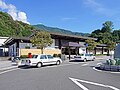
Travel times follow JR東海の公式時刻表(2026年3月14日改正)。身延駅の時刻表PDFの「停車駅のご案内」(身延駅からの所要時間の目安:静岡83・甲府48)と、甲府駅の時刻表PDFの停車駅のご案内(甲府から身延まで48)。特急ふじかわは身延線内で南甲府・東花輪・市川大門・鰍沢口・甲斐岩間・下部温泉・身延・内船・富士宮に停車(停車駅のご案内の赤い線)。静岡行きのふじかわ2・4・6・8・10・12・14号、甲府行きのふじかわ1・3・5・7・9・11・13号はいずれも平日と土曜・休日の両方の時刻表に載り(身延駅の時刻表で平日・土休日とも同じ時刻)、毎日運転の7往復 (checked 2026-10-08). They vary by time of day.

Shape

Borders 8 municipalities across 1 prefectures.

Territory of Minobu Town
Boundaries: National Land Numerical Information (N03)Lakes: National Land Numerical Information (Lake Data), MLIT. Processed by Machigatari. Prepared with the approval of the Director-General of the Geospatial Information Authority of Japan, using its Digital Map 25000 (Spatial Data Framework) and Digital Map 25000 (Place Names and Public Facilities). (承認番号 平27情使、第585号)

North to south

24.8km

Yamanashi Prefecture
早川町, 南部町, 市川三郷町, 富士川町, 富士河口湖町, 甲府市
Shizuoka Prefecture
富士宮市, 静岡市

Minobu Town isthis kind of town.

  1. 01Three Ohatsuki ginkgo trees, whose leaves bear seeds or anthers, are national natural monuments here; the town writes that the seed-bearing leaves were first reported to scholars in 1891 from the tree at Jotakuji
  2. 02The main hall of Honnonji temple is a national Important Cultural Property, and the Nakayama gold mine on Mt. Kenashi is part of a national historic site
  3. 03Home to the Nichiren temple Minobusan Kuonji, and to Hogain Temple, which holds a plaque painted with a thousand horses

If something caught your eye, ask the town itself.